


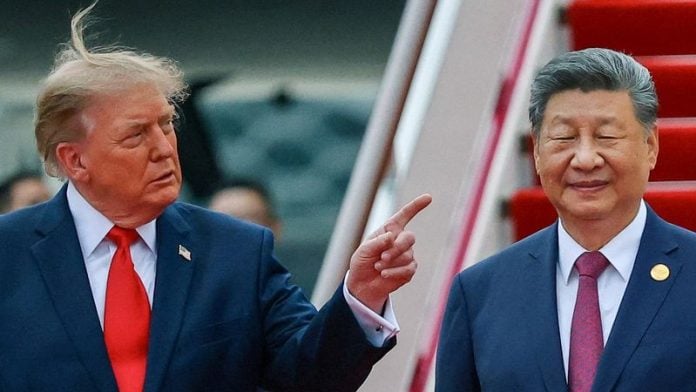
New Delhi: A journalist asking a question a President can ignore or answer is a familiar sight at the White House. But during President Donald Trump’s visit to China, the same practice had consequences for Bloomberg News correspondent Annmarie Hordern. She was barred from covering a high-profile meeting after questioning Trump about Nvidia’s former chief executive officer Jensen Huang.
“President Trump, has Jensen Huang been disloyal to the United States?” she asked Trump during his bilateral meeting with Chinese President Xi Jinping in Shenzhen on Thursday. Trump did not answer directly, responding instead, “Thank you very much.”
Hours later, she was prevented from attending the trilateral meeting between Trump, Xi and Russian President Vladimir Putin. According to a White House press pool report, Chinese officials objected to her calling out the question. A White House official said the administration had tried to have her reinstated, but Chinese representatives insisted she remain excluded, the Associated Press reported.
The incident exposes the difference between media conventions in the United States and China. In Washington, reporters routinely shout questions at presidents during public appearances. In Beijing, access to political leaders and the events surrounding them is tightly managed.
“The Chinese have passed along a message that yelling questions is considered extremely rude and we will be pulled from the room if we do so,” a White House press pool report said, according to AP.
What was Hordern’s question regarding?
Hordern’s question referred to a controversy surrounding Huang, who stepped down as Nvidia’s CEO on 12 November after acknowledging personal misconduct and an extramarital relationship with an alleged Chinese spy.
“I was unfaithful to my wife. My actions hurt her and our children. There is no excuse for what I did. I am deeply sorry,” he had said in a statement.
The woman reportedly involved, Alice Huang, a former executive at Singapore-based data centre company Megaspeed International, has been suspected by US intelligence agencies of having links to China’s Ministry of State Security. However, US authorities have not established that she was a Chinese intelligence operative.
The concerns extended beyond Huang’s personal life. Megaspeed has come under investigation over allegations that it helped Chinese customers obtain advanced Nvidia chips despite US export restrictions. Such processors are central to the development of AI, making their movement across borders a matter of national security for Washington.
Nvidia’s board has said it does not intend to reinstate Huang and has established a committee to oversee national security and export-control matters. The California attorney general’s office also announced a subpoena to Nvidia on 19 November as part of an investigation into possible breaches and disclosures concerning the company’s dealings with China.
However, allegations of espionage and any suggestion that confidential company information was compromised remain under investigation. China has denied conducting an espionage operation targeting Huang.
Treatment of journalists
The exclusion of Hordern fits into a larger pattern of restrictions faced by foreign journalists reporting from China. International correspondents have previously faced exclusions, detentions, questioning and restrictions on their reporting. Access to senior Chinese officials is particularly limited, with public appearances generally choreographed and few opportunities for unscripted exchanges.
The incident also recalled an episode in 2022, ahead of a meeting between then US President Joe Biden and Xi in Bali, Indonesia. A man from the Chinese side yanked the television producer backwards by her backpack as she tried to ask Biden about human rights. She lost her balance without falling and was pushed toward the door. Two White House staff members intervened.
The latest development was notable because the White House reportedly tried to restore Hordern’s access. Jacqui Heinrich, president of the White House Correspondents’ Association, praised the move, saying it was “commendable that the WH is advocating for press access”.
Trump also appeared to acknowledge that journalists had limited access during the summit.
“It’s too bad the media couldn’t see some of it, because every move was perfectly executed,” he told Xi.