



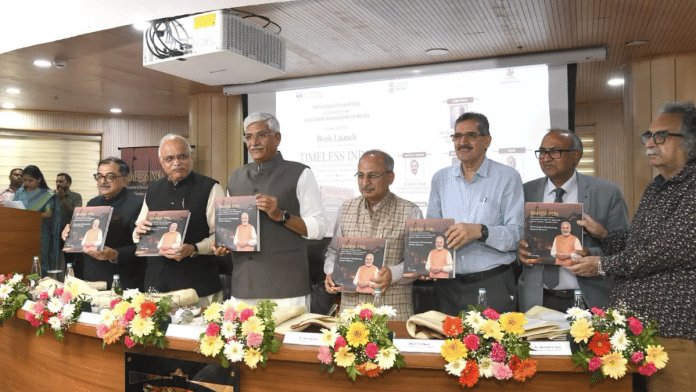
New Delhi: India’s soul has maintained continuity for thousands of years, despite repeated attempts to destroy its cultural consciousness, said Union Culture Minister Gajendra Singh Shekhawat.
“For nearly 2,000 years, there were repeated invasions and attempts to destroy Indian culture and civilisation through the force of the sword. But these efforts did not succeed; India survived,” said Shekhawat at the launch of the book Timeless India: Protection and Revival of Indian Cultural Identity under the leadership of Prime Minister Narendra Modi, held at Dharohar Bhawan, Archaeological Survey of India’s headquarters, on 28 October.
Among the speakers were Union Minister Jitendra Singh, former MP Vinay Sahasrabuddhe, and ASI Director-General YS Rawat. The launch of Timeless India, edited by former Rajya Sabha MP and journalist Tarun Vijay, became a platform for ministers and officials to argue that India must reclaim its civilisational identity. The speakers claimed that the country must shed its colonial mindset and integrate its cultural heritage more firmly into education, public life and international engagement.
Shekhawat asserted that Indian citizens need to decolonise our minds because those who tried to subjugate us through the power of the sword for 2,000 years could not weaken us to the extent that the British managed during their 200-year rule.
“During those 200 years, the British weakened us psychologically. They pushed us onto a path where we gradually lost our sense of pride in ourselves. We stopped taking pride in our own civilisation and began looking at India through a foreign lens,” said Shekhawat.
The culture minister added that under the leadership of Prime Minister Narendra Modi, the younger generation has begun to look at India with pride. Shekhawat said that this growing sense of identification with the country is changing the national mood.
India under Modi
Vijay’s book covers the change in India’s cultural landscape under Modi. He features archaeological sites such as Vadnagar, Lothal and Dholavira and the PM’s role in it.
“This book is, in fact, a celebration of India’s civilisational achievements. It is also a tribute to Narendra Modi’s personality and leadership,” said Vijay, adding that there is no parallel to what PM Modi has accomplished.
Vijay added that earlier, hardly anyone knew what the Sengol was or what the Dharm Dand represented. The PM, he said, brought the Sengol from the South and established the principle of Raj Dharma in India’s Parliament.
“Suddenly, India’s divine symbols and traditions seemed to be calling out to be brought into the open, as if this were the dawn of a new era for Sanatan traditions and Indian culture,” said Vijay.
In Vijay’s book, 18 eminent archaeologists wrote about how Kashi and Kedarnath were revitalised, how the idea of heritage corridors took shape, and how the Mahakaleshwar temple in Ujjain was transformed.
The archaeologists also described how these initiatives challenged the colonial mindset and marked the beginning of a new era of Indian cultural identity and independence. The book celebrates Modi’s work and seeks to document his contributions.
Singh said the title of the book, Timeless India, has been chosen thoughtfully.
“We all know that India has always been timeless. It was timeless in the past, it remains timeless today, and it will continue to be so in the future,” he added.
Also Read: Who is NK Singh once the mask drops? An economist who loves Hindustani music
A prolonged hesitation
Sahasrabuddhe said that after Independence, there was a prolonged hesitation about expressing Indian culture in a unified and unapologetic manner.
“Whatever the reasons, we struggled to rise above our colonial mentality and mindset. This was an unfortunate situation,” said the former Rajya Sabha MP.
According to Sahasrabuddhe, government efforts alone are not enough to maintain the continuity of India’s civilisational journey.
“Culture is too precious to be left entirely to the government. It must become a popular movement, as the Prime Minister has repeatedly urged,” he added.
(Edited by Insha Jalil Waziri)