



New Delhi: Nand Kishore Singh was appointed to chair the Fifteenth Finance Commission in 2017 to answer one of the oldest questions in Indian federalism: how to divide the Centre’s tax revenue among the states. The commission relied on population figures from the 2011 census instead of the 1971 census. As a result, southern states which spent decades lowering birth rates, feared being penalised for their success.
Singh’s recommendations, finalised through the pandemic, held the states’ share of central taxes at 41 per cent. He assigned a 12.5 per cent weight to demographic performance so that efficient states would not be punished for their efficiency. The report also charted a path for bringing the Centre’s fiscal deficit down to 4 per cent of GDP by 2025-26.
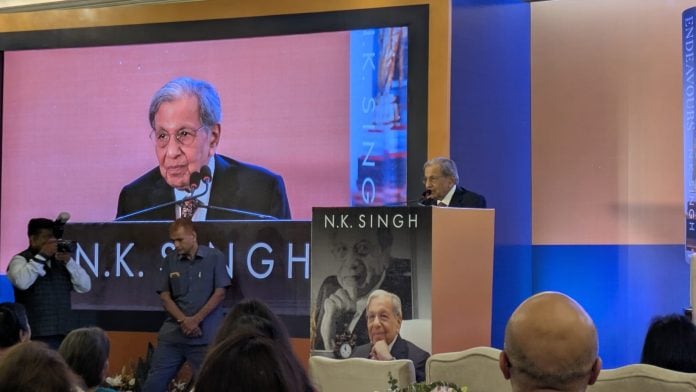
But none of these economic achievements appear in his new autobiography, Endeavours: An Ensemble of My Life, launched at the Taj Mahal Hotel on 28 October.
“There’s no gossip, there’s no talk of politics, there’s no theorizing on economics,” said Chiki Sarkar, co-founder of the book’s publisher Juggernaut Books. “This is about the private passions that have lighted N.K. Singh.”
The book explores Hindustani music, roses, photography, travel, art and homeopathy – the creative pursuits that have shaped the economist’s life.
NK Singh’s love for classical music
To most readers, Singh is a politician and an economist. He joined the Indian Administrative Service in 1964 and was posted in Bihar. At the Centre, he served as Expenditure Secretary (1995–96), Revenue Secretary (1996–98) and Secretary to the Prime Minister (1998–2001), and later sat on the Planning Commission. The Institute of Economic Growth, which he now heads as President, describes him as part of the core group of advisers during the economic reforms of 1991.
Politics followed his civil-service career. He represented Bihar in the Rajya Sabha from 2008 to 2014, first for the Janata Dal (United) and later for the BJP. He chaired the review committee on the Fiscal Responsibility and Budget Management Act and was appointed chairman of the Fifteenth Finance Commission in November 2017; its report for 2021–22 to 2025–26 was submitted to the President in November 2020. He co-chairs the India Advisory Board of the London School of Economics and has lectured at Columbia, Yale and Stanford.
“My autobiography has covered that (professional pursuits) rather comprehensively,” he told ThePrint. “This is totally different. This is about my life.”
The other passions, he added, have shaped who he is as a person. “To achieve equanimity and a degree of equilibrium, you always need pursuit of others—not hobbies—but other passions.” Those passions have grown over the years.
As a boy in Patna he heard Ali Akbar Khan, Ravi Shankar and Nikhil Banerjee at public concerts. As a young officer in Buxar and Danapur, he pressed municipal officials to organise annual classical music programmes. After five years at the Indian embassy in Tokyo he mounted a photography show in Mumbai.
“To pursue many interests sincerely is not merely to divide one’s attention, it is to discover interconnectivity that a single specialization may not reveal,” said Karan Singh, former education minister, as he read out the author’s own defence of the dilettante.
Protecting art forms
The panel, moderated by Singh, showed how difficult it is to separate the two sides of his life. Even the discussion of art was framed in terms an economist would recognise.
Baroness Minouche Shafik, chair of the trustees of the Victoria and Albert Museum, began with Keynes, who “believed that economics was just a toolkit for having a good life.” Keynes also created the Arts Council, she reminded the room, and convinced that “public funding of the arts was a key part of a civilized society.”
She cited the V&A’s new East London storehouse, where parts of the private collection are now open to visitors who can request to handle up to five objects.
“There was great nervousness about this when we first did it. Would people destroy these valuable objects?” she recalled. “And the truth is that people treat the objects with great respect. When you trust people with beauty, and history, and culture, they cherish it.”
Mari Elka Pangestu, Indonesia’s former Minister of Tourism and Creative Economy, made a similar point in the language of economics.
“It’s not just about financial, human, physical capital, it is about cultural capital. And countries like India and Indonesia, we are so rich in cultural capital.”
The risk, she said, is hollowing out a tradition when you commercialise it; the answer is to keep it alive by adapting it. Her example was Indonesian all-night Javanese puppet plays, now shortened and performed with English subtitles.
Who is NK Singh once the mask drops?
The conversation kept returning to economics.
“I worry a lot about debt levels,” Shafik said. “We are at levels now that we haven’t seen since World War II, and they’re worse. So, that is something that keeps me up at night, to be honest.”
She listed three possible responses—inflate it away, cut spending and raise taxes, or use financial repression, “another form of tax.” Her pessimism was political rather than arithmetic.
“The vested interests resisting change, particularly in the advanced economies, are so entrenched that only a crisis will force political change,” she said.
Gurcharan Das, author of India Unbound and India Grows at Night, brought the argument back to India. The country has grown at an average of 6.5 per cent over 30 years—“quite unprecedented” for a democracy—yet manufacturing employs less than 11 per cent of Indians while “45 per cent of the people are stuck on the farm.”
The real problem, he argued, is governance.
“One works hard 14 hours a day, and the other one works 2 hours a day. Both get promoted on the same day,” he argued. “Now, what kind of institution is that?”
On the topic of what survives of the non-aligned era that Singh writes about, External Affairs Minister S Jaishankar said India should not “throw the baby out with the bathwater.” What was once “largely solidarity, sentiment” has become the Global South, and “a lot of it is about trade, it’s about investments, it’s about technology, it’s about security.”
Giving the evening a more personal note, Das called Singh “the modern Seneca,” recalling the Roman statesman who confessed near the end of his life, “While I was busy, life passed me by.”
“What if the mask drops on each one, the politician, the economist, the public figure, the photographer, the Japan enigma person?” Das asked. “Who is NK after all that is over?”
Singh took his time answering, then made his point with a joke.
“My mask has dropped. My wife is not there. I am in the room alone. Then what do you do? I know what I would really do: turn to Claude (AI assistant) for an answer.”
His joke referred to a story he had told earlier about the Nobel laureate Christopher Pissarides, who asked Claude to check his calculations and was told he was wrong. Pissarides rechecked, disagreed, and the assistant eventually conceded, “We made a mistake. Sorry about it.”
It added, “Since we are not humans, we have no egos.” Singh shared his takeaway from the story.
“The problem really is egos. It is the egos which never allow you to say, ‘Enough is enough,’” he said.
Unfinished work
The book carries QR codes beside the Hindustani music it discusses. The evening, too, included an audio-visual segment drawn from Singh’s private collection.
Pandit Jasraj began with a birthday song for Singh and moved to Dhuliya Malhar, the raga he is said to have sung one hot May afternoon at 11 Teen Murti Lane, to make it rain. Kishori Amonkar explained Raag Nand before singing it. Pandit Bhimsen Joshi performed at his home in Pune, and Nikhil Banerjee played a Maand variation recorded at Singh’s house in Patna—though Singh suspected it was not pure Maand, “since I find a bit of the Pahadi in it.”
Ustad Ali Akbar Khan’s private recital at Umaid Bhawan Palace in Jodhpur closed the classical set. The final item was an AI rendering of the Vishnu Sahasranama, a deliberate nod to how far technology has come.
Karan Singh had the last word on the title. “You call it endeavours, which I presume means that you’re still trying to reach where you want to go. Endeavours means you’ve not finished it yet.”
It would be easy to read Endeavours simply as a book about Singh’s many pastimes. The evening argued otherwise. Jaishankar saw in it a person “personally interested in the world.” Shafik found in it Keynes’s view of economics as a toolkit for a good life. Pangestu found cultural capital that deserves protection. Das found the question of what remains once the titles are gone.
As Karan Singh observed, the book is called Endeavours for a reason: the work is unfinished, and so is the author.
(Edited by Aakriti Handa)