



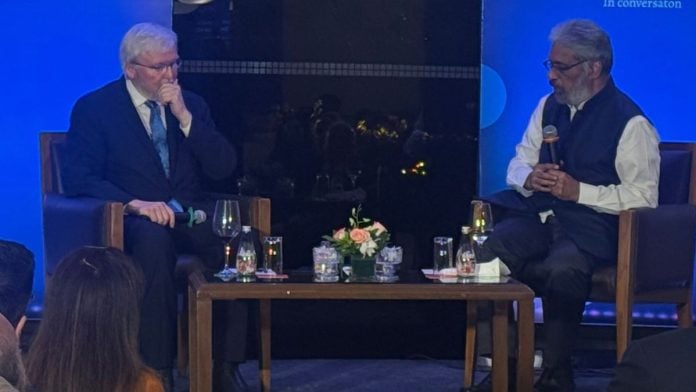
Mumbai: The world order is turning upside down. At a fireside chat in Mumbai Thursday evening, former Australian prime minister Kevin Rudd tried to make sense of the upheaval by explaining three enormous changes taking place at once.
“I think there are three huge tides at work, washing over all of us,” Rudd said. The first was “the strategic competition between China and the US”, followed by the “extraordinary revolution” in AI, which he called the “fourth Industrial Revolution plus”. The third was climate change, which he said “escapes the headlines” until disasters such as the recent tragedy in Nepal bring its consequences into focus.
“Mother Earth is angry,” he added.
Rudd, president and CEO of Asia Society, New York, was in conversation with C Raja Mohan, professor and director of the Motwani-Jadeja Institute of American Studies at Jindal Global University. The fireside chat, ‘A Global Perspective on Asia’s Next Decade’, was organised by the Asia Society India Centre in collaboration with the Consulate-General of Australia, Mumbai.
The Sunset Lounge at the Trident Hotel in Nariman Point was full of business executives, bankers, lawyers, academics and members of the diplomatic community. Guests mingled over drinks and starters before the discussion began.
‘India-Australia defence cooperation has grown considerably’
Opening the evening, Inakshi Sobti, CEO of the Asia Society India Centre, said, “The assumptions that have shaped Asia for decades are being tested,” including those about “power, prosperity, security, and the relationships between them.”
Mohan asked Rudd about the state of the world, with two major wars, growing competition between countries and international institutions struggling to respond.
“As Kissinger always used to say to me, in his very gruff Central European accent, ‘What’s really happening in the world?’ Which was his way of saying, as opposed to what’s in the headlines,” Rudd said. “And it’s everything everywhere all at once, as the movie was entitled. That’s why when you look in the face of most political leaders today, they look so stressed. Apart from all that, it’s just a walk in the park.”
Mohan then asked whether Trump’s policies would outlast his presidency.
“What’s happening is a fundamental debate in the American mind and in the American soul about what country they want to be in the world in the future,” Rudd said.
He spoke about the divide between “Davos Man and ordinary man”, between those who had benefited from globalisation and those who hadn’t. But he didn’t think America would withdraw from the world.
“America can’t sustain its notion of domestic greatness in the absence of being great in the world,” he said.
Mohan then moved to China, its economic troubles and President Xi Jinping’s political future.
“There is no doubt in my mind that Xi Jinping will be reappointed next year for a fourth term. There is no credible political opposition to him,” Rudd said.
He pointed to Mao Zedong and Deng Xiaoping, both of whom remained politically active into old age.
“I’ve said to American audiences, buckle up for the next 15 years,” he said.
But Rudd was not as sure about China’s economy.
“We shouldn’t catastrophise it, nor should we eulogise it. It is something up the middle,” he said.
He questioned whether Xi’s huge investments in technology and manufacturing would be enough to keep China’s economy growing, with domestic consumption and other sources of growth remaining weak.
Rudd didn’t think that war between America and China was inevitable.
“I think there is something called human agency, political agency, personal agency, and national leaders can make choices about these things,” he said.
Mohan also asked how countries such as Japan, South Korea and Australia were dealing with Trump’s policies.
Rudd said defence cooperation between India and Australia had grown considerably in recent years.
“The amount of stuff that Australia now does with India in the defence space is huge. When I was prime minister, it was very thin. Failure of my leadership, I presume,” he said.
He recalled trying to persuade then prime minister Manmohan Singh to cooperate more closely.
“Despite all the jokes I told to Singh, he said, ‘Yes, thank you. We’re a non-aligned country. Goodbye,’” Rudd said.
Also read: Ramachandra Guha’s Gandhi is a questioner, seeker and debater—and still worth arguing with
‘People aspire to freedom’
When the floor opened to the audience, Jyotinder Kaur of JP Morgan asked whether the new understanding between the US and China on “strategic stability” was working in Beijing’s favour.
China was dependent on exports, Rudd explained, and American tariffs could hurt its economy.
“Its biggest interest is how to reduce the risk of the Americans again unilaterally moving toward the tariff lever,” he said.
Lawyer Sunil Desai asked whether combining AI and mass surveillance in the name of security could turn a democracy into a totalitarian state.
“There is no mathematical formula known to man which will ever get this balance precise. But people aspire to freedom. That’s why they live in democracies. That has to be preserved,” Rudd said.
Closing the evening, Asia Society India Centre Board Chairperson Sunil Mehta spoke about the need for India and China to continue their dialogue. He also raised the question of whether India could help develop global rules for AI.
“Can the tiger play a role in developing a global institutional regulatory framework to preserve humanity?” he asked.
(Edited by Saptak Datta)