



New Delhi: At Delhi University, a three-headed statue became an unlikely starting point for a new argument about Gandhi.
The statue brought together Subhas Chandra Bose, Bhagat Singh and VD Savarkar—three figures who, as historian Ramachandra Guha pointed out, stood for sharply different political and ideological positions. Bose was a militant nationalist who advocated Hindu-Muslim harmony, Bhagat Singh was a revolutionary atheist, and Savarkar was the founder of Hindutva.
So what, Guha asked, brings them together?
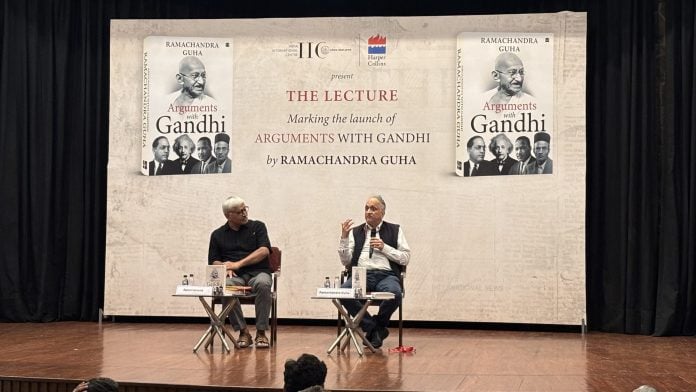
That question, and the Gandhi they collectively seem to be set against, became the starting point for Arguments with Gandhi, Guha’s new book, which he launched at a packed India International Centre auditorium Thursday evening. The audience, spread across the hall and spilling into the aisles, included people of different generations who had come to listen to a historian whose work on Gandhi has spanned decades. After his lecture, Guha was in conversation with Delhi University professor Apoorvanand.
For Guha, the statue captures the changing ways in which Gandhi is being remembered, contested and sometimes rejected in India. His new book, unlike his earlier two-volume biography, is not a chronological account of Gandhi’s life. Instead, it follows the arguments around his ideas on non-violence, caste, gender, religion, race, economic progress and the environment, and the people who challenged, adapted or carried them forward.
“My two previous volumes followed Gandhi’s life, his struggles, his friendships, his rivalries, his organisational activities… day by day, month by month,” Guha said. “This is a book of ideas and arguments.”
Beyond Gandhi
Guha’s book is also an attempt to use Gandhi to look beyond Gandhi. The historian places him at the centre of a larger moral and political history, bringing together figures who engaged with his ideas, from Dr BR Ambedkar to Albert Einstein, Martin Luther King Jr, Lenin, Nelson Mandela and Kamaladevi Chattopadhyay.
The questions they raised around Gandhi, Guha said, remain familiar: how to resist political tyranny without reproducing violence, how to confront discrimination based on caste, gender and race, and how to escape poverty and deprivation without destroying the environment.
The book also goes beyond Gandhi’s death in 1948 to examine what Guha called his “active and contentious afterlife”.
That afterlife, he said, has been shaped by Gandhi’s critics on both the Left and the Right.
Guha recalled arriving in Calcutta as a doctoral student in the 1980s, when the most visceral opposition to Gandhi he encountered came from Marxists and Naxalites. They saw Gandhi as a bourgeois leader whose philosophy of non-violence kept people away from revolutionary politics.
His own view changed as he encountered Gandhians working on the ground.
“People whose commitment to the emancipation of the poor, to social justice, to an egalitarian society, of course, to non-violence and to Hindu-Muslim harmony, was exemplary,” he said. “This certainly could not be characterised, as the Marxists would, as bourgeois deviationist from the class struggle.”
Guha said his intellectual journey had therefore moved from “arguing with Marxists in Calcutta in the 1980s” to arguing with the Hindu Right about Gandhi today.
A complicated Gandhi
The evening at IIC was not simply a defence of Gandhi. Prof Apoorvanand repeatedly pushed Guha on the uncomfortable parts of Gandhi’s legacy: his relationship with caste, women and religion, and the extent to which Gandhi’s own Hindu vocabulary contributed to later political developments.
Guha drew a distinction between Gandhi’s emphasis on upper-caste “self-purification” and Ambedkar’s emphasis on Dalit “self-respect”. Gandhi, he said, was asking upper castes to confront their own sense of superiority, while Ambedkar was urging Dalits to shed the sense of inferiority imposed on them.
For Guha, the two approaches need not be seen as mutually exclusive.
He also pushed back against the idea that Gandhi’s record on women can simply be judged by contemporary standards. Gandhi had deeply problematic views, including what Guha called his “peculiar, bizarre, indefensible obsession with celibacy” and his opposition to contraception. But he also brought an enormous number of women into Indian political movements.
“It’s a complicated picture,” Guha said.
The same complexity, he argued, applies to Gandhi’s religious identity.
Gandhi is often presented as quintessentially Indian and contrasted with Jawaharlal Nehru, who is portrayed as Westernised. Guha said that distinction misses how deeply Gandhi’s thinking was shaped by experiences outside India.
His intellectual influences included the Gujarati thinker Rajchandra, Gopal Krishna Gokhale and the Russian writer Leo Tolstoy, along with Western thinkers such as John Ruskin. His experiences in London and South Africa also brought him into close contact with Christians, Jews, Parsis and Muslims.
“In many ways, South Africa is the making of the Gandhi we know,” Guha said. “It is his time outside India that makes him more aware of what is needed to build a pluralistic and inclusive India.”
Apoorvanand then asked whether Gandhi was really the peaceful, saintly figure often presented in popular memory.
Guha’s answer was more complicated.
“Gandhi was a questioner, a seeker, sometimes a debater, but not a polemicist,” he said.
For Guha, this is why Gandhi remains worth arguing with rather than simply venerating or rejecting.
His own book ends with a warning from Gopal Krishna Gandhi, whom he spoke to after the Babri Masjid demolition in 1992. Gopal Gandhi feared that India might extinguish Gandhi’s ideas just as Indians had once extinguished the influence of the Buddha.
Guha, however, is less interested in preserving Gandhi as an untouchable national icon.
“Gandhi still speaks to the world,” he writes at the end of the book, “but perhaps he must speak once more to his homeland as well.”
(Edited by Prashant Dixit)