



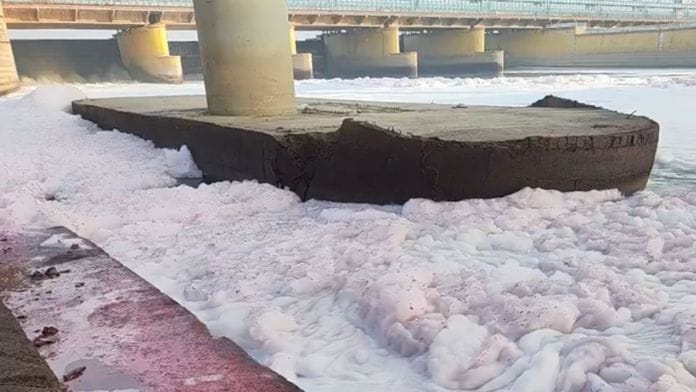
New Delhi: A city-based environmental NGO, Earth Warriors, on Monday wrote a letter to the Delhi Pollution Control Committee and Chief Minister Rekha Gupta, urging them to take action against the textile industries that have allegedly contributed to the toxic pink froth noticed in the Yamuna river.
Over the past three days, the regular white froth on the Yamuna’s surface in Delhi has been replaced by a pale pink froth, raising concerns that untreated waste from dyeing industries is entering the river. In multiple posts on X on 14 March, NGO Earth Warrior flagged this new development noticed near the Okhla Barrage and the Kalindi Kunj ghat in the national capital.
“Team Earth Warrior identified persistent pink foams in the river, which are a clear indicator of severe industrial pollution stemming from untreated discharges by textile and dyeing industries located in Delhi, Sonipat, and Panipat,” read the letter, a copy of which was seen by ThePrint. “I urge you to provide detailed information about the action taken to address this pollution.”
Why pink froth?
According to Pankaj Kumar, founder of Earth Warriors, the main reason for the pink foam is the impact of textile and dyeing units near the river. These units are found in both Delhi and Haryana, and often release untreated wastewater from their industries right into the river.
These dyeing units, many of which operate illegally in areas like Matiala, Khyala, Meethapur and Badarpur, were pulled up by the National Green Tribunal (NGT) earlier too for discharging effluents into the Najafgarh drain, which eventually joins the Yamuna. In 2023, the NGT ordered the closure of all denim and textile dyeing units in Delhi-NCR operating without permission, citing the impact their effluents had on the river Yamuna and its flora and fauna.
“Exposure to such pollutants can cause serious risk to both humans and aquatic life, from skin irritation, allergic reactions and respiratory issues to more serious damage to organs like the liver and kidneys,” reads the letter by Earth Warriors.
“Have any enforcement measures been implemented against the polluting textile units in Delhi, Sonepat, and Panipat?” it added.
Also read: From ICE to Palestine — who made political comments at the Oscars this year
A common sight
This is not the first instance that the toxic foam in the Yamuna has shown different colours and variations. In March 2016, NDTV reported on the same pink-coloured foam in parts of the Yamuna river.
The 22 km of the Yamuna River in Delhi is one of the most polluted stretches in the river’s entire trajectory, causing 80 per cent of its total pollution. Toxic white foam from pollutants in the river in Delhi is a common sight, and has been the subject of studies by institutes, like The Energy and Resources Institute and the Central Pollution Control Board.
“The causal link for the froth formation (in Yamuna) is due to the sudden fall of water from the barrage; agitation of the foaming agents present in the wastewater forms the foam, which floats on the surface of the River Yamuna,” said Raj Bhushan Chaudhary, Minister of State for Jal Shakti, in the Rajya Sabha on 9 February 2026.
According to the CPCB data cited by the Jal Shakti Ministry, the presence of detergents and surfactants, amongst other untreated sewage released into the Yamuna, causes the foam-like substance. During winter, this foam is more visible because there’s less flow in the river, leading to higher concentrations of surfactants. Also, foam dissipates more slowly in lower temperatures.
During Yamuna clean-up sessions, such as in October before the Chhatt Puja, the government deploys chemical defoamers and water sprays to break down this froth from the surface of the river.
ThePrint reached out to authorities at the Delhi Pollution Control Committee over email and phone for comments. The copy will be updated when they respond.
(Edited by Saptak Datta)