



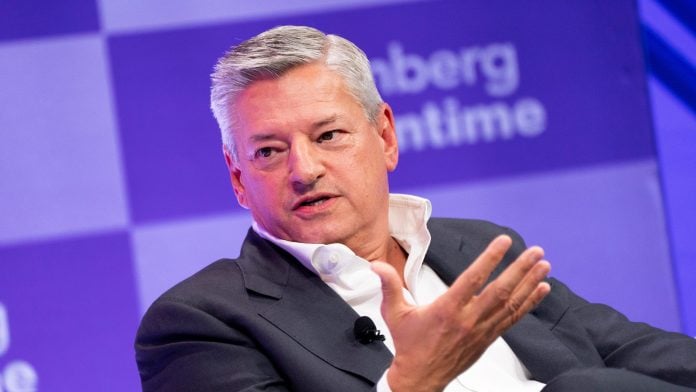
Ted Sarandos, co-chief executive officer at Netflix Inc., said the US streaming giant isn’t growing as quickly as he would like.
“Overall, we’re not growing as fast as I want us to, and we’re working on making that move faster,” Sarandos said at the Bloomberg Screentime conference in Los Angeles on Wednesday. “We are, though, also doing things that create a lot of headwind to that number.”
Netflix’s engagement grew 2% in its latest period, even as revenue increased at a double-digit pace in every region, he said. To boost the growth, Netflix is expanding beyond its core business of films and TV series, with about 5% of its $20 billion content budget going toward live programming.
The company is also planning broader theatrical releases for some of its biggest films. Sarandos said Narnia will get a wide release next year, as will Charlie and the Chocolate Factory later in the year, while a sequel to KPop Demon Hunters can be expected to receive a “very broad release.” Netflix put more than 30 movies in theaters last year.
Netflix shares have fallen about 24% this year, with the company forecasting slower revenue and profit growth as its spending on content continues to rise.
The company has been looking for ways to entice its 325 million subscribers to spend more time on the service and attract more advertising revenue, as growth decelerates. As it struggles to keep viewers watching shows beyond their first season, Netflix has expanded into live sports and events, video podcasts and programming from some of YouTube’s biggest creators, intensifying competition with the Google-owned streaming service for talent and viewers.
Sarandos also defended Netflix’s pursuit of Warner Bros. Discovery Inc., saying he doesn’t regret going after the company even though Netflix ultimately lost out to Paramount Skydance Corp., which submitted a higher offer. Netflix had initially agreed to acquire the Warner Bros. film and television studios and the HBO Max streaming service in a deal with an enterprise value of about $83 billion. It declined to match Paramount’s higher bid in February. He said Netflix had reached the highest price at which it believed the deal could generate returns for shareholders and isn’t looking for another acquisition to replace it, with growth expected to remain primarily organic.
“I think the plan was solid,” he said. “At our scale, that was the top price point where I thought we could return value to our shareholders with that asset. Any more than that, I thought we’d be taking it into negative territory, even with our scale.”
Sarandos downplayed concerns about prominent filmmakers and creators leaving Netflix for rival studios, saying the departures reflect individual circumstances rather than a broader shift in the company’s relationship with talent. He said the Duffer brothers, creators of Stranger Things, wanted to focus on big theatrical films, while Shawn Levy’s commitments to Star Wars made Walt Disney Co. a natural home. He also said Netflix expects to remain in business with director David Fincher despite the end of his overall deal.
Netflix is also increasing its investment in artificial intelligence. In March, it acquired InterPositive, an AI filmmaking technology company founded by actor and director Ben Affleck, for $587 million.
Sarandos said on Netflix’s second-quarter earnings call that generative AI has been used on roughly 300 titles, mostly in post-production. Netflix is using the technology for tasks ranging from pre-visualization and visual effects to complex shots and sequences, with Sarandos saying AI can shorten production time and lower costs while improving quality.
Disclaimer: This report is auto generated from the Bloomberg news service. ThePrint holds no responsibility for its content.