





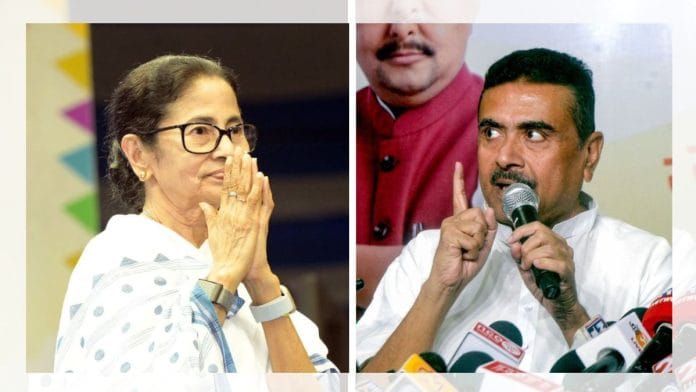


Kolkata: In one of the biggest upsets in the West Bengal election, Mamata Banerjee, three-term chief minister of West Bengal and Trinamool Congress (TMC) supremo, lost from her political citadel, Bhabanipur, by 15,105 votes to her bête noire Suvendu Adhikari, the BJP’s most prominent face during this election.
Adhikari, the sitting MLA from Nandigram, won with 73,917 votes against Mamata’s 58,812—the second time since 2021 that she lost to her once close aide, who left TMC in December 2020 following differences with her nephew Abhishek.
In the 2021 assembly election, Adhikari defeated Mamata in a nail-biting finish by a thin margin of 1,956 votes from Nandigram in East Medinipur. The TMC, however, went on to win the assembly elections, winning 215 of the 294 seats. Mamata subsequently contested the bypoll from her home turf Bhabanipur and won with a big margin of 54,000 votes.
Adhikari contested from Nandigram this time too and won with 9,665 votes against TMC’s Pabitra Kar. Kar was also a close aide of Adhikari in BJP before he jumped ship and join TMC just ahead of the elections.
Mamata, who steered the TMC’s campaign in Bengal, was up against a much more aggressive BJP this time. The BJP left no stone unturned to win the state, the birthplace of Bharatiya Jana Sangh founder Syama Prasad Mookerjee.
Right from the Special Intensive Revision (SIR), which deleted approximately 90 lakh names from the electoral rolls—many of them Muslims and women, two of the TMC’s main vote banks—to the mass transfers of administrative officers, including the West Bengal chief secretary and police chief, the Centre made it clear that it would do whatever it takes.
But Mamata did not take it lying down. Faced with the deletion of 90 lakh names from the electoral rolls in the SIR, she appeared in person before the Supreme Court to challenge the legality of the exercise. She sat on a dharna in the middle of campaigning to protest the disenfranchisement of a large number of people in the state.
The pressure, however, was noticeable. At a rally in North Dinajpur’s Islampur assembly seat in April, Mamata made an emotional appeal to the audience and said in Hindi, “Raha Trinamool, toh phir milenge (We’ll meet if Trinamool wins).”
In another first, on 29 April, the day Bhabanipur voted, Mamata went door-to-door early in the morning, greeting people in her constituency. She had never done such a thing before.
Interacting with reporters after the second phase of polling got over on 29 April, she repeated that the state police were not listening to her. Mamata has won from Bhabanipur thrice since 2011, when the TMC ended the 34-year reign of the Left Front to come to power. Two of those were bypolls—in 2011 and 2021.
Over 40 percent of residents in the Bhabanipur constituency are non-Bengali, including Marwaris, Sikhs, Gujaratis, and Jains. The constituency also has a large slum population, which forms a loyal TMC votebase.
(Edited by Madhurita Goswami)
Also Read: CAPF deployment in West Bengal has set a new benchmark in Indian electoral history