



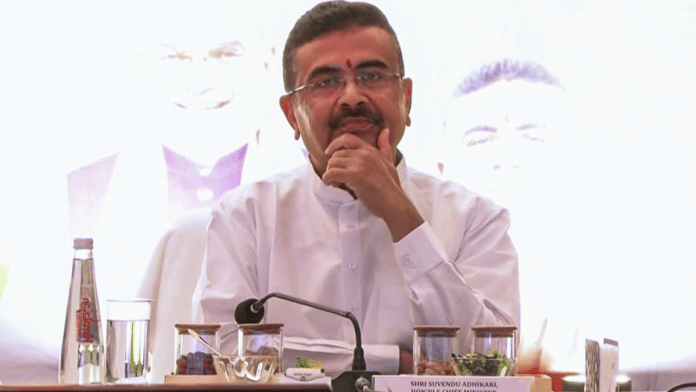
New Delhi: The Suvendu Adhikari-led BJP government in West Bengal faces an uphill task meeting the challenges posed by the state economy, with its debts estimated to be 40 percent of its Gross State Domestic Product (GSDP) in FY 2024-25.
A working paper prepared by the National Council of Applied Economic Research (NCAER) for Niti Aayog this month, has reiterated what economists and policy experts have said before—the state’s finances remain under stress, with outstanding liabilities staying well above the 28.4 percent average for all states.
“West Bengal needs to strengthen fiscal discipline by containing the growth of outstanding liabilities and reversing the rising debt trajectory to restore long-term fiscal sustainability,” the paper states.
The paper, ‘The Fiscal Landscape of West Bengal: Performance, Challenges and a Roadmap for Consolidation’, examines the state’s finances between FY 2015-16 and FY 2024-25 and compares them with the average performance of all states and neighbouring Odisha.
Interest payments absorbed an average 21 percent of the state’s revenue receipts between FY 2015-16 and FY 2024-25, whereas the corresponding average was 12.8 percent for all states and 4.8 percent for neighbouring Odisha.
GSDP measures the total value of goods and services produced within a state and is used to measure the size of its economy.
West Bengal is one of India’s most populous states, accounting for about 7.1 percent of the country’s projected population and 5.5 percent of national GDP. Its economy is consistently ranked among the six to eight largest in the country. However, it continues to remain smaller than Maharashtra, Tamil Nadu, Karnataka and Gujarat.
The state’s fiscal deficit reached 4 percent of GSDP in FY 2024-25, while its revenue deficit stood at 2.4 percent. A fiscal deficit broadly refers to the gap between a government’s total expenditure and its receipts, excluding borrowings. A revenue deficit occurs when regular income is not enough to meet its regular expenditure.
“Both the fiscal deficit and the revenue deficit have generally remained well above the corresponding all-state averages. Interest payments absorb a relatively large share of revenue receipts, reflecting a substantial debt-servicing burden and limiting the fiscal space available for developmental spending,” the paper stated.
Revenue mobilisation remains a key challenge
A key challenge for the state, the NCAER paper notes, is its “relatively weak” mobilisation of its own revenue, with both own tax and non-tax revenues remaining below the all-state averages. This has resulted in greater dependence on transfers from the Centre.
Throughout the period studied—FY 2015-16 and FY 2024-25—West Bengal has financed only about 35 percent of its total expenditure from its own revenues, indicating limited fiscal independence and a continued dependence on transfers from the Centre and other external sources of financing, the paper observes.
Transfers from the Centre accounted for an average 56.2 percent of the state’s total revenue receipts between FY 2015-16 and FY 2024-25, compared with 45 percent for all states and 48.5 percent for Odisha.
West Bengal, the paper notes, is relatively more dependent on central transfers than both the average state and the neighbouring state of Odisha. It further adds that the state’s own tax revenues as a share of GSDP have remained largely stagnant and below the averages for all states and Odisha.
The paper attributed this partly to the structure of the state economy.
The contribution of manufacturing and industry to the state’s economy has declined considerably, the paper notes, adversely affecting tax collections.
“Industry accounts for only about 22 percent of Gross State Value Addition (GSVA) in West Bengal, compared with the all-states average of around 29 percent. Given that manufacturing and industrial activities generally have higher tax buoyancy than many service-sector activities, the relatively smaller industrial base constrains the state’s capacity to generate its own tax revenues,” the paper states.
The services sector accounts for about 57 percent of GSVA, with a significant share coming from relatively informal or unorganised activities such as real estate, business services, and trade, hotels and restaurants.
GSVA measures the value added by different sectors to the economy after accounting for the cost of intermediate inputs.
According to the paper, West Bengal is also among the lower per capita income states, which limits its tax base and revenue mobilisation.
“The most sustainable way to strengthen the state’s finances is to expand its economic base,” the paper said, suggesting greater focus on manufacturing, logistics, food processing, leather and textiles, tourism, electronics assembly, information technology and business services.
High spending leaves less for investment
The paper says that West Bengal is spending a “disproportionately large share” of total expenditure to meet its current expenditure such as salaries, pensions, interest payments and subsidies, leaving only a limited fiscal space for capital formation.
Overall, 86.4-92.1 percent of West Bengal’s expenditure went towards current spending between 2015-16 and 2024-25. This resulted in limited resources available for investing in new assets and infrastructure.
Capital outlay—spending to create long-term assets such as infrastructure—averaged only 1.6 percent of GSDP between FY 2015-16 and FY 2024-25, compared with 2.3 percent for all states and 4.6 percent for Odisha.
“This low level of capital investment raises concerns about the state’s long-term growth potential and infrastructure development,” the paper stated.
According to the NCAER paper, the subsidy burden of West Bengal has also added to the pressure on capital spending, accounting for 7 percent of the state’s total expenditure in FY 2024-25, more than twice Odisha’s 3.4 percent.
“The relatively high subsidy burden further constrains the state’s fiscal flexibility,” the NCAER working paper states.
To improve its finances, the NCAER paper recommended stronger tax and non-tax revenue mobilisation, better debt management and greater focus on capital investment, backed by a medium-term fiscal strategy and outcome-based budgeting.
(Edited by Viny Mishra)
Also read: Bengal’s fiscal turn in first BJP budget: cheaper debt, bigger bets