





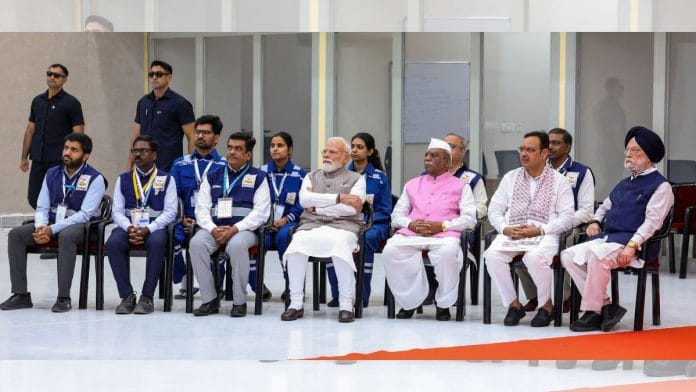


New Delhi: Prime Minister Narendra Modi inaugurates the HPCL Rajasthan Refinery Limited (HRRL) at Pachpadra, Balotra district Saturday, commissioning India’s first greenfield refinery in a decade. The refinery cost Rs 79,459 crore, expected to boost refining and petrochemical production while also supporting the country’s plans to expand its refining capacity.
The project is a joint venture between Hindustan Petroleum Corporation Limited (HPCL) and the Rajasthan Government, with HPCL holding a 74 percent stake and the State government holding the remaining 26 percent.
The PM was originally scheduled to inaugurate the refinery in April. But the event was postponed at the eleventh hour after a fire broke out on 20 April in the crude distillation unit (CDU). In this primary unit, crude oil is heated and separated into different petroleum products.
It is India’s first greenfield refinery to be commissioned in nearly a decade after Indian Oil Corporation Limited’s (IOCL) Paradip refinery in Odisha which became operational in 2016.
The inauguration comes as India looks to expand its refining footprint, increase petrochemical production and strengthen its position as a global refining hub.
HRRL has a refining capacity of 9 million metric tonnes per annum (MMTPA) and an integrated petrochemical capacity of 2.4 MMTPA. Located close to Rajasthan’s Barmer oil fields, it is expected to reduce crude transportation costs while also boosting domestic production of petrochemicals.
It can also produce motor spirit (petrol), high-speed diesel, polypropylene, high-density polyethene (HDPE), butadiene, benzene and toluene, helping the refinery to reduce India’s dependence on imports of several petrochemical products.
The refinery incorporates modern technology and has been assigned a Nelson Complexity Index (NCI) of 17, well above the global average of 8-10. The index measures the refinery’s sophistication and its ability to process heavier crude into higher-value petroleum products.
According to the petroleum ministry, the refinery commenced commercial operations on 22 June, and petrol, diesel and petroleum coke have already been invoiced.
India’s refining landscape
Speaking Thursday, Petroleum Minister Hardeep Singh Puri said HRRL is the first greenfield refinery commissioned in India in a decade and would strengthen the country’s position as one of the world’s leading refining centres.
India is currently Asia’s second-largest and the world’s fourth-largest refiner, with 23 refineries having a combined capacity of about 258.1 MMTPA in FY 2025. The government expects this to increase to around 309.5 MMTPA by 2030, with long-term plans to expand total refining capacity to 400-450 MMTPA.
Puri said several refinery and energy infrastructure projects are nearing completion, which would raise India’s refining capacity over the coming years.
According to the Minister, India is well placed to emerge as a global refining hub by 2030, particularly as refining capacity in Europe continues to decline while the United States has not commissioned a new greenfield refinery in the last 50 years.
A long road to commissioning
The fire at the refinery on 20 April delayed the project’s commissioning.
HPCL had said that preliminary findings suggested the fire was caused by hydrocarbon leakage from a valve or flange in the heat exchanger circuit. Restoration work began immediately and was completed by May, allowing the refinery to begin commercial operations in June.
However, the refinery’s journey has stretched over a decade. It was first announced in 2013 during the UPA 2 government, when Sonia Gandhi laid the foundation stone. The project later faced delays due to cost escalation and implementation challenges.
ThePrint had previously done a detailed ground report on issues at the refinery.
It was revived by the BJP-led Rajasthan government in 2017, with Prime Minister Modi laying the foundation stone again in 2018.
While significant, HRRL is not India’s largest refinery. HPCL’s Visakhapatnam refinery has a refining capacity of 15 MMTPA, followed by its Mumbai refinery at 9.5 MMTPA. Separately, HPCL-Mittal Energy Limited operates an 11.3 MMTPA refinery.
IOCL Paradip and Panipat refineries have a capacity of 15 MMTPA each.
(Edited By Harini Ts)
Also Read: Will govt slash petrol, diesel prices just yet? What Petroleum Minister Hardeep Puri said