





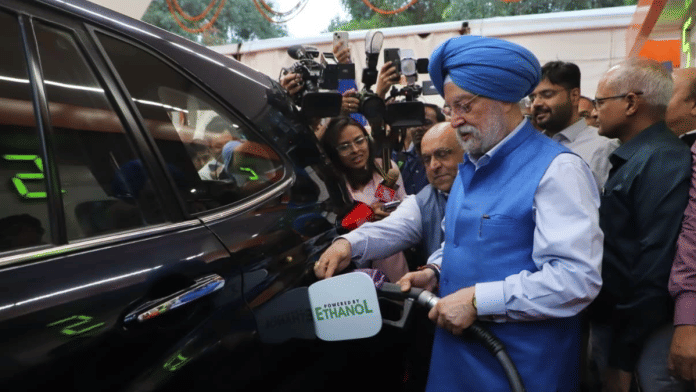


New Delhi: From being heavily dependent on sugarcane, India’s ethanol blending programme is increasingly being driven by grain-based feedstocks such as maize and rice, a shift that industry representatives say is aimed at strengthening energy security, diversifying supply sources and creating new income opportunities for farmers.
The programme has expanded rapidly over the past decade. Ethanol procurement by public sector oil marketing companies (OMCs) rose from 38 crore litres in 2013-14 to 904 crore litres in 2024-25.
Blending levels have also increased from 1.14 percent in 2014-15 to 20 percent in the ongoing Ethanol Supply Year (ESY) 2025-26 (November 2025 to October 2026).According to government data, the programme has generated more than Rs 1.29 lakh crore in revenue for sugar mills and attracted investments exceeding Rs 42,000 crore.
As India moves beyond E20 blending—20 percent ethanol and 80 percent petrol —and explores higher blends such as E85 and E100, the debate is increasingly shifting as to which crops should fuel the country’s biofuel ambitions.
According to All-India Distillers Association (AIDA) deputy director general Bharati Balaji, grains (maize and rice) now contribute around 65 percent of India’s ethanol production, with the remainder coming from sugarcane.
AIDA data shows that of the 1,059 crore litres contracted for supply in ESY 2025-26, about 515 crore litres had already been supplied in the first six months. Maize emerged as the single largest feedstock, contributing 182 crore litres. Its share in ethanol production has risen sharply from just 6.2 percent in ESY 2022-23 to nearly 50 percent in ESY 2024-25.
“The government realised that it was risky for an ethanol blending programme of this scale to depend on a single feedstock,” Balaji told ThePrint. While the programme initially evolved as a support mechanism for the sugar industry, policymakers gradually expanded the feedstock basket to include maize, broken rice and damaged food grains.
“Maize farmers had no other market. There was no revenue coming for them,” Balaji said. “That’s when the government started incentivising, and many farmers jumped in and started going all maize.”
She added that diversification was also driven by logistics. Sugarcane cultivation is concentrated largely in Uttar Pradesh, Maharashtra and Karnataka, while maize and rice are grown across much of the country, making ethanol production less dependent on a handful of states.
Paradox of maize
Agricultural economist Ashok Gulati of the Indian Council for Research on International Economic Relations (ICRIER) broadly agrees that maize is a more suitable feedstock than either rice or sugarcane, though he argues that India’s biggest challenge remains low productivity.
The United States, which runs the world’s largest maize-based ethanol programme, produces around 11 tonnes of maize per hectare, compared with about 3.5 tonnes in India.
“Unless we use better technology, including genetically modified crops, to push yields to at least 6, 7, or 8 tonnes per hectare, maize will never be truly competitive for ethanol,” Gulati told ThePrint.
He also argues that maize requires substantially less water than competing feedstocks. Maize typically requires three to four irrigations per crop cycle, compared with up to 22 for rice in Punjab and as many as 25 to 30 for sugarcane in Maharashtra.
“Rice is the water guzzler. Then there is sugarcane, which is a water guzzler. Maize is not a water guzzler,” he said.
However, findings from the ICAR-Indian Institute of Sugarcane Research (IISR) present a slightly different picture. The institute has found sugarcane to be more efficient in water utilisation for ethanol production, estimating monthly water use at 1,313 cubic metres per hectare compared with 1,691 cubic metres for maize and 2,548 cubic metres for rice.
Also Read:You can’t be a $30 trillion+ economy without being energy-independent—ex NITI Aayog CEO Amitabh Kant
Subsidy debate
India is currently sitting on large rice surpluses, with Food Corporation of India (FCI) stocks estimated at around three times the prescribed buffer norms. Balaji argues that diverting a portion of these stocks to ethanol production is a practical solution.
“The rice that would otherwise have got wasted is now being diverted to energy,” she said, arguing that the industry is helping absorb grain that would otherwise have little economic use.
Gulati disagrees, arguing that the economics simply do not add up.
The FCI procures and stores rice at a cost of roughly Rs 42 per kg, supported by subsidies on power and fertilisers. The same rice is then sold to ethanol distilleries at Rs 22-23 per kilogram.
“I think this is the most irrational policy that the government has. It’s a waste of money. Nowhere in the world ethanol is being produced by putting rice into the system,” Gulati said.
He also argues that subsidies mask the true cost of ethanol production.
“You have to look at what is the most cost-effective way of producing ethanol. Because there are hidden subsidies in the form of electricity and fertilizers, which are going into your ethanol production.”
Shruti Jain, associate fellow at Observer Research Foundation (ORF), says ethanol’s economics remain heavily dependent on government support.
“In an open market without indirect support provided by central and state governments, ethanol will find it tough to compete with traditional forms of fuel such as petrol due to its lower energy density,” she said.
Creating demand
OMCs procure ethanol through a tender-based system, with prices linked to feedstock. According to Balaji, maize-based ethanol currently attracts Rs 71.86 per litre, compared with Rs 60.32 for rice and Rs 65.61 for sugarcane-based ethanol in the current year.
India now has around 370 ethanol plants with installed production capacity of about 2,000 crore litres, Balaji said.
Against this, E20 blending requires roughly 1,100 crore litres annually, while pharmaceutical and other industrial uses like solvent for paint, intermediate for plastics among others consume another 300 crore litres, leaving nearly 700 crore litres without any market.
The industry association is, therefore, seeking permission to export ethanol to countries such as Nepal, Bangladesh, Thailand and the Philippines, while also pushing ethanol-based cooking fuel and wider adoption of flex-fuel vehicles capable of running on E85 and E100.
According to Balaji, around 40 additional ethanol distilleries are expected to come online, making demand creation the sector’s biggest challenge. Industry representatives are also seeking a reduction in GST on flex-fuel vehicles which is currently between 18 and 40 percent. She argues that the current tax structure disadvantages flex fuels compared with electric vehicles which are taxed at 5 percent.
However, ORF’s Jain cautioned that expanding ethanol production could influence cropping patterns over time. Higher returns from ethanol feedstocks may encourage farmers to prioritise crops such as maize, sugarcane and rice over pulses and oilseeds, she said.
(Edited by Tony Rai)
Also Read: I’ve changed my mind on ethanol blending. It’s a win India can’t afford to slow down