





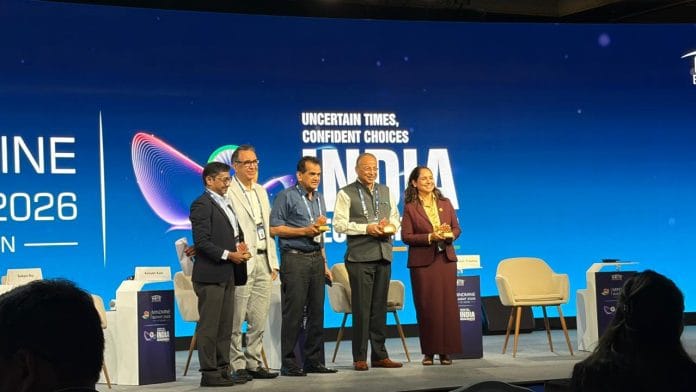


New Delhi: India cannot achieve strategic independence or sustain high economic growth without becoming energy independent, former G20 Sherpa Amitabh Kant said Monday. He called for a faster rollout of renewable energy, nuclear power, battery storage and electric mobility.
Speaking at the Mindmine Summit 2026 during a session, ‘The New Energy Map: Oil, Atom or Sun?’, the former NITI Aayog CEO argued that India’s continued dependence on imported fossil fuels leaves it vulnerable to oil market shocks that threaten its long-term economic outlook.
“Strategic independence is dependent on energy independence,” Kant said. “You can’t have strategic independence of India without energy independence.”
India imports fossil fuels worth $180 billion annually, leaving the economy vulnerable to disruptions in global oil markets, Kant said. He added that sharp increases in crude prices affect economic growth and the currency (rupee).
Calling energy independence ‘priority number one’, Kant said India cannot become a developed nation or major economic power while relying on imported energy.
“You cannot be a $30 trillion plus economy without being energy-independent,” he said. “If India wants to grow at 9 to 10 per cent annually over a three-decade period, this growth can only come from being energy-independent.”
Kant also linked the energy independence issue to India’s technology ambitions. He argued that the rapid expansion of artificial intelligence and data-centre infrastructure would require massive increases in reliable power generation.
India has already secured around $70 billion in commitments for data centres, while another $90 billion worth of projects have been announced, he said.
“About $160 billion worth of data centres are coming in. We need energy. If you are not able to have energy, and you are not energy independent, you will not be able to drive artificial intelligence,” Kant said.
He argued that India should view renewable energy not only as a climate commitment but also as an economic and strategic necessity. While India has set a target of 500 GW (gigawatts) of renewable energy capacity, Kant said the country should think far more ambitiously by laying out a roadmap for 1,500 GW.
He compared India’s progress with China’s, noting that India added about 56 GW of clean energy capacity last year, while China added nearly 400 GW.
Kant also cautioned against replacing dependence on imported fossil fuels with dependence on imported critical minerals and battery supply chains. Without calling out China, he warned that monopoly in critical mineral processing had created a new strategic vulnerability for countries pursuing clean energy transitions.
“Critical minerals are all available in surplus. But the critical mineral processing technology has been monopolised,” he said. To address this, he called for long-term policy support for domestic battery manufacturing, which would enable procurement commitments to allow Indian firms to scale up.
He also said that India is well-positioned to become a global leader in renewable energy and green hydrogen due to its climatic advantages. However, scaling up renewable energy would require substantial investment in transmission networks and energy storage.
Highlighting the gap between daytime and night-time electricity prices, Kant said renewable power is being sold for as little as Re 1 per unit during the day and as much as Rs 10 per unit at night, underscoring the need for battery storage and pumped-storage projects.
“India needs to have 24×7 storage power,” he said.
Kant also made a strong argument for nuclear energy, particularly small modular reactors, saying that renewable energy expansion on a large scale is not possible without dependable baseload power in India.
“You need base load energy, and that can only come from nuclear energy,” he said.
He welcomed the passing of the Shanti Bill in parliament that allowed the private sector participation in nuclear energy; however, he said that the government must also notify the rules and remove regulatory bottlenecks relating to fuel supply and waste management.
Kant also called for a more aggressive push towards electric mobility and urged the government to provide a clear roadmap for electrification.
He suggested that India’s 15 largest cities should transition fully to electric two and three-wheeled vehicles within the next three years, while buses and trucks should transition by 2030.
(Edited By Harini TS)