



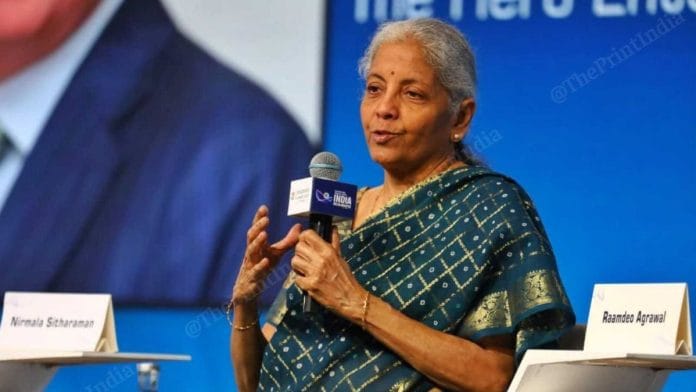
New Delhi: Finance Minister Nirmala Sitharaman Monday flagged the possibility of a weaker monsoon due to El Nino conditions, warning that farm incomes could come under pressure this year even as the government remains confident of avoiding any food shortage because of adequate buffer stocks.
Speaking at the inaugural session of the 16th edition of the Mindmine Summit 2026, themed ‘Uncertain Times, Confident Choices, India Recalibrates’, Sitharaman said unfavourable weather remains an economic risk as policymakers are preparing for a less favourable monsoon outcome. “Because of the El Nino effect, I think we are preparing for not so good a monsoon,” the finance minister said.
Declaring that food security is not a concern, Sitharaman acknowledged that farmers’ incomes could take a hit if rainfall is deficient or unevenly distributed. “We have enough buffer stocks. Since last year, we’ve maintained stocks, so there shouldn’t be a food shortage. But for farmers, it will have an impact, because this year’s income will be stressed out,” she said.
The remarks come amid growing concerns over the impact of weather disruptions on agricultural output, inflation and rural demand. Sitharaman noted that uncertainty over the monsoon remains an annual challenge for India, with risks ranging from dry spells to highly patchy rainfall patterns.
The minister placed the monsoon challenge within a broader framework of global economic uncertainties confronting India. These include volatility in crude oil prices, shipping and insurance costs, foreign exchange requirements and disruptions in the supply of critical imports. India’s large domestic market and rising consumption provide a cushion, she said, but the country remains dependent on imported raw materials and intermediate goods whose supply chains have come under increasing strain.
Highlighting the unpredictability of global markets, Sitharaman pointed to recent fluctuations in fertiliser supplies. She said that traditional major exporters had stepped back from the market to build domestic inventories, raising fears of shortages. Those concerns were later eased by China’s return to fertiliser exports after nearly a year-long absence.
“One week you have a challenge, the next week that challenge is addressed, but newer challenges come up,” she said, adding that governments must remain prepared for rapidly evolving disruptions.
Sitharaman also struck a positive note on India’s emergence as a hub for global capability centres (GCCs) and data centres, describing the sector as a significant source of jobs and investment over the coming decade. She said that the Centre is working closely with states to formulate policies that can attract data centre and GCC investments, calling them “immediate job-generating investments”.
According to Sitharaman, the expansion of GCCs and data centres is no longer limited to traditional technology hubs such as Bengaluru, Hyderabad and Noida. Smaller cities are increasingly emerging as destinations for such investments. “Earlier it used to be just Bangalore and probably somewhat Hyderabad, and Noida. Now you have cities like Mangaluru and many other Tier II cities are also becoming hosts to data centres,” she said.
The rapid spread of data infrastructure across states, she added, is being driven by a growing pool of Indian technicians and young professionals who are adapting quickly to the sector’s requirements.
(Edited by Nardeep Singh Dahiya)
Also Read: Of the 16 El Niño events since 1950, five led to extreme droughts in India