





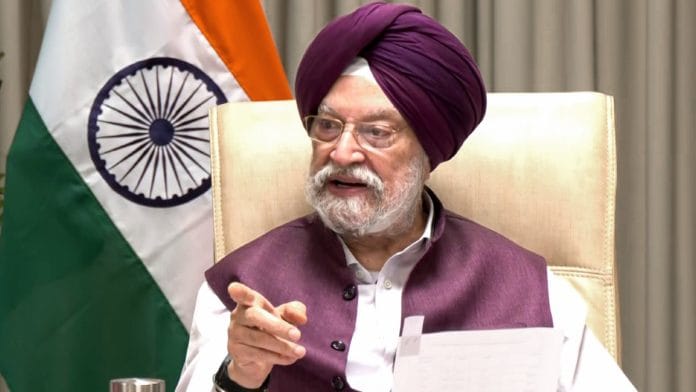


New Delhi: With global crude prices coming down to around $70 a barrel, Union Petroleum Minister Hardeep Singh Puri Thursday said consumers should not expect any immediate cut in petrol and diesel prices.
Any possibility of reduction, he said, could take two to three months, as oil companies are still selling fuel refined from costlier crude bought during the peak of the West Asia conflict.
Highlighting the impact of the West Asia crisis on public sector oil marketing companies (OMCs), Puri said that in the first quarter of FY2027 (April-June 2026), the actual loss stood at around Rs 74,781 crore, while under-recoveries on petrol, diesel and LPG were about Rs 1.88 lakh crore.
Addressing a press conference here on the West Asia crisis, he said retail fuel prices do not immediately reflect changes in international crude prices because refiners procure crude oil weeks in advance. “The crude that you buy at the dispensing station today would have been obtained two months ago,” Puri said, explaining that fuel currently being sold was refined from crude purchased when prices, insurance costs and freight rates were significantly higher.
Asked when consumers could expect a cut in fuel prices, Puri said it would depend on whether international crude prices remain at current levels.
“If this (international prices) persists for the next two-three months, then that would be a legitimate question. But that’s hypothetical,” he said, while declining to elaborate further.
Puri also defended the government’s fuel price hike, noting that fuel prices were largely shielded during the crisis through excise duty cuts.
He said petrol prices in Delhi were hiked by only about 5.6 percent between June 2022 and June 2026, and diesel prices by about 6.2 percent, compared with substantially higher increases in several developed and neighbouring countries.
According to Puri, international crude prices had climbed as high as $128 a barrel, but retail prices were not hiked proportionately because the Centre reduced excise duty by Rs 10 per litre each on petrol and diesel in March.
Also Read: 5 global oil shocks in 53 years: How they caused upheaval, forced reforms in India | Cut The Clutter
OMCs absorbed the impact
While consumers were insulated from higher prices, Puri said the burden was borne by state-run oil marketing companies.
He said cumulative under-recoveries on petrol, diesel and LPG during the first quarter of FY2027 (April-June 2026) amounted to about Rs 1.88 lakh crore. If LPG under-recoveries carried over from the previous year are included, the total rises to around Rs 2.2 lakh crore.
However, the minister said the actual loss incurred by OMCs during the April-June period stood at around Rs 74,781 crore. He added that the companies are still recovering from the financial impact of selling fuel below the actual cost during the West Asia crisis.
The minister reiterated that India successfully navigated the 110-day Hormuz crisis without fuel shortages despite concerns over disruptions to the Strait of Hormuz, one of the world’s busiest energy shipping routes.
He added that none of India’s nearly 107,000 retail fuel outlets reported a dry out during the period from late February through June.
Any report of shortages, he alleged, were largely fuelled by misinformation and panic buying. “We came out of it (crisis) without any closures and dry outs,” he said, adding that some isolated incidents do not reflect the national supply situation.
Focus shifts to building reserves
Looking ahead, Hardeep Singh Puri said the government will now focus on expanding India’s energy storage capacity.
However, he argued that this should not be viewed only through the lens of underground strategic petroleum reserves (SPRs), as the country also holds inventories across refineries, ports, terminals and floating cargoes.
“If you add what is in the ports, terminals, refineries and strategic petroleum reserves, it is at least 76 to 80 days (worth of supplies),” Puri said, adding that “we should have more” and describing expanding storage as one of the key lessons from the Hormuz crisis.
He said that at the peak of the West Asia conflict, India maintained crude and LNG stocks for around 60 days each, while LPG stocks were sufficient for about 45 days.
According to Puri, India was able to manage the Hormuz disruption through supply diversification, growing refining capacity and coordinated action across ministries.
He said India has diversified its crude sourcing network from 27 countries to 41 countries in the last few years and that has allowed refiners to switch suppliers based on commercial viability.
While there were concerns over LPG supplies during the crisis, Puri said these were addressed by sourcing cargoes from newer suppliers, including the US, Canada and Norway, while also increasing domestic production.
The minister also said that domestic LPG production was raised from about 35,000 metric tonnes per day to 54,000 metric tonnes per day by reconfiguring refineries to prioritise LPG over higher-value petrochemical products.
With global crude prices easing, Puri said the government’s immediate focus would be to build long-term resilience.
“I’m not worried about future prices, but I have to prepare for them,” he said, adding that increasing storage capacity, stocking crude while prices remain low and strengthening partnerships with oil-producing countries would all need to go hand in hand.
(Edited by Amrtansh Arora)
Also Read: How India dodged the worst of the Hormuz energy shock. The fuel crisis that never arrived