



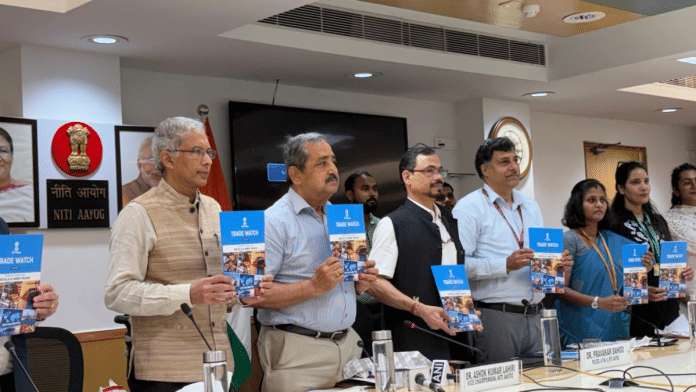
New Delhi: India’s merchandise exports grew 16 percent year-on-year to $129.5 billion in the first quarter of 2026-27, but the country remains under-represented in products that account for a large share of global import demand, according to NITI Aayog’s latest Trade Watch Quarterly released Wednesday.
“India’s export basket continues to show an apparent mismatch with global demand,” the report said, noting that nearly 68 percent of global imports are concentrated in products where India’s average export share was below 1 percent in 2025.
The report analysed six-digit Harmonised System (HS) products and found that 4,361 products fell in this category. Together, these products accounted for $17.49 trillion, or 67.8 percent of global imports in 2025.
India had an average share of just 0.2 percent in these products, highlighting the country’s limited presence in some of the world’s largest product markets.
The report does not provide an itemised list of all 4,361 products.
At the other end, products where India had more than 10 percent of the global market accounted for 28.1 percent of India’s exports in 2025. India’s average export share in these products was 18.7 percent, while they accounted for only 2.6 percent of global imports.
The report said this distribution shows “significant scope for expanding India’s presence in high-demand global product segments”.
“Strengthening competitiveness and market presence in such products could help align India’s export basket more closely with global demand and support sustained growth in merchandise exports,” it added.
Petroleum, electronics & engineering drive Q1 exports
In the April-June 2026 quarter, merchandise imports grew faster than exports, rising 19.8 percent to $216.12 billion. This resulted in a merchandise trade deficit of $86.62 billion, 26 percent higher than a year earlier.
Services exports rose 9.6 percent to $106.75 billion, while services imports increased 10.2 percent to $54.53 billion, leaving a services trade surplus of $52.22 billion.
Mineral and related fuels remained the largest export category in Q1 FY 2026-27, accounting for 28.6 percent of exports and growing 37.4 percent year-on-year. Petroleum-product exports increased to $9.59 billion in April 2026 from $7.12 billion in April 2025.
Electrical machinery and parts accounted for 19.8 percent of exports and grew 20 percent. Iron and steel exports rose 22.9 percent, while finished steel exports increased 31.4 percent. Vehicle exports grew 13.1 percent and organic chemicals increased 16.7 percent.
India also saw strong growth in several export markets.
Tanzania entered the top 10 export destinations, while exports to Tanzania, Singapore and South Africa grew 146.7 percent, 100.5 percent and 76.5 percent, respectively.
The report said the growth in exports to Tanzania and South Africa was driven particularly by mineral fuels.
FTA exports jump
Trade with free-trade agreement (FTA) partners grew faster than overall merchandise exports during the quarter.
The report highlighted that export to FTA partners grew 36.3 percent to $52.66 billion in Q1 FY 2026-27, from $38.63 billion a year earlier. Imports from these countries increased 10 percent to $71.99 billion from $65.32 billion, leaving India with a trade deficit with FTA partners.
Exports to Sri Lanka rose 124.6 percent, Singapore 100.5 percent and Malaysia 74.3 percent. Exports to South Korea, Australia and Japan increased 21.6 percent, 25.1 percent and 22.7 percent, respectively.
The report attributed this increase to higher shipments of petroleum products, electronics, engineering goods and agricultural products.
The report said India’s policy challenge is now to move beyond building basic export capability and expand its presence in larger global markets, with competitiveness, market access, supply-chain integration and diversification emerging as key areas.
At the launch, NITI Aayog Vice Chairperson Ashok Lahiri stressed the need for diversification. “We need to diversify. We need to find many more products where we can export, many more countries where we can export, and many more states from which we can export.”
(Edited by Viny Mishra)