





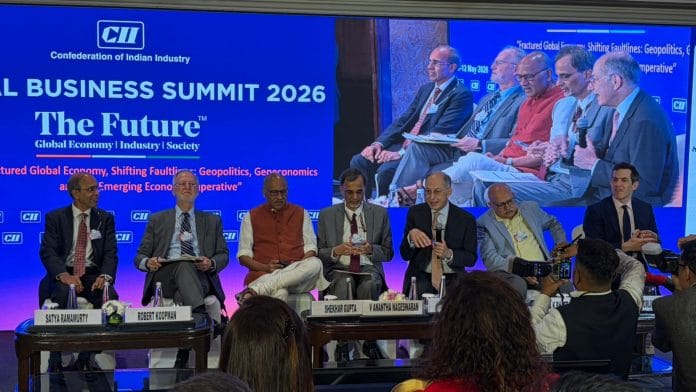


New Delhi: At a time when the world economy is undergoing wars, technology battles, and protectionism, Chief Economic Advisor V. Anantha Nageswaran offered a stark message at the Confederation of Indian Industry’s (CII) Annual Business Summit 2026 — the global economic order that powered growth for decades is under severe pressure, and India must prepare for a harsher, more transactional world.
Speaking Tuesday at the session “Fractured Global Economy, Shifting Faultlines: Geopolitics, Geoeconomics and the Emerging Economic Imperative,” Nageswaran said the assumptions underpinning the post-1945 global economy, which accelerated after the 1990s, were now collapsing. “What we are experiencing is not a crisis within the system,” he said. “It is a structural challenge to the organising principles of the system itself.”
The CEA identified four major shifts reshaping the world economy – geoeconomic fragmentation, technology bifurcation, the uneven costs of the energy transition, and the permanent repricing of geopolitical risk. Trade wars, export controls, and sanctions, he argued, are replacing comparative advantage as the basis of global commerce.
“Supply chains built over decades for efficiency are now being rebuilt for resilience,” he said.
On technology, he noted that semiconductor supply chains and digital infrastructure were splitting into rival ecosystems, making neutrality increasingly impossible for emerging economies.
“The choice of technology partner has become inescapably a geopolitical choice, and emerging economies that assume they could remain agnostic are discovering that the architecture itself does not permit permanent neutrality,” Nageswaran said.
The third shift, according to the CEA, is the changing politics around climate commitments and industrial policy. Referring to the dilution of “net zero” references in recent international discussions, Nageswaran said governments were now confronting economic costs that “had not been previously honestly shared with their public.”
The fourth and perhaps most immediate risk for India, he said, was the “permanent repricing of geopolitical risk” across energy, capital, and commodity markets.
Linking the ongoing West Asia crisis directly to India’s economy, Nageswaran pointed out that Brent crude prices had jumped sharply, container freight rates from the Gulf to China had surged 500 percent year-on-year, and fertiliser prices had more than doubled.
“These are not the readings of a temporary shock that will self-correct when the situation stabilises. They are the early-stage consequences of a sustained disruption to one of the world’s most critical energy and commodity corridors,” he said.
But Nageswaran’s sharpest remarks came when he spoke about how large economies behave in a fractured world order.
“In such a world, large and developed economies which are rule-setters and primary beneficiaries of the existing order, have their own interest in managing the pace and character of any aspirant’s rise,” he said.
“The assumption that our rise will be enthusiastically facilitated by those whose current advantages it will eventually challenge requires scrutiny rather than comfortable acceptance.”
It is against this backdrop, he said, that India’s recent push on free trade agreements should be viewed. He described the signing of nine trade agreements and economic partnerships in five years as “the most concentrated burst of trade diplomacy in independent India’s history”.
CEA Nageswaran argued that the agreements with the UK, EU, Mauritius, European Free Trade Association (EFTA), Australia, UAE, Oman, New Zealand, and the US were not merely commercial arrangements but part of a strategy to diversify economic relationships and reduce dependence on any one geography.
“But agreements create value only at implementation, not at signing,” he cautioned.
Another panellist, A.K. Bhattacharya, Editorial Director at Business Standard, shifted the focus to domestic reforms India would need to capitalise on global disruptions.
While acknowledging India’s progress on trade agreements, Bhattacharya said India needed to think beyond trade and link it more closely with investment and technology partnerships.
“Trade, investment and technology—this triad needs to be explored much more assiduously,” he said.
Bhattacharya also argued that the current crisis should be used to revive stalled agricultural reforms, noting that nearly half of India’s workforce remained dependent on agriculture. He also stressed the need for deregulation, civil service reforms, skilling, and healthcare improvements.
On the discussion around strategic autonomy, ThePrint’s Founder and Editor-in-Chief, Shekhar Gupta, argued that there was “no such thing as perfect strategic autonomy”.
Drawing examples from India’s Cold War years and sanctions after the 1974 nuclear test, Gupta said every country adjusts to geopolitical realities and pays a price for its choices.
“Strategic autonomy is the ability to decide what’s good for me today,” he said, adding that countries often take decisions “completely cynically” in their national interest.
Gupta compared the current global crisis to an aircraft flying through severe turbulence with a difficult pilot at the controls.
“This turbulence will be over, the pilot will change,” he said, arguing that countries like India must learn to navigate uncertainty without suffering long-term damage.
Shekhar Gupta also criticised what he described as India’s instinctive anti-Americanism, excessive faith in government-led solutions, and tendency to see itself as “destined for greatness”.
“People are polite. They don’t say too much to our faces. But behind our backs, they smirk,” Gupta said.
(Edited by Varnika Dhawan)