





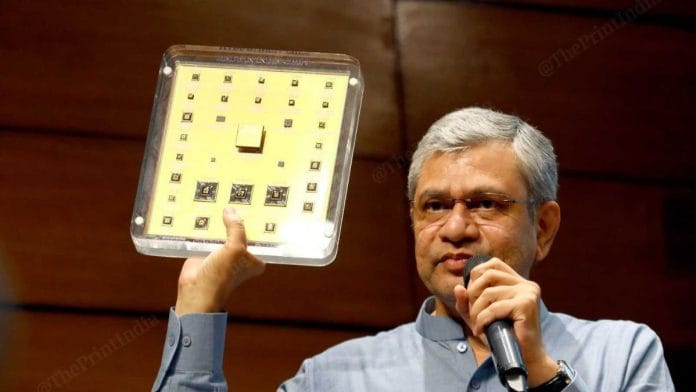


New Delhi: The Union Cabinet on Wednesday approved two electronics sector schemes worth a combined Rs 1.9 lakh crore: Semicon 2.0 with an outlay of Rs 1.27 lakh crore for semiconductor design and manufacturing, and the Rs 62,500-crore Mobile Phone Manufacturing Scheme (MPMS).
The MPMS replaces the Production Linked Incentive (PLI) scheme that ended on 31 March.
At a Cabinet briefing here, Electronics and Information Technology Minister Ashwini Vaishnaw put numbers to the chip programme. “The expected outcomes include investments worth approximately Rs 4 lakh crore, production valued at Rs 2 lakh crore, and exports amounting to Rs 1 lakh crore.”
“It will generate both direct and indirect employment,” he said.
Semicon 2.0 rests on six pillars: chip design, machines and materials, fabrication plants, assembly and packaging units, research and development (R&D), and talent.
Also Read: India’s semiconductor market to grow to $120 billion by 2030, says Deloitte study
A new financing model
Semicon 2.0 rests on six pillars: chip design, machines and materials, fabrication plants, assembly and packaging units, research and development (R&D), and talent.
The design pillar breaks from grant-only support. Start-ups and micro, small and medium enterprises (MSMEs) get a grant plus equity co-investment. Larger companies get royalty financing or equity co-investment—the government funds the design and recovers a share of revenue from the chip.
The government exists either at equity valuation or at 1.5 times the royalty financing. Eligibility is restricted to start-ups and companies owned by Indian citizens or Overseas Citizens of India (OCIs).
That the state is now taking equity and royalty positions, rather than writing cheques, is the sharpest departure from Semicon 1.0, under which 24 design projects were approved for support and 105 start-ups given Electronic Design Automation (EDA) tools; 15 of those have since raised venture capital.
Strategic chips run on a separate track. A high-level expert committee chaired by the National Security Adviser and the Principal Scientific Adviser will identify which chips get built. Indian companies will develop them in consortia with multinationals, academia and start-ups.
“Chips for all our strategic requirements — including drones, missiles, aircraft, and tanks — will be designed in India,” Vaishnaw said.
The machines pillar covers equipment, refurbished equipment and components, R&D for advanced nodes, supply chain development and a PLI for sourcing inputs from domestic companies. Materials covers chemicals, gases and materials — 150 to 500 items, for domestic consumption and export.
The R&D pillar targets a 7-3 nanometre (nm) path on the same equipment, silicon photonics and packaging technologies; India’s fabs today sit at 28-110 nm. Talent sets a target of one lakh design engineers in five years, plus operators, engineers and PhDs for fabrication, packaging, equipment and materials.
Three plants running, first fab in 2028
Twelve units were approved under Semicon 1.0 with cumulative investment over Rs 1.64 lakh crore — one silicon fab, one silicon carbide fab, an integrated gallium nitride micro-LED display fab and nine packaging units, of which one is advanced packaging.
Three are in commercial production: Micron at Sanand from 28 February, Kaynes from 31 March, CG Semi from 4 July . One more is expected in 2026.
The Tata fab at Dholera, on 163 acres, is under construction for commissioning in 2028; Tata’s Jagiroad plant in Assam, an Assembly, Testing, Marking and Packaging (ATMP) unit of the kind the industry also calls an Outsourced Semiconductor Assembly and Test (OSAT) facility, covers 171 acres.
“Chips are once again being exported from here to Japan, Europe, and the US,” Vaishnaw said.
Two-nm chips are already designed in India, though not fabricated here.
Partnerships have been signed with the United States (2023, extended via Pax Silica this year), the European Union and Japan (2023), Singapore (2024), the Netherlands (2025) and Germany (2026).
Mobile scheme pays for Indian brands
MPMS runs five years, from financial year (FY) 2026-27 to FY 2030-31, paying 2.25 to 5 per cent on eligible sales, with Indian brands at the top rate.
The incentive would be up to 1.5 percent more for domestic sourcing of components and sub-assemblies, and 3 per cent more for design and R&D by Indian brands— the first time the incentive is tied to brand ownership rather than volume.
The government expects cumulative production of about Rs 39 lakh crore against Rs 22 lakh crore under PLI, exports of about Rs 15 lakh crore against Rs 7.5 lakh crore, and 60,000 direct jobs.
The PLI Scheme for Large Scale Electronics Manufacturing (PLI-LSEM), which ended in March, reported investment of Rs 20,587 crore against a Rs 7,000 crore target, production of Rs 11.62 lakh crore against Rs 8.13 lakh crore and exports of Rs 6.43 lakh crore against Rs 4.88 lakh crore.
Rs 19,090 crore was disbursed as incentive; roughly Rs 3 lakh crore came back as goods and services tax (GST) and Rs 25,000 crore as direct tax. About 125 crore handsets were made, 12 lakh jobs added and $14 billion invested across the ecosystem.
The two schemes sit against a base that has grown seven times since FY 2014-15, to Rs 13.1 lakh crore of electronics production in FY 2026, with exports up 11 times to Rs 4.2 lakh crore.
Electronics was 1.7 per cent of merchandise exports in 2014-15 and about 11 per cent in 2025-26 — $48 billion of $442 billion — moving from ninth to third among export categories.
Smartphones, outside the top 100 commodities in 2014-15, now rank first, and account for 61 per cent of electronics exports and 48 per cent of electronics manufacturing, which is why the government’s next phase leans on them.
India is the second-largest manufacturer of handsets by volume; 99.2 per cent of phones used in the country are locally made. The target set by the Prime Minister is $500 billion of production by 2030-31, $240 billion of exports and employment of about 60 lakh — 35 lakh above current levels.