



New Delhi: Two years after former Bangladesh Prime Minister Sheikh Hasina was ousted in August 2024, the country’s economy presents a mixed picture—foreign exchange reserves have recovered, remittances have surged and inflation has eased, but growth remains subdued, private sector credit is slowing and prices continue, albeit relatively slowly, to rise.
Economic distress was among the factors that fuelled the student protests that forced Hasina to resign and flee the country. Rising living costs, dwindling foreign exchange reserves and an economic slowdown exacerbated by the Russia-Ukraine war had strained the economy and pushed Dhaka to seek assistance from the International Monetary Fund (IMF).
Yet the economic trends since her departure have not moved uniformly.
The recovery in foreign exchange reserves has reversed a decline that began well before she left office, while the slowdown in economic growth also predates her ouster.
Growth slows after decade of expansion
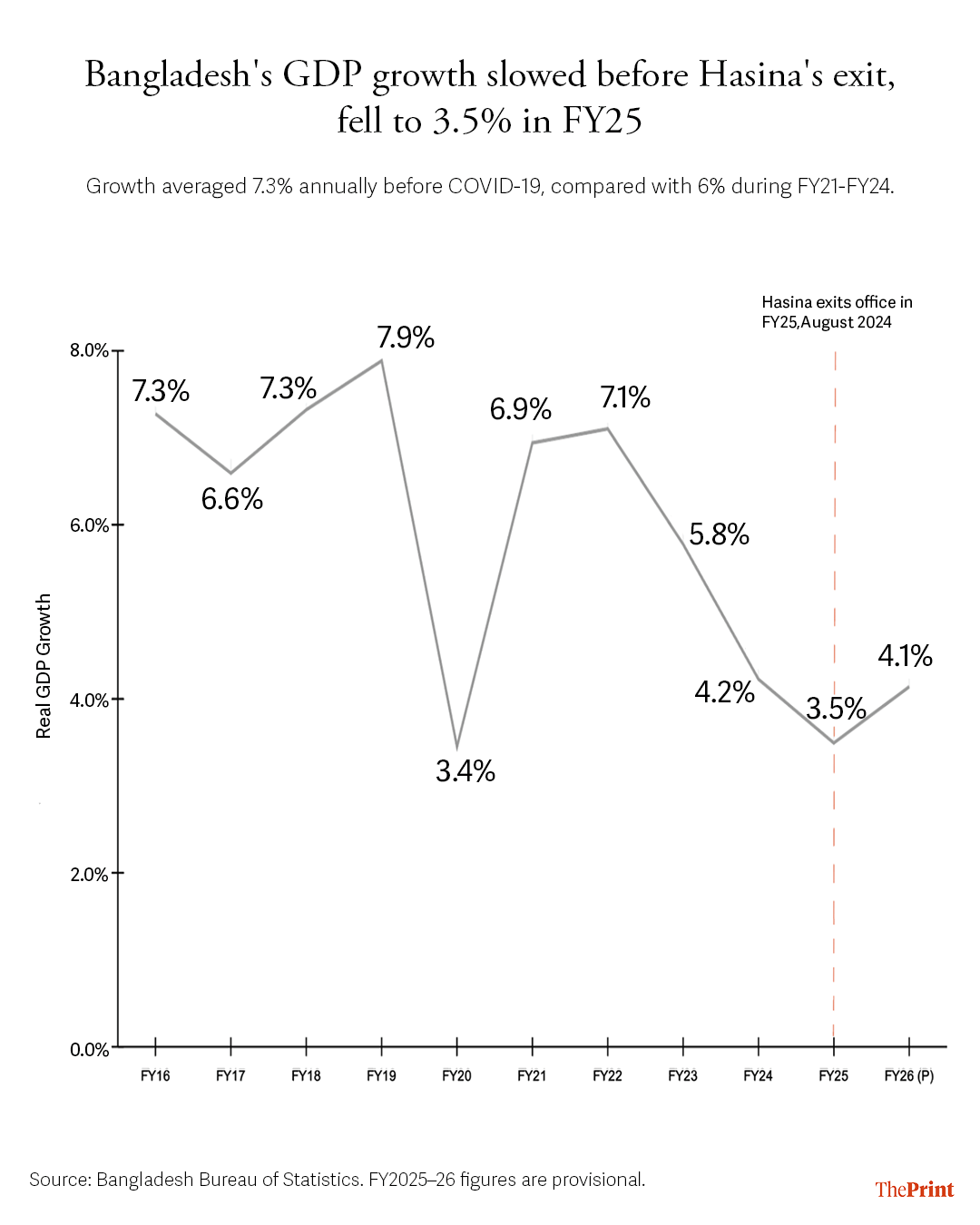
Bangladesh’s economy expanded over the past decade, including during the COVID-19 pandemic, but growth weakened in the final years of Hasina’s rule and slowed further in the fiscal year of her departure.
Between July 2024 and June 2025, the country’s inflation-adjusted economic output stood at approximately 34.6 trillion Bangladeshi taka, measured at constant 2015-16 prices.
The pace of expansion, however, varied considerably. Between FY16 and FY19, the economy grew at an average annual rate of 7.2 percent, before slowing to 3.4 percent in FY20 during the pandemic. Growth rebounded to 6.9 percent the following year and reached 7.1 percent in FY22, before losing momentum again.
The slowdown was already evident two fiscal years before Hasina’s departure. In FY25, the fiscal year in which she left office, GDP growth fell to 3.5 percent, its second-lowest rate in a decade. Growth subsequently recovered modestly to a provisional 4.1 percent in FY26.
Also Read: Migrant remittances & IMF loan have limits. Now Bangladesh must rebuild its institutions
Forex reserves recover
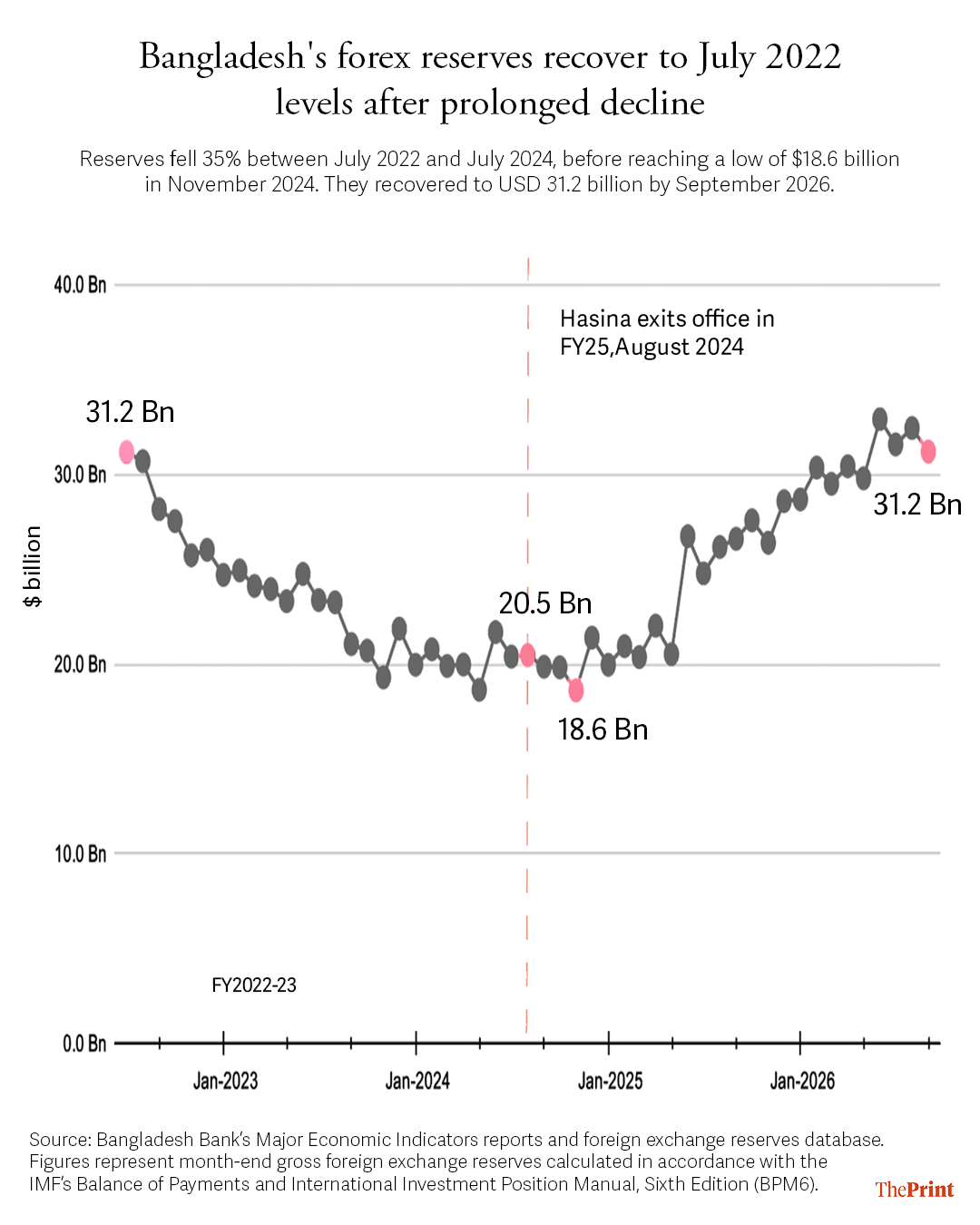
The trajectory of foreign exchange reserves offers a contrasting picture. After a prolonged decline that began before Hasina’s departure, reserves have recovered by nearly 68 percent from their November 2024 low, returning by September 2026 to roughly their July 2022 level.
Between July 2022 and July 2024, reserves fell from $31.17 billion to $20.39 billion, a decline of approximately 34.6 percent. The slide continued after Hasina left office, with reserves reaching $18.61 billion in November 2024, their lowest level in the period analysed.
Reserves rebounded in December 2024 and, despite subsequent fluctuations, rose to $32.91 billion in June 2026. They stood at $31.2 billion in September 2026.
Inflation eases, but prices remain elevated
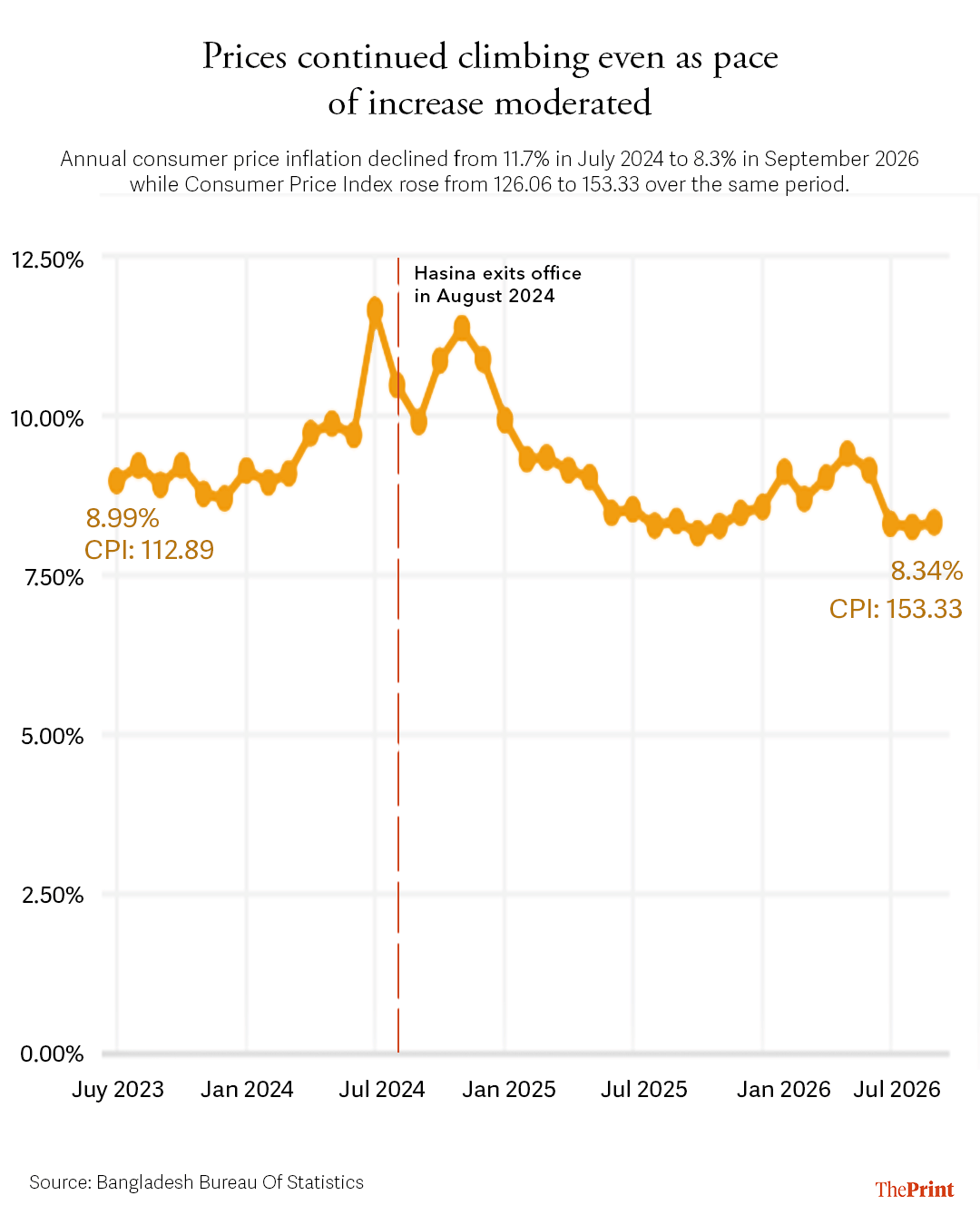
The country’s annual consumer price inflation declined between July 2024 and September 2026. Annual inflation fell from 11.7 percent in July 2024 to 8.3 percent in September 2026.
However, the overall price level continued to rise over the same period—Consumer Price Index rose from 126.06 to 153.33, an increase of approximately 21.6 percent.
This means that prices continued to climb even as the pace of increase moderated. The decline in inflation rate signals slower price rises, not a reversal of the increase in living costs that had contributed to public discontent. Bangladesh experienced disinflation (slower increase in price) in the said period, not deflation (fall in prices).
Private sector credit points to weak demand
Another sign of continuing economic strain is the slowdown in private sector credit growth. While the total amount of outstanding credit has continued to increase in nominal terms, its annual growth rate has fallen sharply.
Between July 2024 and July 2026, annual growth in outstanding private sector credit declined by approximately 5.5 percentage points, from 10.1 percent to 4.6 percent. It reached approximately 4.5 percent in June 2026, the lowest during the period analysed.
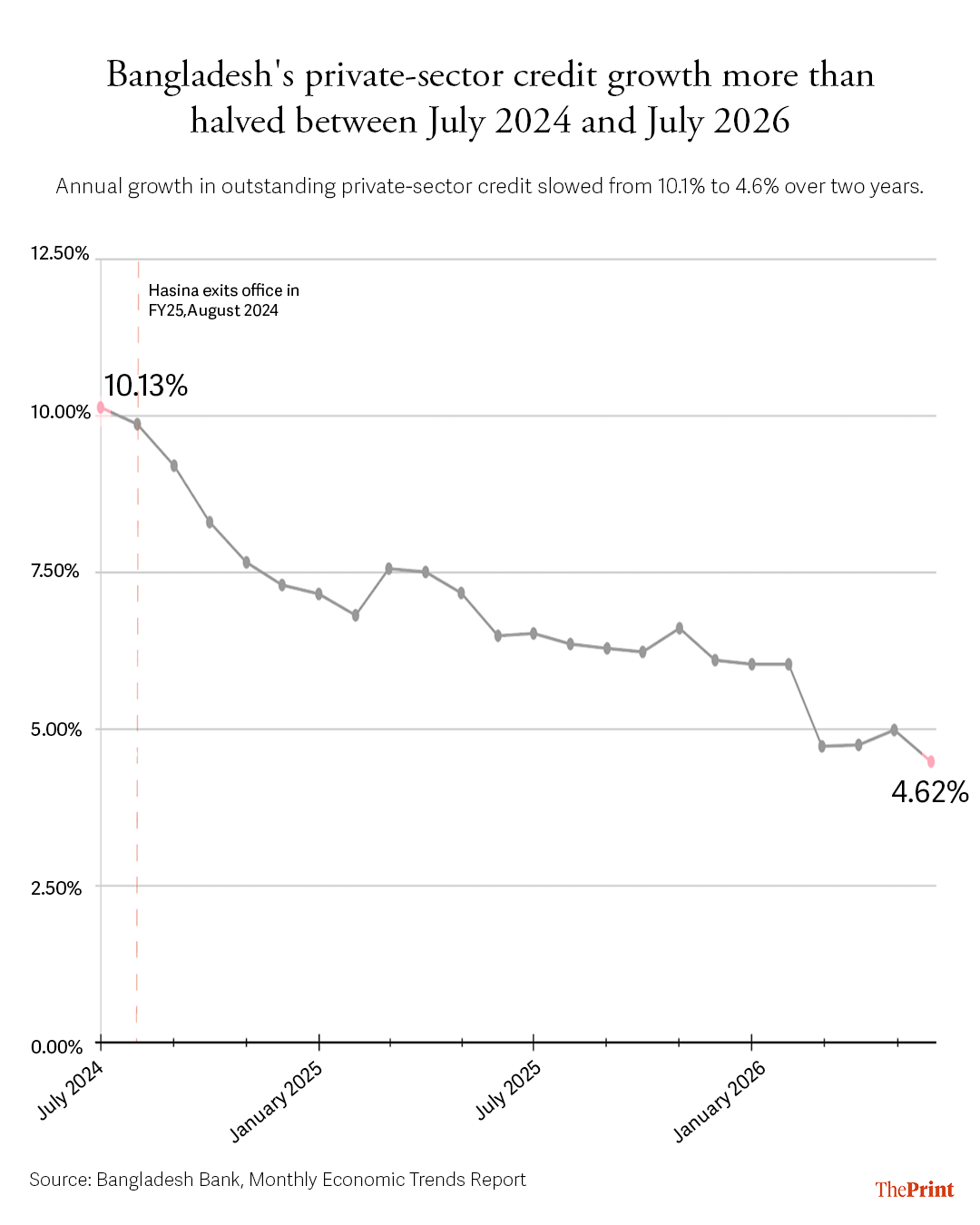
In its monetary policy statement for July–December 2026, Bangladesh Bank, the country’s central bank, attributed weak private sector credit demand to tight financial conditions and broader economic uncertainty. It also noted that commercial banks had become more cautious about lending amid rising loan defaults and increased government borrowing requirements. Banks were increasingly directing surplus funds towards lower-risk government securities rather than lending to private businesses.
Tax revenue remains under pressure
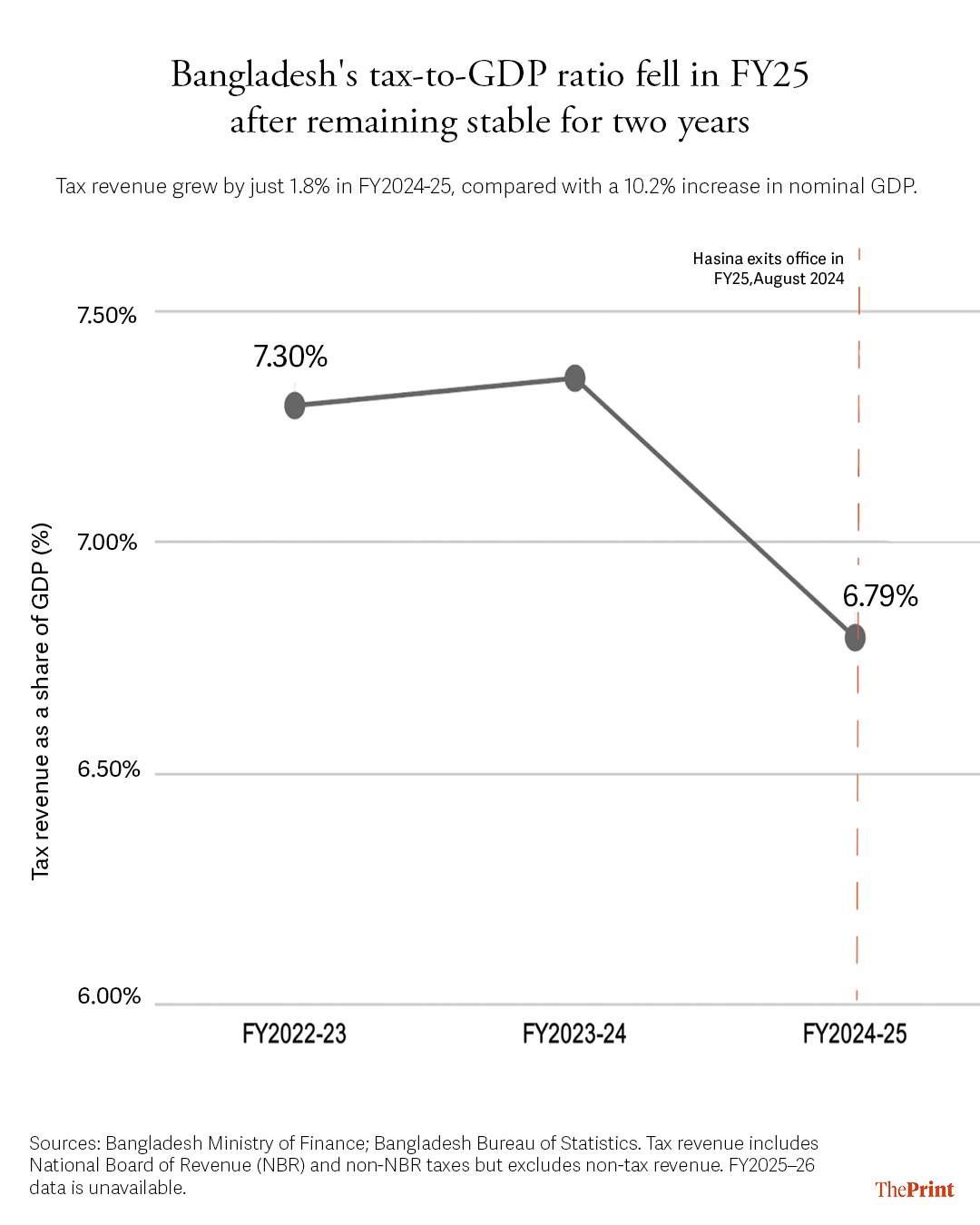
The government’s ability to mobilise revenue has also weakened relative to the size of the economy. Bangladesh’s tax-to-GDP ratio, which measures tax revenue as a share of economic output, rose marginally from 7.30 percent in FY23 to 7.36 percent in FY24, before falling to 6.79 percent in FY25.
Remittances surge; garment exports recover unevenly
Bangladesh’s remittance inflows and readymade garment exports, two important sources of foreign currency, have followed different trajectories. Remittances have risen sharply, while garment exports recovered in FY25 after two consecutive years of decline before slipping slightly in FY26. Bangladesh is the world’s third-largest garment exporter.
Annual remittance inflows increased from $23.91 billion in FY24, the last complete fiscal year under Hasina, to $30.33 billion in FY25 and $35.59 billion in FY26. This represented a cumulative increase of nearly 49 percent over two years.
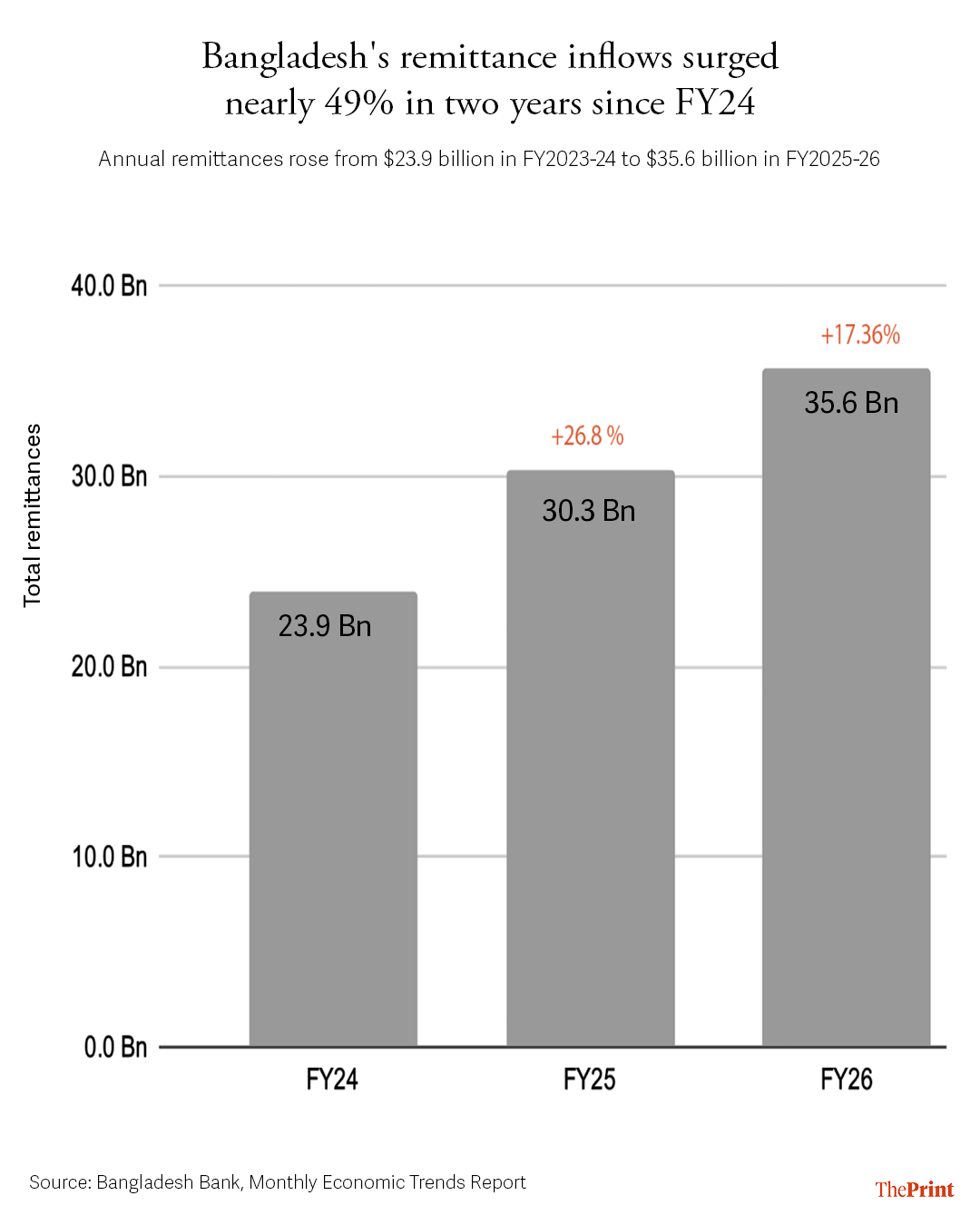
The World Bank identified the depreciation of the taka and incentives offered by the government and banks as factors contributing to stronger remittance inflows through formal banking channels in FY25.
Garment exports, meanwhile, have been more volatile. The sector, which accounts for more than 80 percent of Bangladesh’s merchandise export earnings, recovered after the COVID-19 pandemic, with exports reaching $42.61 billion in FY22. Earnings subsequently declined for two consecutive fiscal years, falling to $36.15 billion in FY24.
Exports rebounded by 8.8 percent to $39.35 billion in FY25, before declining slightly in FY26. Despite the latest fall, export earnings remained above their FY24 level.
Taken together, the indicators present a mixed picture of Bangladesh’s economy two years after Hasina’s ouster. Several of these trends began before Hasina left office, complicating any attempt to attribute the economy’s performance entirely to the political transition. The subsequent recovery in some indicators also does not, by itself, establish that the underlying weaknesses have been addressed.
The challenges remain significant enough for Bangladesh to seek a new $4.5 billion loan package from the IMF to stabilise its economy amid worsening macroeconomic conditions and geopolitical strains arising from the war in West Asia.
Notably in her 5 August speech in New Delhi this year, her first public address since her ouster, Hasina alleged that Bangladesh’s economy had deteriorated sharply following her removal from office. She claimed that growth had slowed, investment and job creation had weakened and the economic gains made during her tenure were being reversed.
(Edited by Chingkheinganbi Mayengbam)
Also Read: Dinesh Trivedi has done what India’s Bangladesh policy needed—put Dhaka on the backfoot