



New Delhi: Various adversaries threaten the United States with missiles or sanctions; however, Mohammad Bagher Ghalibaf, the speaker of Iran’s parliament and Tehran’s chief negotiator, has identified algebra to be a unique source of unease for Washington.
Last month, ThePrint analysed the initial equation he presented: coinciding with the Federal Reserve’s first interest rate increase in three years, Ghalibaf modified the Taylor Rule, a formula central bankers have relied on for over three decades, by adding terms related to the Strait of Hormuz and Bab el-Mandeb. This alteration underscored the notion that no interest rate adjustment could reopen a shipping lane. Although I concluded it was a jest, it rested on sound economic principles.
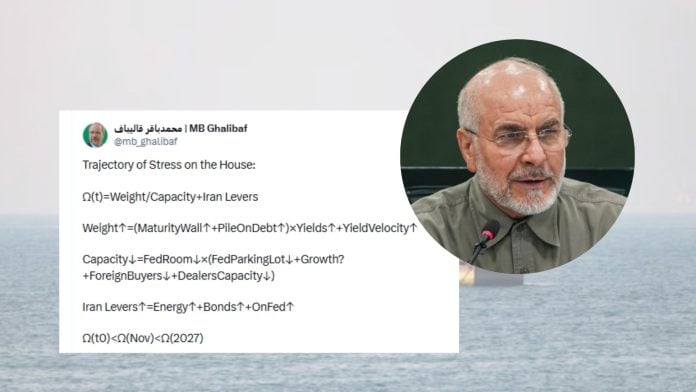
Now the speaker, who also engages in macroeconomic analysis, has introduced a subsequent equation, this time targeting the US Treasury. On the evening of 30 September, he disseminated what he termed the “Trajectory of Stress on the House” in the succinct style of a bond trader’s notes. This formula juxtaposed America’s debt with its capacity to manage it, included a term for Iran’s leverage, and concluded with an inequality resembling a countdown: current stress levels are lower than those projected for November, which are, in turn, lower than those anticipated for 2027.
While the first equation was a jest with serious economic underpinnings, the second represents a more unsettling forecast. It also served as a response. Three days earlier, Treasury Secretary Scott Bessent told Fox News that about 15 million barrels of Iranian oil remained at sea, and that within two weeks, once the final shipments reached China, Iran would have no oil left to trade. Bessent was effectively timing Iran’s oil reserves, and Ghalibaf countered by presenting a timeline focused on America’s debt.
Straits Taylor Rule:
i = r* + π* + 1.5(π−π*) + 0.5(y−y*) + α(SOH−SOH*) + β(BEM−BEM*), α,β > 0
Let’s see if a hike could open SOH or produce a single barrel 🙂
You can’t 25bp a chokepoint and r* isn’t neutral. It’s SOH risk premium, and We set it.
Stay unanchored !
— محمدباقر قالیباف | MB Ghalibaf (@mb_ghalibaf) September 16, 2026
Trajectory of Stress on the House:
Ω(t)=Weight/Capacity+Iran Levers
Weight↑=(MaturityWall↑+PileOnDebt↑)×Yields↑+YieldVelocity↑
Capacity↓=FedRoom↓×(FedParkingLot↓+Growth?+ForeignBuyers↓+DealersCapacity↓)
Iran Levers↑=Energy↑+Bonds↑+OnFed↑
Ω(t0)<Ω(Nov)<Ω(2027) https://t.co/9sL4pIpXKn pic.twitter.com/NYUnsRRBnG
— محمدباقر قالیباف | MB Ghalibaf (@mb_ghalibaf) September 30, 2026
Also Read: Why Bagher Ghalibaf and Abbas Araghchi are the most crucial negotiators in Iran war
Reading the equation
The formula draws on engineering principles, where the stress on any structure is the load it bears divided by the strength supporting it. In the context of the United States’ fiscal situation, the “weight” refers to its debt: the accumulation of matured Treasury bonds requiring refinancing, plus new borrowing to address deficits, multiplied by the prevailing interest rate needed to refinance the entire structure. This concept is not new to Iran. The Congressional Budget Office forecasts interest payments of $1,039 billion for fiscal year 2026, while the Treasury is currently disbursing an average of $2.8 billion daily in interest. Ghalibaf’s nuanced term, “yield velocity”, is significant because, in bond markets, it is the speed of yield changes, rather than their magnitude, that imposes losses on leveraged investors and transforms an orderly sell-off into a market rout.
Yields have been increasing rapidly. In mid-September, the 10-year Treasury yield rose to 5.04 per cent, the highest since July 2007, and recently it exceeded 5.34 per cent, a level not observed since 2002. On the other hand, the “capacity” to absorb this debt is diminishing. The Federal Reserve has limited capacity to intervene, having unanimously voted on 16 September to raise its target range to 3.75 to 4 per cent, marking its first increase since July 2023. The “Fed parking lot”, a facility where money market funds previously deposited idle cash at the central bank, which could absorb new Treasury bills, has been significantly depleted. Additionally, reduced foreign demand and banks constrained by regulatory balance sheet limits further thin the pool of buyers as the supply of debt increases. Notably, Ghalibaf questioned “growth”, the sole variable capable of rectifying America’s fiscal calculations, and recent data validate his caution: September payrolls increased by only 29,000, falling short of all estimates, while unemployment rose to 4.2 percent.
Subsequently, the “Iran Levers” emerge: energy, bonds, and the Federal Reserve. This sequel completes the narrative initiated by the first equation. The Straits Taylor Rule targeted the central bank; this equation targets the Treasury, collectively illustrating a predicament: the oil shock compels the Federal Reserve to raise rates, and each rate increase worsens America’s trillion-dollar interest burden. Economists have a term for the culmination of this trajectory. In their 1981 paper “Some Unpleasant Monetarist Arithmetic”, Thomas Sargent and Neil Wallace demonstrated that when government debt becomes sufficiently large, a central bank loses its autonomy, as combating inflation becomes prohibitively costly for the Treasury. They termed this fiscal dominance, and Ghalibaf’s two equations, when considered together, represent an effort to accelerate this condition from an external perspective.
Also Read: Why India should fear oil prices more than US Federal Reserve rate decisions
Whose house?
To understand the term “House”, it helps to revisit early September, when Bessent addressed an audience at Southern Methodist University and asserted, “I am the house now”, challenging traders to wager against him on the yen. Ghalibaf was attentive to this declaration. On 24 September, as yields surpassed 5 per cent, he commended the United States on its new borrowing costs, stating that this represented “the floor two years out”. The reference to “two years out” pertains to 2027, marking the conclusion of his inequality.
The campaign began much earlier, and its progression is the most noteworthy part of the narrative. In June 2025, at the BRICS Parliamentary Forum in Brasilia, Ghalibaf still advocated de-dollarisation, promoting national currencies, digital assets, and collaborative banking platforms as a countermeasure against sanctions. However, within weeks of the war’s onset, his rhetoric shifted completely. By late March, he was advising his audience to interpret Trump’s announcements as a contrarian indicator, suggesting, “If they pump it, short it,” which led the Irish Times to comment that he resembled a macroeconomic newsletter rather than a theocrat. In April, he dismissed hedging in Treasuries during the Hormuz crisis as a “house of cards that works on paper”, and by mid-September, he had shifted from slogans to mathematical equations.
Two clocks, one question
Is his assessment accurate? Partially, but he misinterprets the very point he most wants to be accepted. His analysis of the United States’ debt dynamics aligns with the views of numerous American economists, and the oil shock has undeniably empowered the Federal Reserve to implement tighter monetary policies. However, his interpretation overstates Iran’s contribution to the situation. The market attributes the rise in yields to a combination of anticipated Federal Reserve tightening, the ongoing Middle East conflict, concerns regarding the US fiscal and debt outlook, and robust economic data. The United States’ fiscal challenges were significant well before the first tanker was halted. Iran is exacerbating a burden that Washington established, not one created by Tehran.
Moreover, Ghalibaf’s own situation is considerably more precarious. In August, he cautioned that Iran could not survive if its population faced hunger, prompting criticism from hardliners who contended that acknowledging such vulnerability would only invite increased American pressure. The statistics underscore his apprehension: Iran’s 12-month inflation rate reached 66 per cent in July, and food prices rose 128 per cent from the previous year. Bessent evaluates Iran’s sustainability in weeks, while Ghalibaf assesses America’s in years, each articulating the other’s vulnerabilities while remaining conspicuously silent about their own.
The thinker who most effectively elucidates this scenario is not a macroeconomist but the biologist John Maynard Smith. His 1974 model of the war of attrition showed that in a contest of endurance, victory goes not to the stronger participant but to the one who can endure the cost longer. Ghalibaf’s strategy bets that America’s political resolve, tested at the ballot box in November and again by the debt ceiling of 2027, will falter before Iran’s economic resilience does. Bessent’s strategy is the exact opposite.
Every gambler familiar with a casino understands the fundamental rule that the house invariably prevails. However, fewer recall the implicit condition: the house wins only as long as all participants believe it can fulfil its obligations. Bessent has asserted that he represents the house, while Ghalibaf has spent seven months attempting to convince others to reassess their positions. Regardless of which timeline concludes first, the world has learned a lesson it will not easily forget: in this century, the most perilous element a chokepoint can obstruct may not be oil, but confidence.
Edited by Sunanda Ranjan
Also Read: Pakistan just set a reserve record. Much of it is borrowed money