







Hyderabad: Andhra Pradesh spent more than 95 percent of its own revenue in the last financial year on salaries and pensions. In rupee terms, a whopping Rs 1,05,039 crore was spent on human resource-related expenditure in FY26, according to the State Finance Department Progress Report presented Tuesday by Chief Minister N Chandrababu Naidu.
Andhra employs between 10-12 lakh people directly and indirectly in the state public sector undertakings, corporations, and secretariats at state, district, village, and ward levels. In addition, the state supports about 3.59 lakh pensioners, according to official data.
In contrast, other southern states spend far less on paying its staffers: Karnataka under a third of its state own revenue (SOR) on salaries, Telangana about 44 percent of SOR, Tamil Nadu 49 percent, and Kerala 68 percent of its revenue. on paying its staffers.
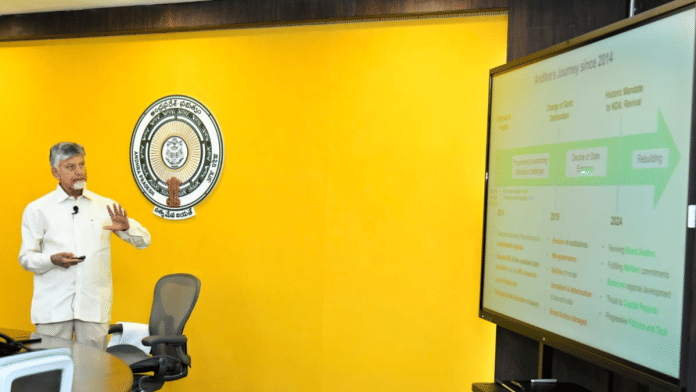
Making a presentation on the state’s progress in the last couple of years since the Telugu Desam-led NDA government assumed office in 2024, the chief minister states high HR expenditure increased the state’s fiscal burden.
Explaining that the soaring HR budgets were on account of a “legacy problem”, Naidu admitted that the state’s inability to “fix this” overnight since the state must guarantee salary payments to its workforce.
Blaming the previous Jagan Mohan Reddy-led YSR Congress Party dispensation, CM Naidu said, “This over-allocation is a primary example of what happens under a government lacking financial accountability. It severely choked the state’s fiscal room for other vital allocations and capital expenditures,” he explained to a room full of ministers and bureaucrats at Andhra Pradesh’s secretariat in Amaravati.
To put this in perspective, at the time of the state’s bifurcation in 2014, Andhra’s HR spend was 66 percent of its revenue, and in FY15, the state spent Rs 25,094 crore in salaries.
This rose to 116 percent during FY20, after the YSRCP government came to power in 2019, and by FY24, Andhra was paying Rs 92,147 crore to its employees, the report—dubbed White Paper on the State’s Finances—reveals.
Highlighting the “corrective actions” taken over the past two years, Naidu said the current NDA government successfully managed to bring this cost down by 13 percent to 14 percent, reducing the current figure to roughly 95 percent of SOR.
“To remedy the situation, we cleared the unpaid liabilities and released pending dues of Rs 30,849 crore of gratuities, CPS (contributory pension scheme) contribution, provident fund, APGLI schemes (Andhra Pradesh Government Life Insurance), and medical reimbursement,” CM Naidu said.
Although the finance minister and finance secretary of Andhra Pradesh were not available for comment, the rising salary bills could also be on account of successive governments raising the retirement age of government employees.
Thus far, Andhra Pradesh raised the retirement age from 58 in 2014 to 62 in 2026, stating that it did not have adequate funds to settle the retiring employees’ dues.
Also Read: Andhra Pradesh missing from Budget spotlight, why Chandrababu Naidu’s still happy
Debt trap and corrective action
While the chief minister refrained from alluding to the decision of increasing the retirement age of government employees, in his nearly hour-long presentation, he summarised the practical economic reality of the state.
He said the state’s own revenues were entirely exhausted just paying salaries, while central fund devolutions were strictly bracketed toward paying off debt and interest. “Consequently, the state is trapped in a cycle where it has to borrow money even to fund basic welfare schemes,” he added.
As a result, Andhra Pradesh’s aggregate debt and liabilities surged by 259.6 percent over the previous five years, expanding from Rs 3.75 lakh-crore in March 2019 to Rs 9.74 lakh-crore in May 2024, according to data released by the government.
However, ironically, despite the state’s ballooning salary bills, the per capita income gap between Telangana and Andhra Pradesh widened dramatically by 91.4 percent, skyrocketing from a gap of Rs 55,817 in 2018–19 to Rs 1,06,854 by 2023–24.
Telangana has a substantially higher per capita income than Andhra Pradesh, ranking second nationally, while Andhra Pradesh is much lower. Based on recent Reserve Bank of India (RBI) and state data reports, Telangana’s per capita Net State Domestic Product (NSDP) stands at approximately Rs 3,87,623, whereas Andhra Pradesh’s stands at Rs 2,66,240.
Several planning bodies and financial institutions such as the NITI Aayog and the Comptroller and Auditor General of India (CAG) have cautioned the state on escalating expenditure.
The fiscal health index published by NITI Aayog in 2025 ranked Andhra Pradesh 17th among the 18 states analysed, indicating high fiscal strain. NITI Aayog (2025) observed that cumulative capital expenditure of the state on social and economic services had come down by 84 percent and 60 percent, respectively, between 2018-19 and 2022-23.
It noted that the state’s revenue was increasingly being locked in committed expenditure such as salaries, pensions, and interest payments. Committed expenditure as a percentage of revenue receipts had increased from 58 percent in 2018-19 to 65 percent in 2022-23.
NITI Aayog (2025) also noted that the growth rate of states’ own revenue had come down from 17 percent in 2018-19 to 10 percent in 2022-23. It recommended that the state may focus on enhancing the efficiency of capital expenditure, optimising committed spending and diversifying revenue sources for greater resilience.
The state’s newly released Progress Report 2024–26, a copy of which is with ThePrint, also focuses on how the state plans to adopt corrective measures to address the debt and liabilities, a damaged state brand, and zero debt sustainability.
“Over the last two years, my administration has targeted a multi-pronged revival strategy centered on clearing pending liabilities, securing central grants, and aggressively reviving mega capital infrastructure,” he said, explaining how the government’s targeted capital expenditure spend has led the state to occupy the leading position in the country in terms of bagging and executing public-private-partnership (PPP) projects.
“We are moving from a severe debt trap under the previous regime to a structured ‘Recovery and Renewed Momentum’ phase between 2024 and 2026,” the CM said as part of his presentation to his colleagues and officials.
His plan for the next three years includes rebuilding the state, reviving ‘Brand Andhra Pradesh’, fulfilling welfare commitments, balancing regional development, giving a thrust to capital projects and crafting progressive policies.
Pointing to a turnaround in the state’s GSDP, the CM said the state’s growth rebounded to 11.3 percent under the current 2024-26 phase compared to 10.3 percent in 2019-24, thanks to the state’s average capital expenditure over the last 2 years which has scaled up 1.5 times higher than the average capital expenditure recorded during the 2019–24 slowdown period.
(Edited by Ajeet Tiwari)
Also Read: How Andhra Pradesh plans to use Rs 1,010-crore pooled municipal bond to fund urban growth