


New Delhi: In an earlier report, it was established that the number of Indians declaring more than Rs 1 crore income has risen about seven-fold in the last twelve years, and that this growth has been fastest away from the big metros. Tracing this money into two businesses—auto dealerships and mutual fund (MF) distribution—showed that around 18,000 auto dealers in India earn about Rs 14,000 crore of profit after tax (PAT) a year and that India’s independent MF distributors generate revenues of approximately Rs 12,000 crores per year.
A car dealership ties up Rs 25-30 crore of capital, and a mutual distributor needs a licence and, more importantly, a book of clients built over years. In contrast, a salon needs a chair, a mirror and a skill, and many start in a spare room at home. That makes beauty and wellness one of the most widely spread small businesses in India, and one of the few where women increasingly own the business rather than just work in it.
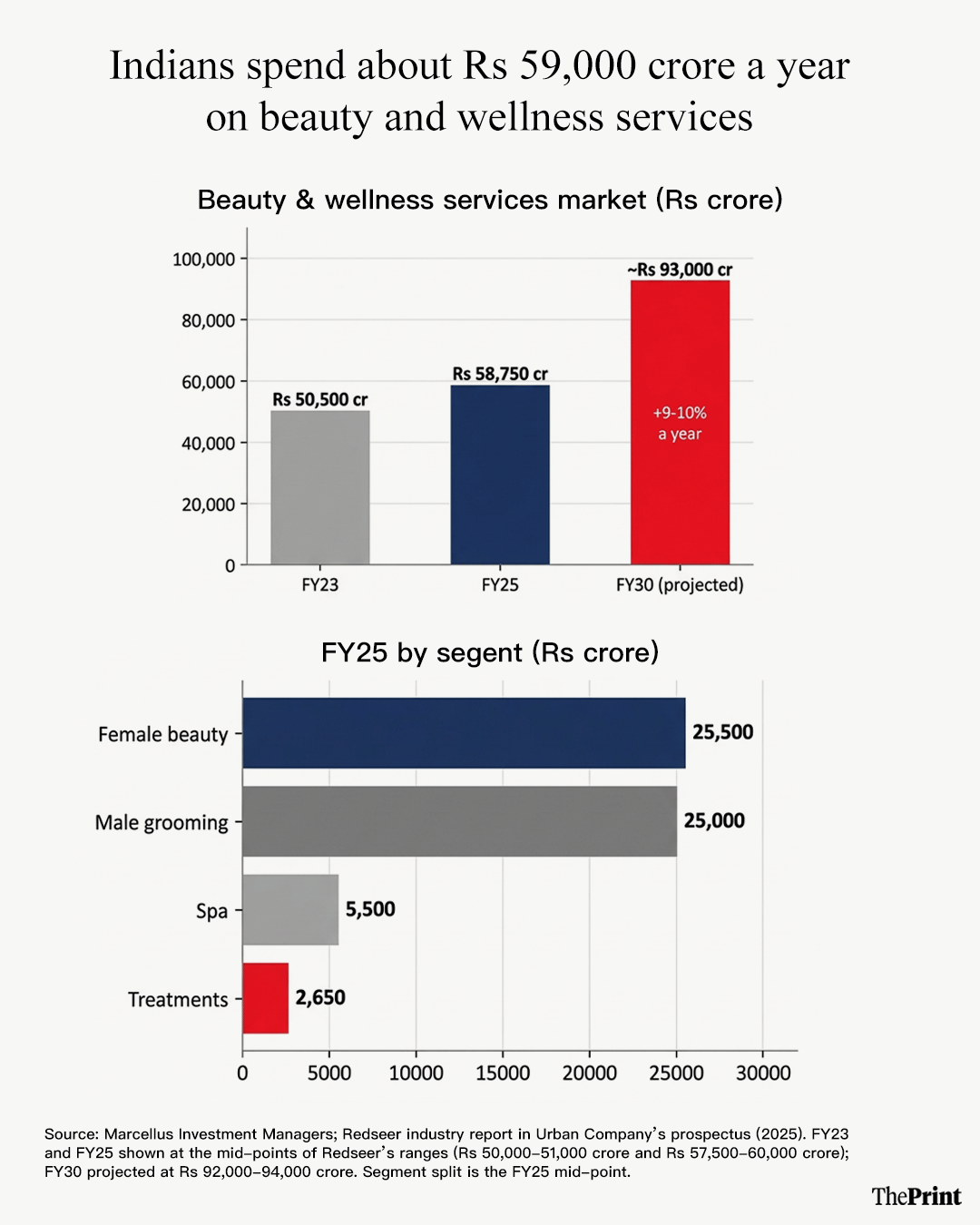
Rs 59,000 crore industry growing at 9-10 % a year
A report by Redseer Strategy Consultants puts Indian spending on beauty and wellness services at Rs 57,500-60,000 crore in FY25, up from about Rs 50,500 crore two years earlier. Redseer expects this to grow at 9–10 percent a year to Rs 92,000-94,000 crore by FY30. Hair and skin care for women and grooming for men make up most of this while spas and treatments such as laser hair removal make up the rest.
The government’s survey data backs this up. India’s small, unincorporated salons and parlours alone had a turnover of Rs 56,800 crore in 2023-24, double the Rs 27,600 crore of 2015-16.
Shruti Naithani/ThePrint
Interestingly, the products that salons use are growing faster than the salons themselves. Based on Kline & Company’s data, the sales of professional hair products in India is estimated to have grown from around Rs 825 crore in FY16 to Rs 3,160 crore in FY26, or about 14 percent a year. Adjusted for personal care inflation (excluding gold and silver, which distort the official index), volumes have grown at around 10 percent a year. We come back to why this matters later.
Nearly 20 lakh salons, most of them run by one person
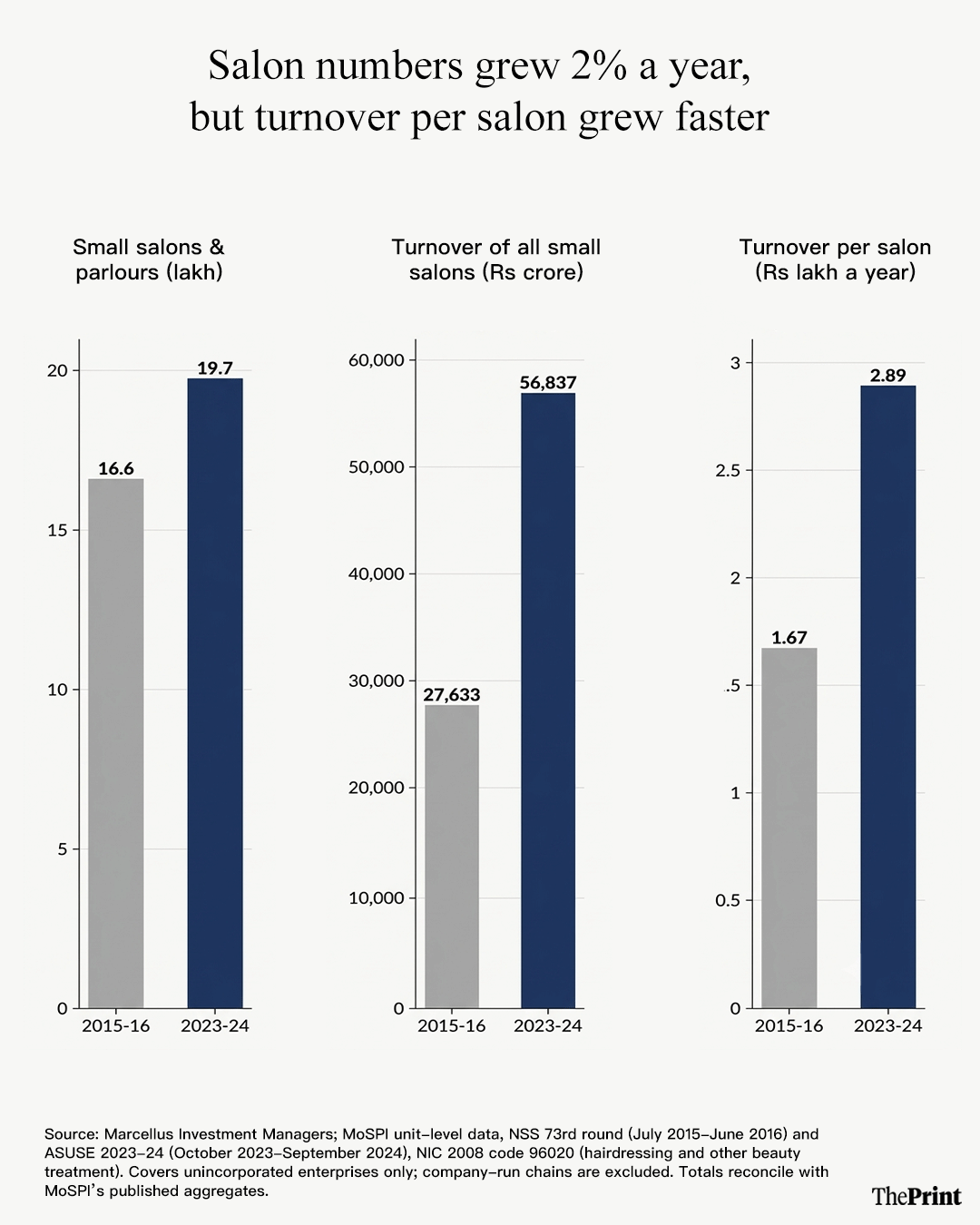
Unit-level data from the government’s surveys of unincorporated enterprises (NSS 73rd round for 2015-16 and ASUSE for 2023-24), estimate 19.7 lakh salons and parlours in India in 2023-24, up from 16.6 lakh in 2015-16. They employ about 27.5 lakh people, and around 85 percent of them are run by just one person.
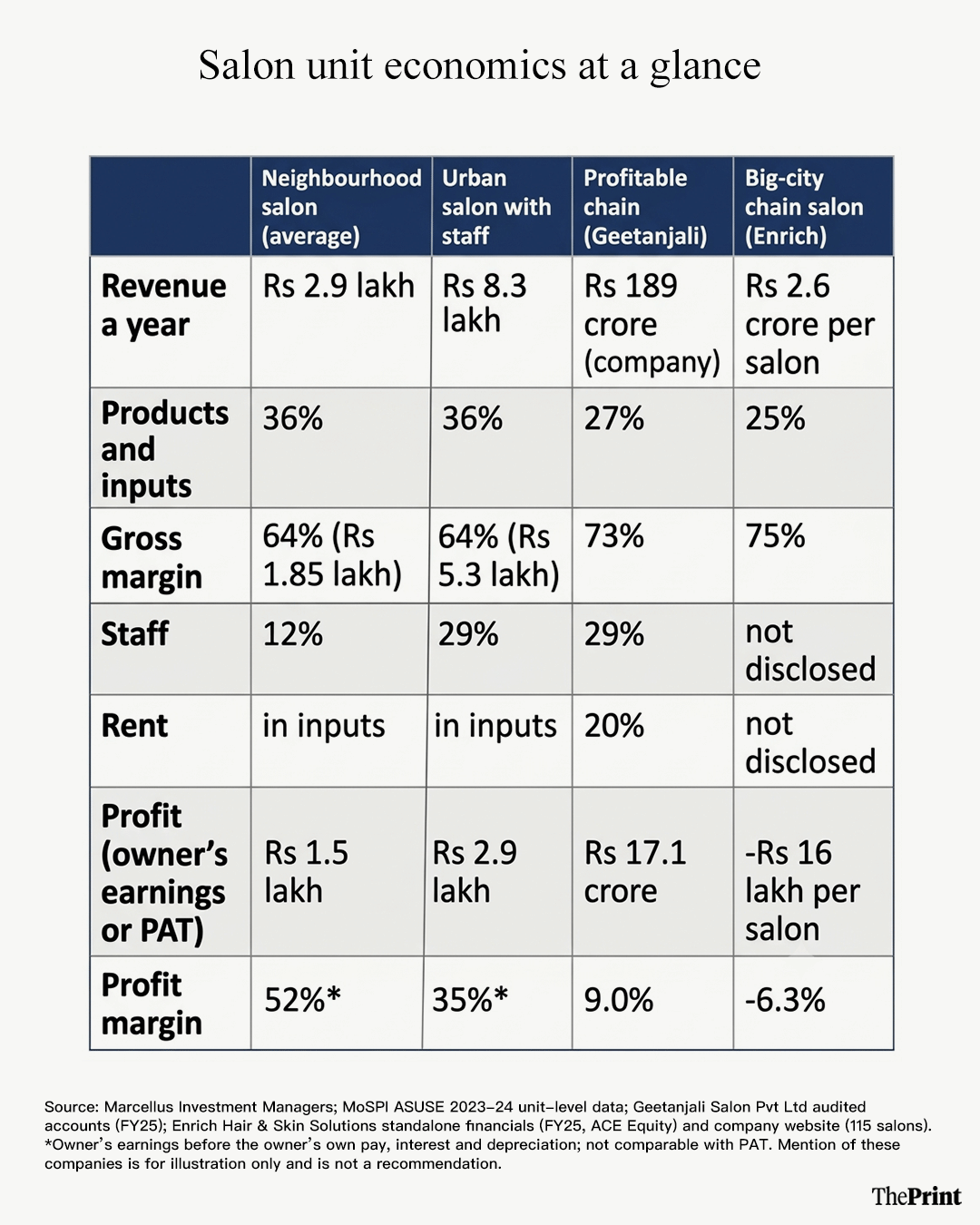
The average salon has a turnover of about Rs 2.9 lakh a year, up from Rs 1.7 lakh in 2015-16. An urban salon with hired staff generates revenues about Rs 8.3 lakh. At the other end, a salon run by a premium chain like Enrich has revenues of about Rs 2.6 crore.
Shruti Naithani/ThePrint
How does a salon make money?
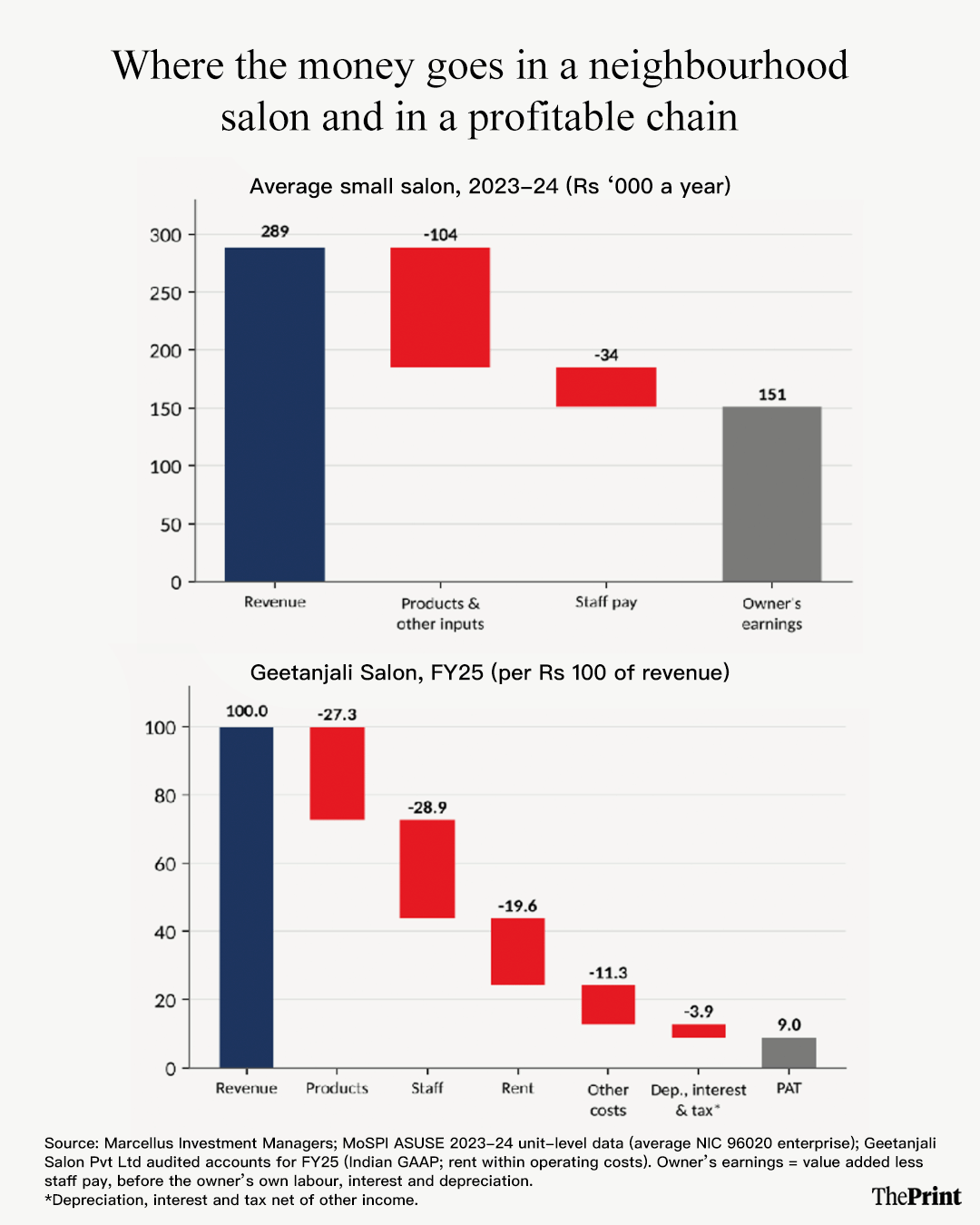
A salon is essentially selling the time of skilled people in a rented chair. For the average small salon, products, electricity and other inputs take up about 36 percent of the Rs 2.9 lakh turnover, or around Rs 1 lakh a year. That leaves a gross margin of about 64 percent—about Rs 1.85 lakh per salon. As most salons are run by the owner alone, salaries to staff take up about 12 percent of turnover on average. The figure is closer to 29 percent in an urban salon with staff. What is left is around Rs 1.5 lakh a year or about half of the turnover. That is what the owner takes home, and this has to pay for her own time.
The chains look very different. At Geetanjali Salon, one of the few salon chains that is profitable, products take up 27 percent of revenue (leaving a gross margin of 73 percent), staff 29 percent, rent 20 percent and other costs 11 percent. That leaves an EBITDA (Earnings Before Interest, Taxes, Depreciation, and Amortisation) margin of about 13 percent and a net profit (PAT) margin of about 9 percent in FY25.
But a chain that runs all its salons by itself in big cities can lose money. Enrich’s salons have a turnover of about Rs 2.6 crore each, yet each lost around Rs 16 lakh in FY25.
Not everyone is getting rich
In the piece on auto dealers, it was estimated that the average dealer earns around Rs 76 lakh a year, about seven times what the average middle-class taxpayer earns. Compared to that, the average salon owner takes home around Rs 1.5 lakh, about one-seventh of what that taxpayer earns. The freelancers we spoke to told us that their rates have not gone up for a decade, ever since app-based home services arrived.
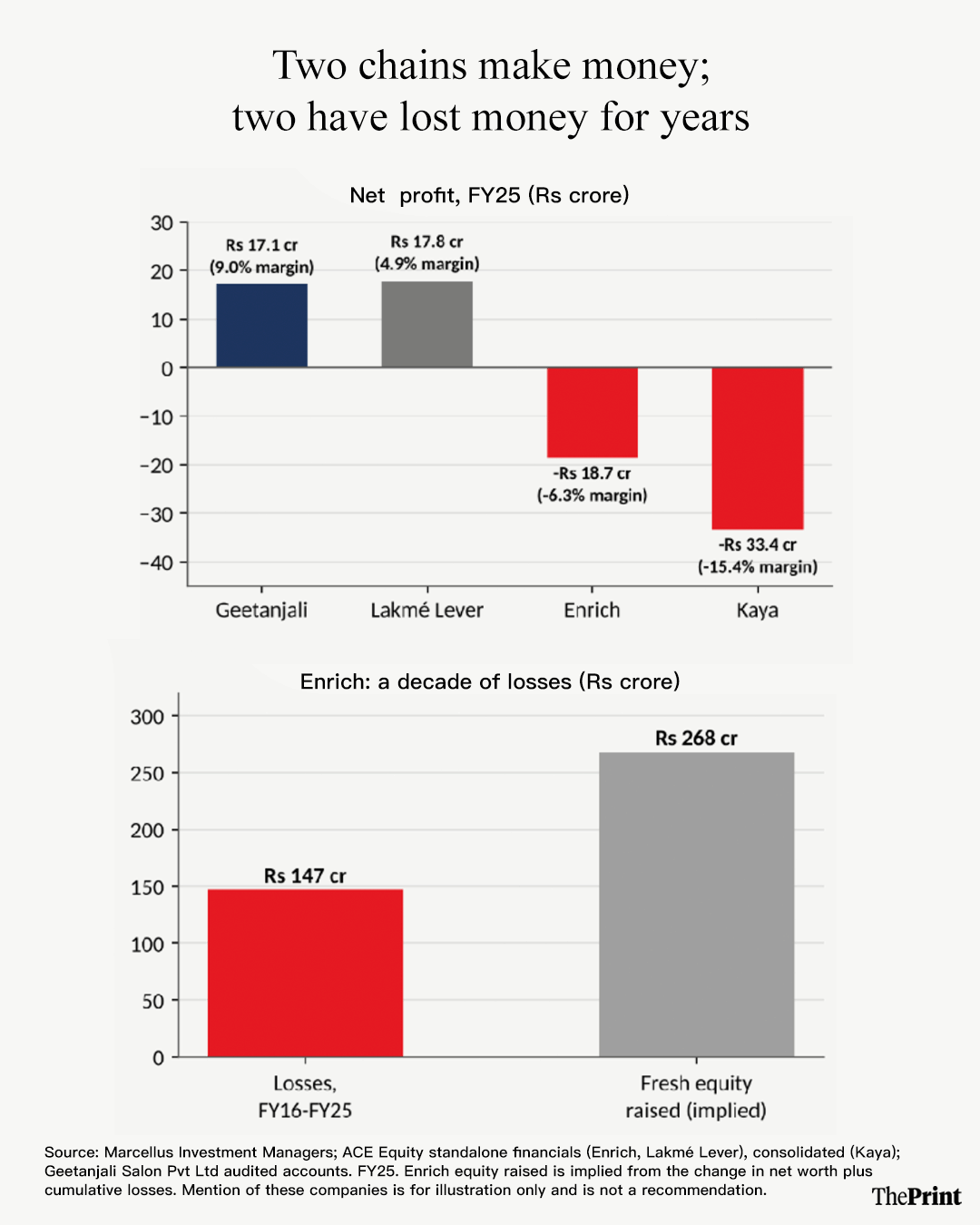
Being big doesn’t necessarily help either. Enrich, a reputed chain with 115 salons across seven cities, all of which the company runs itself, has reported a net loss every year since FY13. Since FY16, it has lost about Rs 147 crore, funded by Rs 268 crore of fresh equity. Kaya, the listed chain of skin clinics, lost Rs 33 crore in FY25 and has a negative net worth. On the other hand, Geetanjali and Lakmé Lever (Hindustan Unilever Limited’s salon business) made around Rs 17–18 crore of PAT each.
So who is making money?
If a growing market isn’t enough, then who is making money in this industry? What do they look like? What does it take to succeed, and where do you need to be? Three answers arise after putting together the survey data, company filings and conversations with beauticians in Mumbai.
1. Franchise the salon and sell the product
The most profitable salon brands don’t bear the full cost of every salon. Geetanjali started with a single salon in Delhi in 1989 and now has more than 200 salons in over 50 cities, many of them run by franchisees who put up the money for new salons. Its revenue has grown nearly four-fold from Rs 48 crore in FY22 to Rs 189 crore in FY25, and it has funded this growth from its own cash flows.
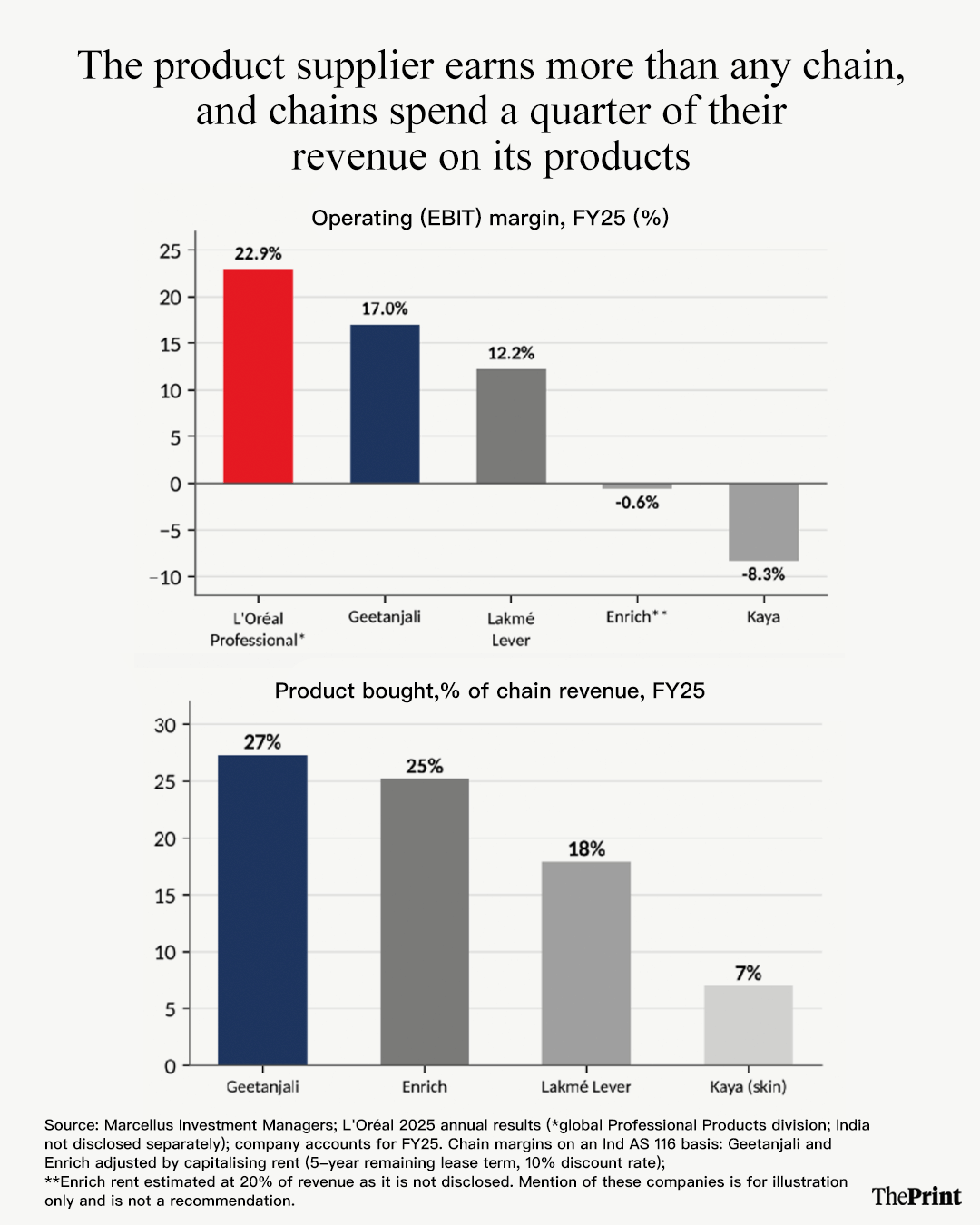
The real difference in profitability becomes clearer when the salon chains are compared on the same accounting basis. If all the four chains—Geetanjali, Lakmé, Enrich and Kaya—are taken on the same accounting basis considering the Indian Accounting Standard 116 which treats rent as a financing cost, Geetanjali’s operating margin is about 17 percent and its pre-tax Return on Capital Employed (RoCE) is about 21 percent—meaning its PAT is around Rs 17 crore. Lakmé Lever earns about 12 percent operating margin and 10 percent pre-tax ROCE.
The companies that supply salons with products are doing even better. Hair salon chains spend 18-27 percent of their revenue on products. Geetanjali alone pays its suppliers around Rs 50 crore a year. L’Oréal’s Professional Products division, the market leader in India, made an operating margin of 22.9 percent globally in 2025, higher than any of the Indian salon chains we looked at. In FY25 the brands gave Geetanjali about Rs 3.2 crore of products for free to keep their business.
2. Go where rents are low and demand is rising
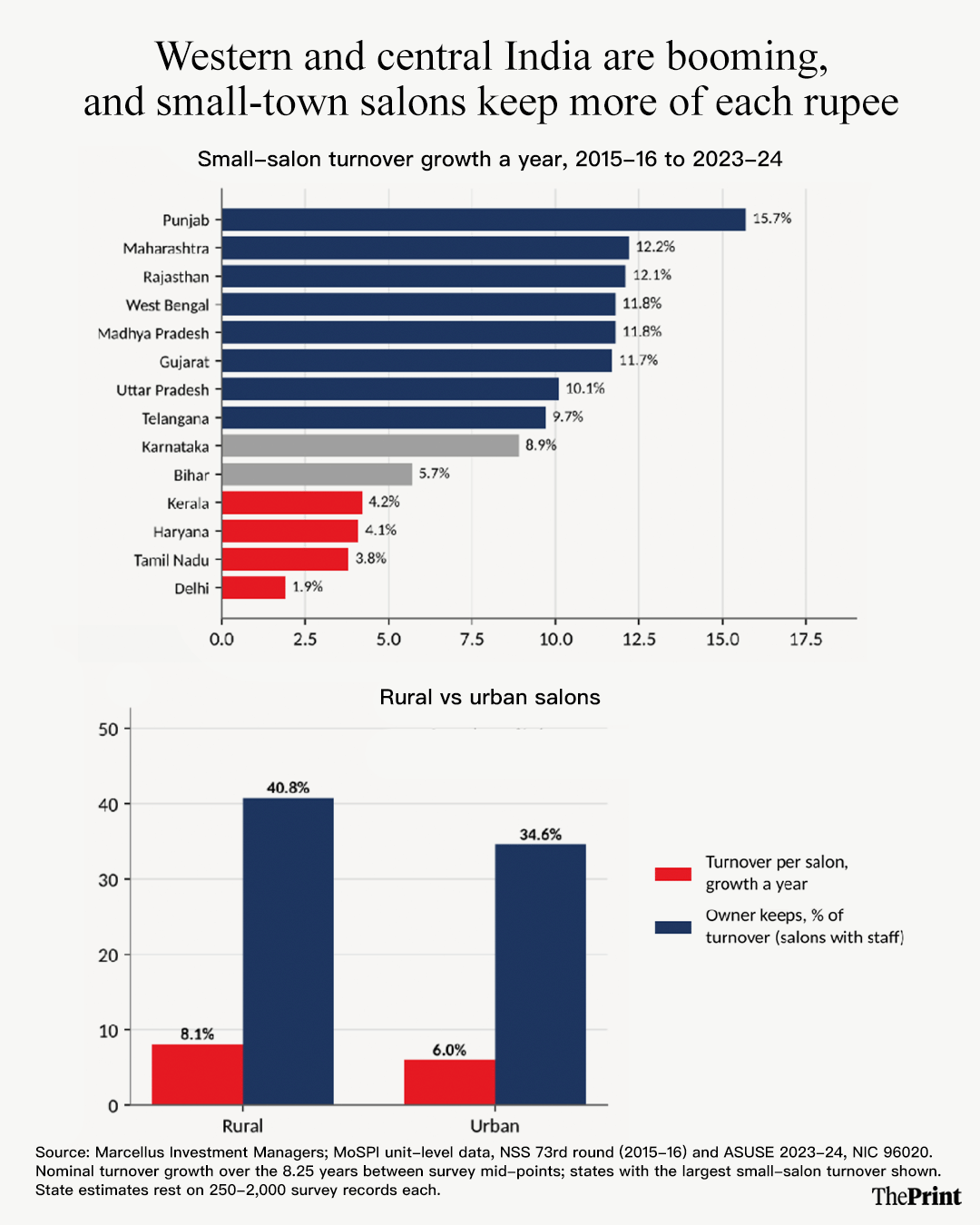
As with auto dealers, location matters. Turnover of small salons grew fastest in Punjab (16 percent a year), followed by Maharashtra, Rajasthan, Gujarat and Madhya Pradesh (around 12 percent each). In contrast, in the megacity of Delhi, turnover barely grew. Turnover per salon grew faster in rural India (8.1 percent a year) than in urban India (6.0 percent).
Rural salons with staff also keep about 41 percent of every rupee as the owner’s earnings, against 35 percent in cities. Rents are much lower in smaller towns, whereas prices are not proportionately lower.
The chains tell the same story. Geetanjali and Lakmé, both profitable, are expanding into tier-2 and tier-3 cities through franchisees. Some of Geetanjali’s recent openings were in Ludhiana, Chandigarh and Bhubaneswar. Enrich and Kaya run their own outlets in big cities where high rents and the cost of premium staff have eaten into their margins.
3. Back skills with franchise or app, which is what women are doing
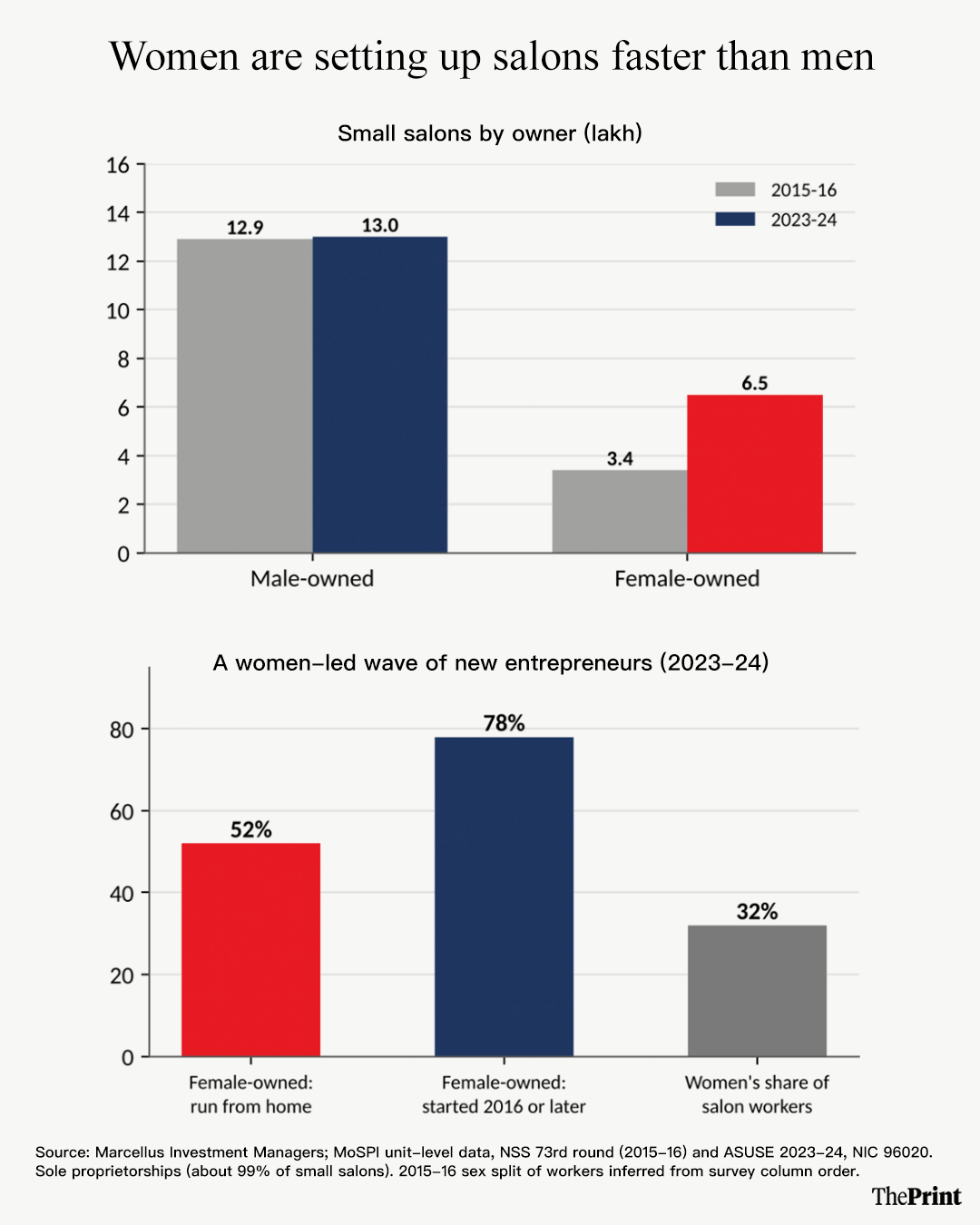
A large number of the fastest growing salons in India are owned by women. The number of women-owned salons nearly doubled from 3.4 lakh in 2015-16 to 6.5 lakh in 2023-24, and their turnover grew at 13 percent a year, against 8 percent for salons owned by men. More than half of women-owned salons are run from home, and nearly four in five were started in 2016 or later. Women now make up 32 percent of the people working in salons, up from 22 percent. Salons run by a single person, most of them women, account for about half of the increase in the industry’s turnover.
Skills matter, but they are not enough on their own. A recognised qualification lets a beautician charge more. A franchise brand, or an app like Urban Company (which has about 59,000 service partners active every month across all its categories), gets her a steady stream of customers, along with training and pricing. Without that, a skilled freelancer ends up competing her rates with those offered by apps. The two women we met in Mumbai show both sides of this.
Meet two beauticians from Mumbai
Neepa Rawat: Skilled, certified, and stuck
Neepa Rawat learnt beauty treatments at a neighbourhood parlour in 2006 and worked there until 2012, arranging home appointments on the side. Her clients liked her work so much that they pushed her to go out on her own, and by 2011-12 she was freelancing full time. When her clients started asking for advanced make-up, she went back to studying. A course at a celebrity make-up artist’s academy taught her very little, so she kept looking, and in 2019 she earned an international media make-up diploma from CIDESCO—the globally-recognised standard for beauty and spa therapy education.

Rawat now has around 250 clients and charges at least Rs 1,000 a visit. She sees 15-20 clients in a typical month and up to 50 in the wedding season. She has spent about Rs 2 lakh setting up a small parlour at home and owns make-up worth Rs 3.5-4 lakh. After travel and materials, she says she keeps about 25 percent of what she bills as gross margin and about 10 percent as profit. That puts her revenue at roughly Rs 2-3 lakh a year, close to the national average for a small salon. She had to stop working during Covid, and when she restarted, the market had changed.
Her rates, she told us, have barely moved in ten years as Urban Company and other competitors have come in. She lives in Goregaon, in a chawl that is being redeveloped, and will move into a 1BHK flat once it is done. Rawat’s story is a reminder that skills and certificates on their own don’t give a beautician the power to raise her prices.
Priya Singh: From a life of despair to Rs 1 lakh a month
Priya Singh (name changed) was 15 when she lost her father to tragic circumstances in 2005. Home became a cruel place after that, and with nowhere else to go, she married young. She was physically assaulted by her husband and she faced harassment from her in-laws as well. She could not pass Class 10 but had learnt beauty work at a salon in 2008-09.
Her in-laws did not allow her to work after her marriage and for the next decade, she put up with the abuse and with her husband’s affairs, hoping that a second child would make things better. It didn’t. Around 2018-19, while she was still nursing their second son, he left her for another woman.
By 2021 she had had enough. Her in-laws still wouldn’t let her work, so she quietly put aside around Rs 1 lakh from the family’s milk distribution business and left home to stay with a friend. She had decided that she would start working whether or not her family found her.
They did find her, and brought her back because of her two boys, but this time she didn’t back down. She got 5,000 pamphlets printed to advertise her services. Only one client called. Then a friend who worked at Urban Company told her that customers now book beauticians through the app. Priya then cleared the interview, spent Rs 30,000 on a month of training and started working.
The first thing she bought was a gold chain worth Rs 60,000. Then came a bed and an almirah worth Rs 25,000, followed by a pair of gold earrings worth Rs 80,000 and, last Diwali, a gold ring worth Rs 1.6 lakh. As she listed these purchases, her voice grew louder and more confident.
Today, she earns about Rs 3,500 a day after costs and works particularly hard on weekends, bringing her monthly income close to Rs 1 lakh, or about Rs 12 lakh a year. That is around eight times what the average small salon owner earns and more than the average middle-class taxpayer. Some of her customers have helped her start investing in mutual funds. Her sons wear branded clothes, and last Diwali, they burst crackers worth tens of thousands of rupees. She had tears in her eyes as she told us this.
Singh says her struggle is far from over. Her next goal is to own a house.
Her message to young women everywhere is blunt: “Once a bad apple, always a bad apple. He won’t become better after kids. Run away immediately. Don’t settle for less, and if you’re hardworking, there’s a whole world out there and a way out for you.”
India: A parlour in every lane, a queen in every parlour
India’s beauty and wellness market, valued at around Rs 59,000 crore and growing at 9-10 percent a year, is spread across nearly 20 lakh salons, making it one of the most widely owned businesses in the country. But, as we have seen, a growing market does not make everyone rich. The money is going to brands that franchise their salons and the companies that supply them, to salons in towns where rents are low and demand is rising, and to beauticians who have paired their skills with a franchise or an app. A salon brand that spreads across districts through franchisees is another tentacle of the small-town ‘Octopus’ described in our book, Behold the Leviathan. And women like Priya, building a business one client at a time, are among the newest of India’s new Kings & Queens.
Nandita Rajhansa and Saurabh Mukherjea work for Marcellus Investment Managers. The views and opinions expressed in this material are those of the authors and do not necessarily reflect official policy.
(Edited by Chingkheinganbi Mayengbam)
Also Read: Indian consumption is being rebuilt on 3 pillars—the new elite, household debt, govt cash transfers