





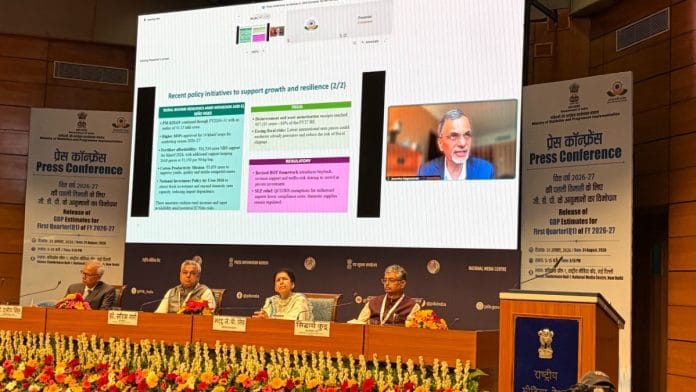

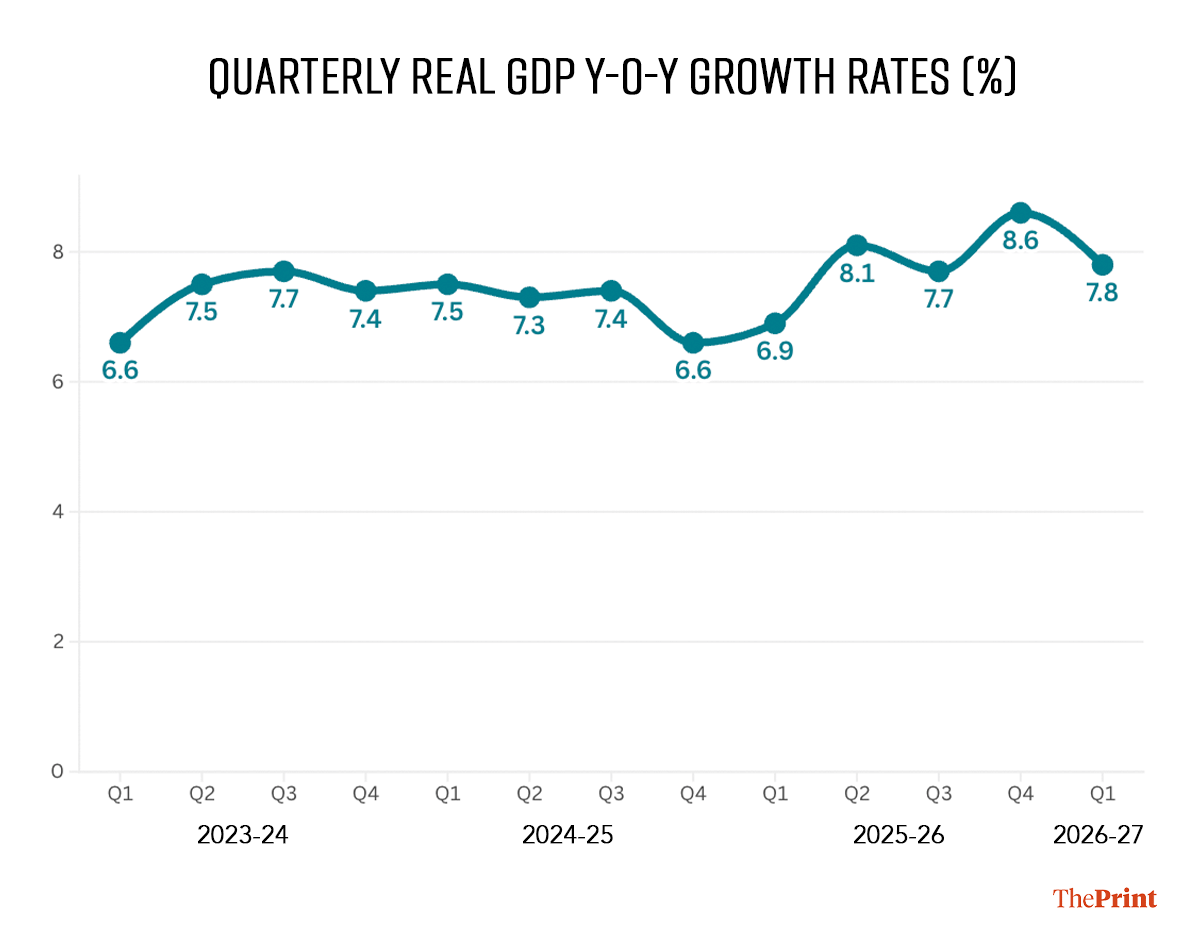
New Delhi: India’s economy grew 7.8 percent in the first quarter of FY 2026-27, beating expectations and the Reserve Bank of India’s forecast of 7 percent, as resilient domestic demand, investment, manufacturing and exports helped the economy withstand higher energy costs and continuing geopolitical uncertainty.
The Ministry of Statistics and Programme Implementation (MoSPI) released the GDP data Monday.
Chief Economic Adviser V. Anantha Nageswaran said the latest numbers showed “continued resilience” in India’s growth performance, with the quarterly data also supported by high-frequency indicators such as GST collections, bank credit, purchasing managers’ indices and export growth.
“The quarterly real GDP numbers in general, after a slight lull towards the latter part of 2024-25, have picked up quite well and have weathered global uncertainties rather well,” Nageswaran said, addressing a press briefing virtually from the US.
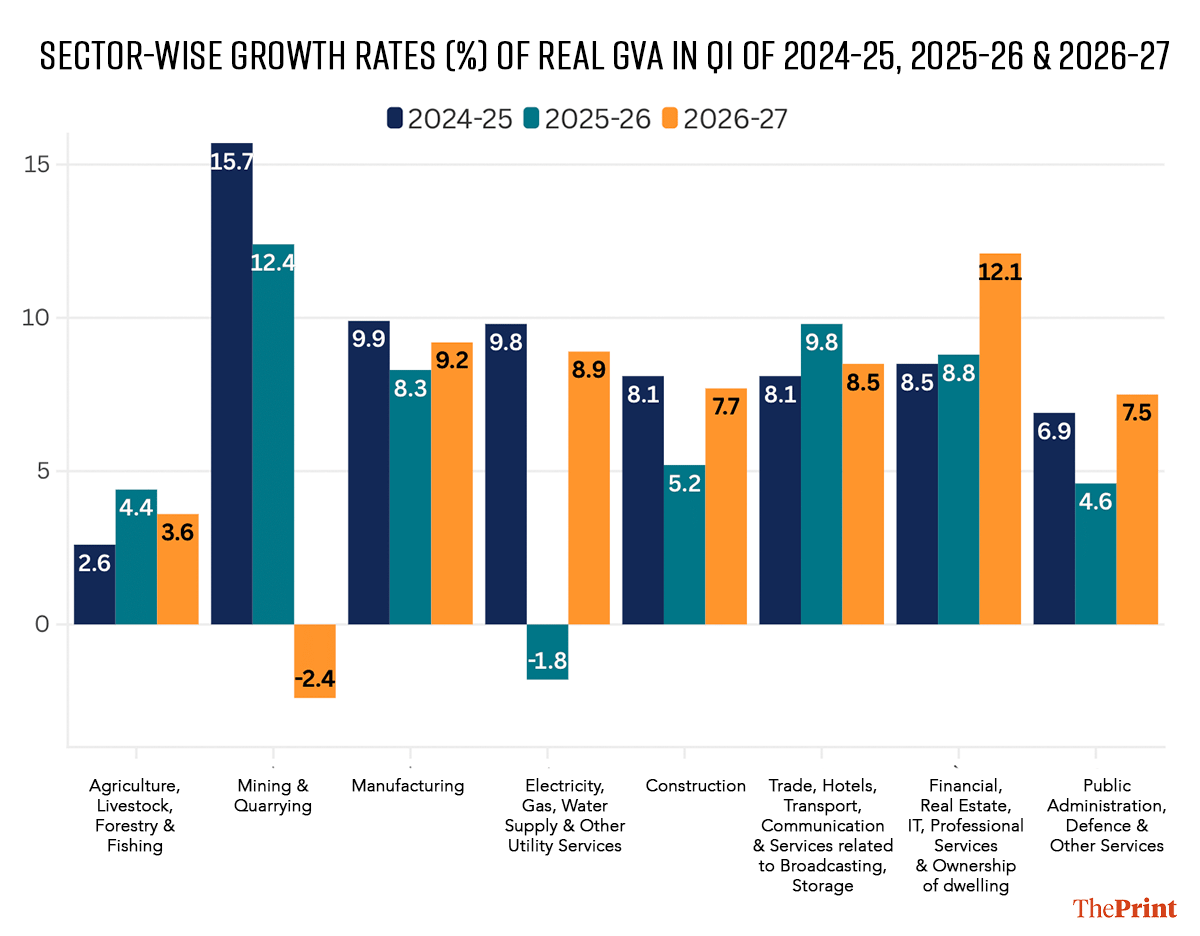
The Q1 performance was supported by all three broad sectors, with manufacturing and services remaining particularly strong despite uncertainties arising from the West Asia conflict, while agriculture made a smaller contribution.
Manufacturing grew 9.2 percent, while construction expanded 7.7 percent. The services sector grew 10 percent.
Exports of goods and services grew 12 percent in real terms in Q1, compared with 6 percent in the same quarter the previous year, providing another key support to growth amid global uncertainty.
Nageswaran said the resilience was also visible in exports. Merchandise exports excluding oil, gold, gems and jewellery have grown briskly in the first few months of the financial year, he said.
“Manufacturing exports are not driven by oil and gems and jewellery,” he said, adding that this could reflect the benefits of free trade agreements, export diversification, and improving competitiveness, innovation and productivity in Indian manufacturing.
Private final consumption expenditure (PFCE), which measures household spending on goods and services and is an indicator of domestic consumption demand, grew 7.1 percent in Q1.
Nageswaran pointed to automobile purchases as one indicator of buoyant demand, with rural and urban sales of two, three and four-wheelers showing strong growth in recent months.
Investment was another major pillar. Gross fixed capital formation (GFCF), which measures spending on fixed assets such as machinery, equipment and infrastructure, grew 11.9 percent in Q1, sharply up from 5.8 percent a year earlier.
However, the composition of investment remains an area that needs attention.
The increase has been mainly supported by government capital expenditure and infrastructure spending, which are policy-driven and less exposed to global shocks, according to Valbha Shakya, project adviser for Finance at the Centre for Social and Economic Progress (CSEP), a New Delhi-based policy think tank.
This government-led investment has helped cushion the economy even as private capital expenditure remains subdued, Shakya said, adding that private investment needs to take over from government capex to sustain growth in the coming quarters.
Also Read: Growth, inflation & the gaps in between: What latest RBI annual report says about where India stands
Oil remains a risk, but impact so far muted
Nageswaran said the impact of the West Asia conflict on crude oil prices had so far been more muted than initially feared, helped partly by weaker Chinese demand and the release of strategic petroleum reserves by the US and other countries.
However, he cautioned that disruptions could last longer than expected, creating a persistent risk of crude supply disruptions. Brent crude prices may consequently struggle to fall materially and sustainably below $80 a barrel, he said. Higher energy costs could weaken consumption in Europe and the US and, in turn, pose a risk to India’s export growth.
“Globally prices of petroleum products could pose a risk to global demand and therefore on the prospect for export growth in the coming years,” Nageswaran said.
However, India’s domestic momentum remains strong. Nageswaran said manufacturing, services, bank credit, GST collections and export data were broadly reinforcing the Q1 GDP numbers.
Agriculture has also performed better than feared despite concerns over deficient rainfall due to El Nino conditions. He said sowing activity was only marginally below last year’s levels across several crops, which could support agricultural output, although the impact on the rabi crop remains to be seen.
CSEP’s Shakya said the outlook for the rest of FY 2027 remained positive, although growth could moderate in the coming quarters. “If oil prices retreat, the monsoon improves, inflation remains contained and private capex accelerates, growth could remain around 7 percent or higher,” she said.
However, she flagged subdued private investment, headline inflation, India’s vulnerability to energy costs and volatile rainfall as key risks to sustaining growth.
(Edited by Amrtansh Arora)
Also Read: India can add $700 bn to $1.4 trn to GDP with higher female workforce participation, says CSEP study