



New Delhi: Japanese Prime Minister Sanae Takaichi earlier this week concluded her three-day official visit to India during which she attended the 16th India-Japan Annual Summit and held talks with New Delhi on boosting cooperation in artificial intelligence, metals, energy and defence. India and Japan, she told reporters, will “leverage each other’s strengths to grow strong and prosperous together”.
Takaichi’s visit was preceded by Prime Minister Narendra Modi’s official visit to Tokyo last August for the previous edition of the India-Japan Annual Summit.
But between the two official visits, the Japanese government in March this year committed an Official Development Assistance (ODA) loan of Rs 16,420 crore to India for four projects in the sectors of urban transport, health and agriculture.
These projects, to be implemented in Punjab, Karnataka and Maharashtra, brought back focus to the ODA programme, which has been a longstanding beacon of cooperation between India and Japan. India was the first nation to receive ODA loans in 1958. Against this backdrop, ThePrint looks at ODA, which symbolises and continues to strengthen the influence of Japanese soft power in India.
Also Read: 3 ways India-Japan relations can go beyond familiar adjectives of ‘natural’ and ‘special’
What is ODA?
The ODA programme evolved after Japan joined The Colombo Plan in 1954. Its aim was to facilitate economic and technical cooperation among member countries of the British Commonwealth of Nations. The early ODA loans were mainly aimed at promoting friendly relations with Asian countries.
The Official ODA Charter that outlines the current form of the programme, was adopted in 1992. It incorporates the philosophies and objectives of Japan’s foreign aid which have evolved over the years. The charter lists four principles for ODA implementation: humanitarian considerations, recognition of interdependence among nations of the international community, environmental consideration, and support for self-help efforts of recipient countries.
Officially, ODA is defined as government-backed financial assistance provided on concessional terms—low interest rates, long repayment periods, and grace periods—to promote economic development and welfare in developing countries.
The programme objectives are achieved through three methods: ODA loans (Yen-denominated), grants, and technical assistance (training, technology transfer, institutional capacity building).
Japanese ODA is primarily administered through the Japanese International Cooperation Agency (JICA), which is also the nodal agency for ODA in India.
ODA vs FDI
ODA provides government-to-government funding for public infrastructure, the primary motive being to promote economic development, stability, and human welfare in partner countries.
Foreign Direct Investments (FDI), on the other hand, represents private corporate capital used to establish businesses and operations abroad with profits, new markets and expanding global operations being the driving force.
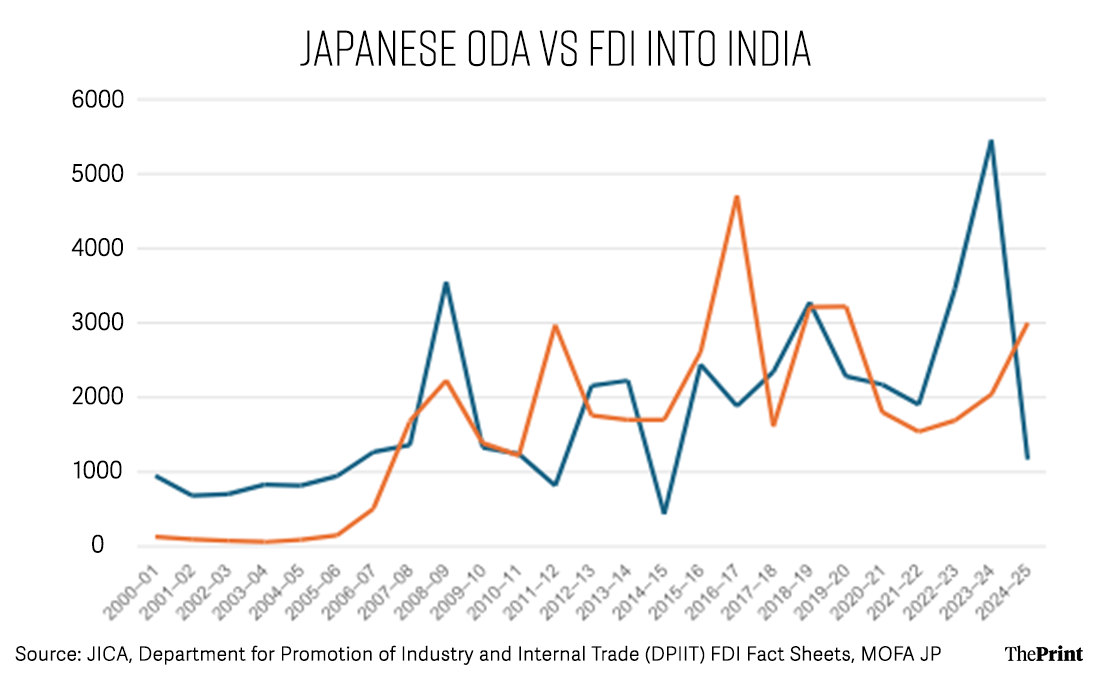
Japanese Foreign Direct Investment (FDI) into India has seen a significant increase since 2005, signalling a shift of India’s position from developmental aid beneficiary via ODA to a more equal economic partnership.
Cumulative Japanese FDI into India (2000-2025) is approximately US$44-45 billion, accounting for around 6 percent of total FDI equity inflows into India.
Both ODA and FDI are complementary tools in the Japanese economic toolkit. While both help in building relations with countries, ODA helps in establishing closer ties as they represent the riskier, long term developmental partnerships between governments.
Analysts of ODA in a peer-reviewed study published in the journal Frontiers in 2024 asserted that Japanese ODA promotes the inflow of Japanese ODI, especially into India. They argued that the direct and indirect effects of ODA on economic infrastructure and the effect of securing paid financial assistance project orders can be identified as FDI-promoting effects.
Also Read: ‘Limits’ of India-Japan ties & Modi’s honours spree, ‘sometimes as 1st & only recipient’
ODA statistics and its focus areas
From joining the Colombo Plan in 1954 to until 2019, Japan’s gross ODA disbursement was approximately USD 550.5 billion worldwide, extended to 190 countries.
OECD preliminary data for FY 2024-25 states the total disbursement of Japanese ODA stands at USD 16.2 billion, representing 0.35 percent of Japan’s gross national income (GNI).
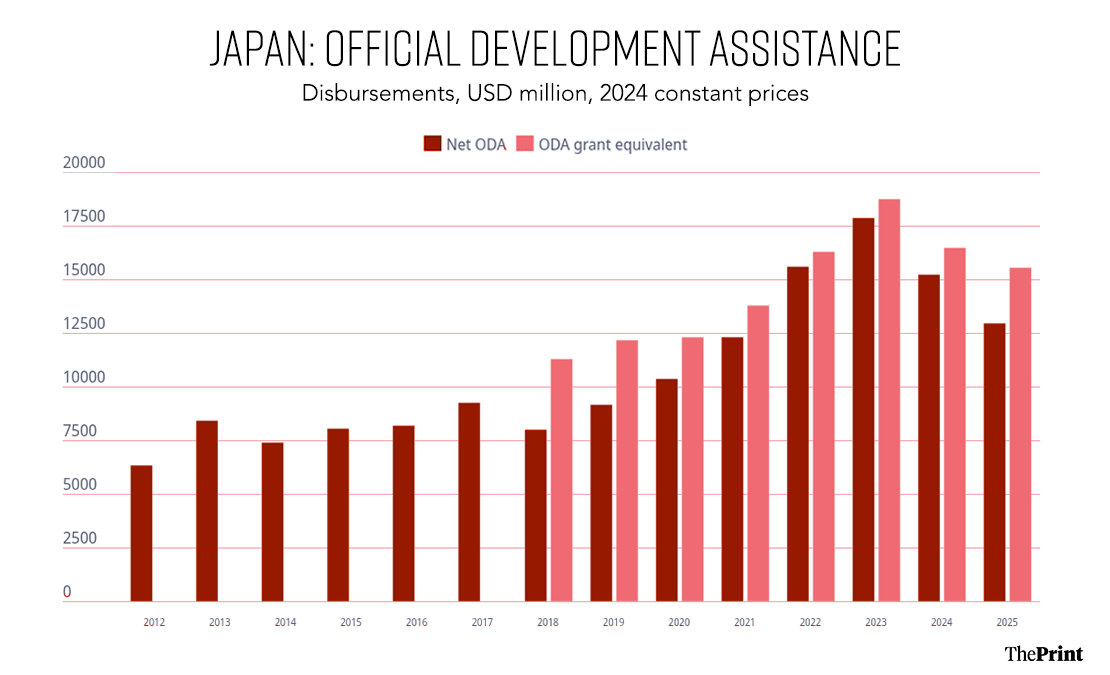
However, there has been a downward trend of ODA disbursement in the past three years, with the OECD noting that part of the decrease reflects depreciation of the yen against the US dollar.
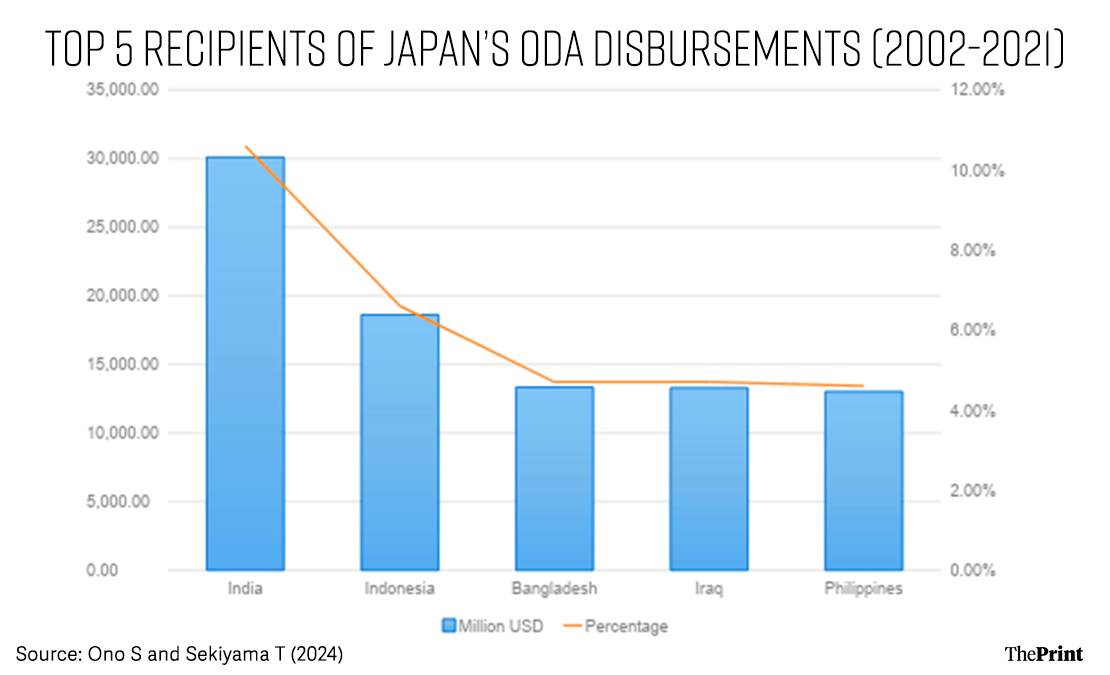
The total JICA financing in India during FY2024-25 for India stood at USD 1.7 billion across seven projects. This includes the developmental agreements signed in March 2026 involving the Bengaluru Metro Rail Project (Phase 3), Mumbai Metro Line 11 Project, construction of tertiary care facilities, college, hospitals, medical colleges, and nursing schools in Maharashtra and another project to promote sustainable horticulture in Punjab.
This represented about 10.4 percent of the total disbursement of FY 2024-25, the most among all recipients. This trend has been similar for the past two decades.
It is interesting to note that Japanese ODA supported India’s push for economic reforms and liberalisation in the 1990s, with an estimated USD 1 billion invested just in 1991-92. The Pokhran-II tests of 1998 led to a temporary suspension of new ODA commitments owing to Japan’s strict non-proliferation policy but relations were normalized in the early 2000s with Japan resuming large-scale ODA into India.
JICA started accelerating large-scale infrastructure financing in India after establishing the Global Strategic Partnership in 2006. This elevated bilateral framework between India and Japan, and deepened cooperation in security, defense, and economic engagement.
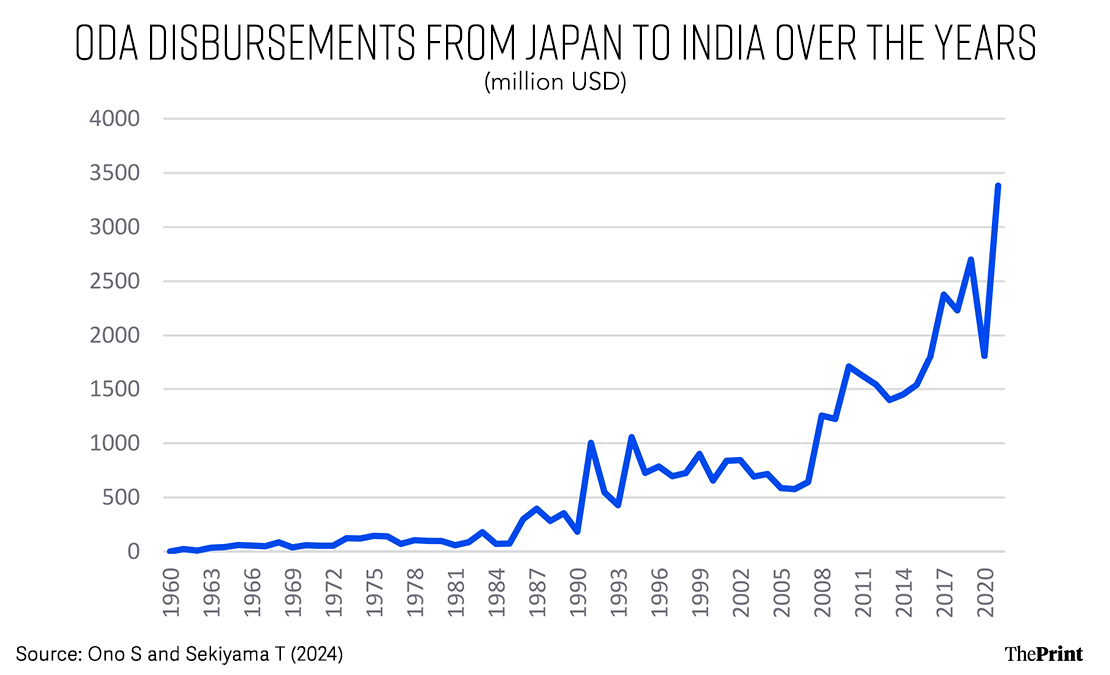
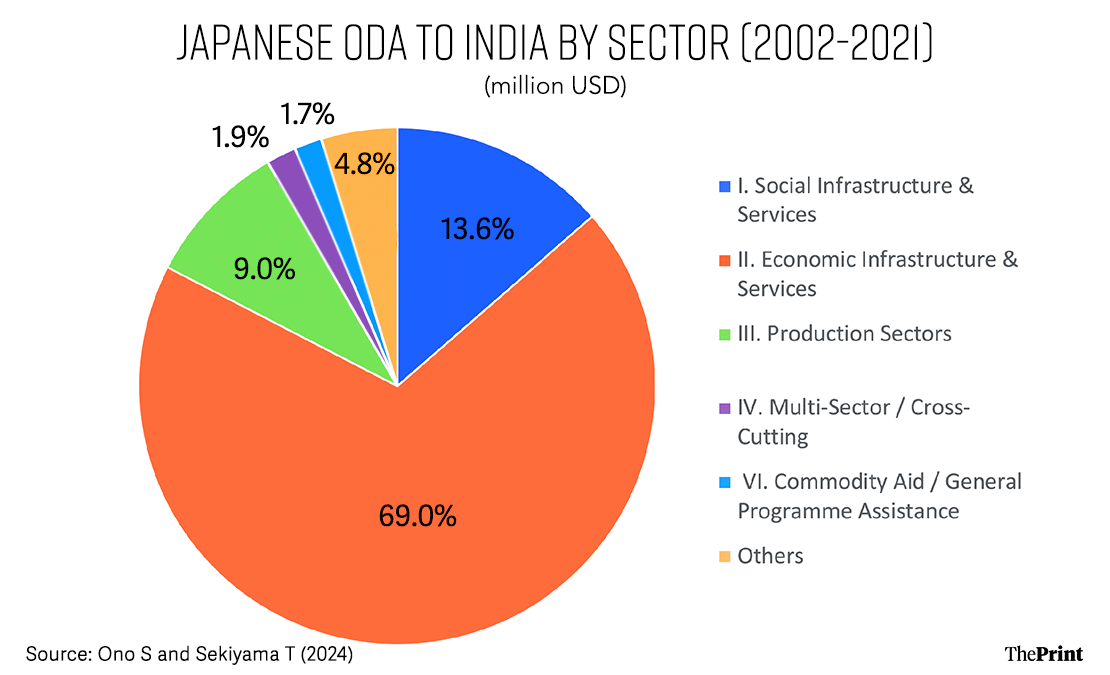
The flagship projects of the ODA programme in India include the successful Delhi Metro, for which Japan has committed approximately USD 5.7 billion since 1997, and the under-development Mumbai-Ahmedabad High-Speed Rail, where JICA has signed an additional USD 2.4 billion loan agreement in 2023. While the majority of the funds is for economic infrastructure projects, ODA is not limited to that sector.
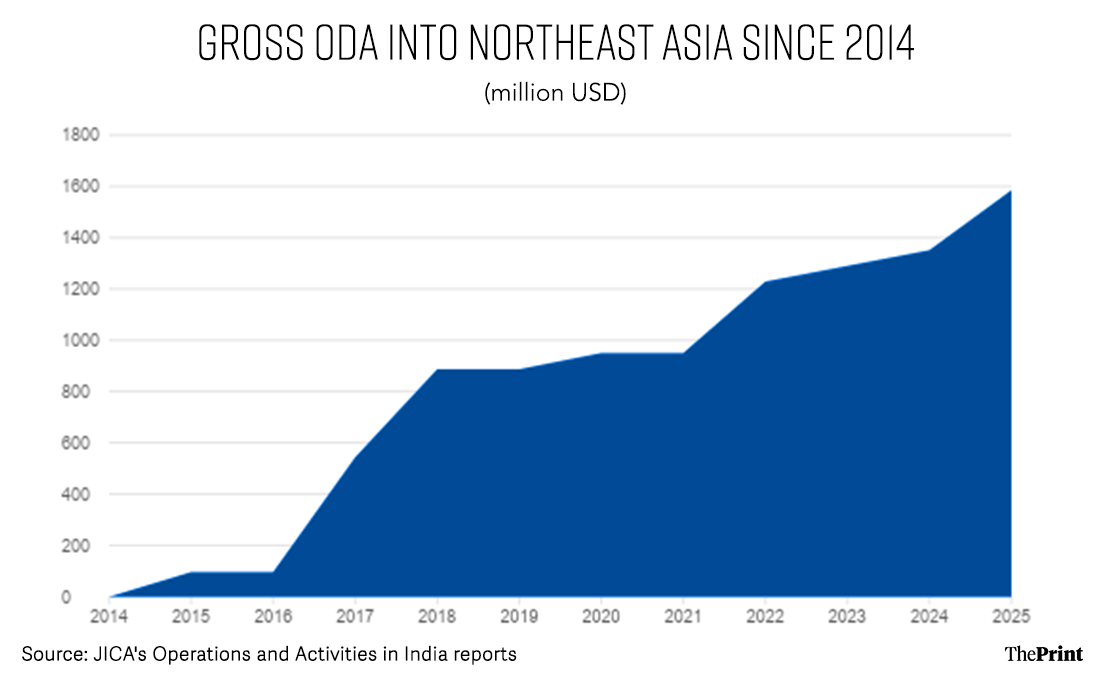
Northeast India has emerged as a priority destination for ODA in recent years, with a gross estimate of USD 1.6 billion invested in the region since 2014. That is more than half of the total ODA commitments of USD 2.9 billion into the region.
The move represents a welcome intersection of India’s Act East policy, with its view of the Northeast as the gateway to Southeast Asia, and Japan’s vision of Free and Open Indo-Pacific (FOIP).
Also Read: Takaichi in Delhi: From China to supply chains, what’s driving India & Japan’s strategic partnership
High ODA to India: Reflection of Indo-Japan relations
The significant gross level of ODA into India till date reflects the continuity of India’s historical acceptance of Japanese developmental aid even during the protectionist era which preceded the 1991 reforms, when inflow of foreign investments was tightly regulated.
India welcomed Japanese ODA because it provided capital, technology, and infrastructure finance while preserving domestic ownership and policy autonomy.
This aligned with India’s state-led planning model.
For Japan, India represents a major future consumer market and a viable alternative production base as companies diversify supply chains beyond China.
Furthermore, ODA improves India’s business environment, supports Japanese companies investing in India, enhances trade and logistics, and expands markets for Japanese technology and engineering.
India and Japan are strategic partners in the Indo-Pacific with shared democratic values and market-oriented economies. Japan views India as a key partner in promoting a Free and Open Indo-Pacific (FOIP), and ODA helps build the infrastructure and connectivity needed for achieving this.
The China factor
Japan used to provide large-scale ODA to China for three decades starting from 1979. An estimated USD 24.5 billion was invested during this period. New ODA commitments were officially ended in 2008 as China’s rapid economic growth meant it no longer met the criteria for ODA. Rising political tensions also played a role.
To that extent, the emergence of the Chinese Belt and Road Initiative (BRI) may seem to be in competition with Japanese ODA. Both initiatives finance development projects, but they are not direct equivalents.
Japan’s model prioritises quality, sustainability, institutional development, and concessional financing, while China’s BRI emphasises scale, speed, and connectivity through a mix of loans, investment, and infrastructure construction.
Many countries engage with both programmes, selecting projects based on their development priorities and financing needs.
Still, analysts view China as a major factor in Japan’s broader strategy, even if ODA is officially declared as development-oriented rather than directed against any country. Counterbalancing Chinese influence in the region and the low level of Chinese investments in India gives impetus for higher Japanese ODA into India and other countries in the region.
The China-Japan rivalry is also visible in the multilateral development banks serving the Asia-Pacific region. While they often co-finance projects, they differ fundamentally in their leadership, core missions, founding eras, and geographic focus.
The older Asian Development Bank (ADB) has been historically led by Japan and the US, with a primary focus on poverty reduction, inclusive socio-economic development, and health. The newer Asian Infrastructure Investment Bank (AIIB) has a specialised mandate to focus on green infrastructure and sustainable development. China is the largest shareholder of AIIB, holding effective veto power.
India is a founding member of both institutions.
OSA: The new cousin of ODA
Official Security Assistance (OSA) is Japan’s newest security cooperation programme, introduced in 2023. Unlike the traditional ODA which is intended for economic and social development, OSA provides equipment and capacity-building support to the armed forces and security agencies of like-minded partner countries.
This represents a shift in their strategic thinking, as promotion of peace and diplomacy while renouncing warfare has been their stance since the World War. It has also been a controversial move as it is alleged to contradict the “peace clause” (Article 9) mentioned in Japan’s constitution.
The Philippines has been the first recipient under this programme with seven other countries also being included till date. While India is not named in the recipient list, Japan and India already cooperate extensively on security arrangements bilaterally, as well as through the Quad.
The consistent financing that India receives through Japanese ODA is likely to continue even as Japan adopts an evolving strategy to reshape the Indo-Pacific security architecture and even as Japanese FDI and defence collaboration evolve. For India, this creates opportunities to develop sustainable infrastructure for the future, diversify its partnerships as well as deepen a 360-degree cooperation with Japan. The official visit by PM Takaichi may well be another step in this direction.
Vignesh Vasudevan is an intern with ThePrint.
(Edited by Amrtansh Arora)
Also Read: India-Japan reaffirm strategic ties in an uncertain world—UNICORN masts, AI, energy security