






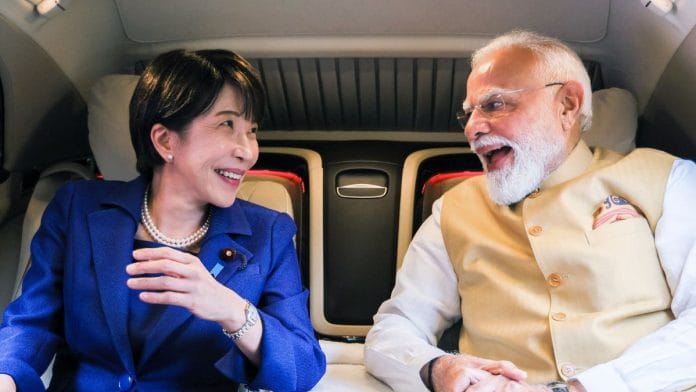


What more could be done for India-Japan relations?’ I asked Professor Tomohiko Taniguchi during the Delphi Economic Forum in Greece earlier this year. Known affectionately as Taniguchi Sensei, he is among Japan’s foremost strategic scholars who wrote former prime minister Shinzo Abe’s landmark address to the Indian Parliament in August 2007—The Confluence of the Two Seas—that would later become the intellectual foundation of what subsequently evolved into the Indo-Pacific.
Looking through his thick-rimmed glasses, Taniguchi replied after a pause: “There is a lot to be done, and it must start with Takaichi San’s visit to Delhi.”
I asked whether such a visit was already in the offing and he smiled in quiet acquiescence.
Three months later, PM Sanae Takaichi—late Shinzo Abe’s protégé—has concluded her first state visit to India. Much has already been written about it and the natural partnership between Japan and India.
Japan has, after all, entered a new phase. Takaichi became the country’s first woman prime minister in a deeply patriarchal political system and, more remarkably, has begun to bring a degree of stability to a country that has cycled through a revolving door of prime ministers for much of the past few years. Stability itself is a political achievement in contemporary Japan; the fact that it is embodied by a woman makes the moment all the more historic.
And yet, when one thinks of India-Japan relations today, an unmistakable sense of complacency lingers. The relationship is described as “natural”, “special”, “trusted” and “indispensable”. Every summit reiterates these familiar adjectives and every joint statement checks the expected boxes. The goodwill is genuine and the political comfort undeniable, but the relationship will plateau unless the timing and development of its critical drivers are kept at the centre. There are three such drivers, to which this column will shortly return.
Also read: Rashtrapati Bhavan rolls out red carpet for Japan’s Takaichi—glimpses from ceremonial reception
Abe’s legacy
My own memories of Japan remain inseparable from the Abe years.
The land of soft cherry blossoms fluffing spring skies remains my favourite image. Cycling through a picturesque university campus, I remember attending seminars where Abe’s evolving strategic vision was discussed with enthusiasm. Those were the years when ‘The Confluence of the Two Seas’ was evolving into a framework for understanding a changing Asia.
As an Indian graduate student working on the Indo-Pacific between 2010-2015, I felt the optimism surrounding India. Being Indian was invariably greeted with a cheerful sugoi (“nice”). Working on India-Japan relations was considered subbarashii—an excellent academic pursuit.
In hindsight, though, much of that rested less on contemporary realities than on imagined and romanticised notions of the other—rooted in centuries of civilisational goodwill, shared democratic values outside the West and comforting histories. There was surprisingly little to study beyond cultural exchanges, India’s status as Japan’s largest recipient of Official Development Assistance, JICA-led infrastructure projects, and the remarkable success stories of Maruti Suzuki, followed by Toyota and Honda.
The potential remained largely untapped as the world around us started to change. The assumptions that had guided Japanese foreign policy for decades gradually eroded. Simultaneously, Trumperica made geopolitics less predictable.
For countries like Japan and India, this changing landscape has produced an uncomfortable realisation that their natural partnership has remained underutilised and now requires a focus on new drivers, not just checked boxes.
Beyond automobiles and 1,500 companies
The first driver is economic.
Until 1991, India was the largest recipient of Japanese Official Development Assistance (ODA). Its imprint is visible everywhere—from the Delhi Metro and the Dedicated Freight Corridor to connectivity projects across the Northeast. Few foreign partners have contributed as much to India’s infrastructure development. But mature partnerships cannot remain defined by aid; the next phase must be driven by trade and investment.
In many ways, that transition has started. The difference is visible in the roles of JICA (Japan International Cooperation Agency) and JBIC (Japan Bank for International Cooperation). While JICA continues to oversee Japan’s development cooperation, JBIC represents a different ambition—supporting Japanese companies as they expand overseas and facilitating commercial investment.
India has become one of JBIC’s priority destinations, with the bank supporting cumulative Japanese investment of 10 trillion yen over the coming years, particularly in semiconductors, artificial intelligence and advanced manufacturing.
Yet, much room for improvement remains.
Japanese cumulative investment in India stands at roughly $40 billion, compared with nearly $800 billion in the US, $130 billion in China and $80 billion in Vietnam. India hosts roughly 1,500 Japanese firms while Thailand, despite being a much smaller economy, hosts more than 5,000. As global supply chains pursue China Plus One strategies, India continues to attract attention but has yet to convert that interest into investment at the scale its potential warrants.
Ajay Singh, a Tokyo-based businessman, said that, of the roughly 1,500 Japanese companies operating in India, only 1 per cent account for the bulk of business activity, most of it concentrated in the automobile sector.
Part of the challenge lies in India’s investment ecosystem. Part of it lies in Japanese firms trying to adapt business models that worked in China or Southeast Asia but often struggle in India’s cumbersome regulatory environment and poor infrastructure landscape.
Business-to-business engagement, therefore, becomes indispensable. The next leap will have to be driven by entrepreneurs and investors.
Also read: Calcutta HC’s new address has link to old legacy—an Indian jurist’s name etched in Japan’s history
A special place for the Northeast
The second driver is India’s Northeast.
When Takaichi’s visit was first announced, she was to travel directly to Guwahati. Many found the itinerary surprising.
For several years now, Japan has quietly maintained steady engagement with India’s Northeast. High-level delegations visit the region regularly, and Japanese financing has become central to infrastructure, connectivity and capacity-building projects. Japan remains the only foreign development partner undertaking large-scale strategic infrastructure projects in the region, a fact that is no coincidence.
For Tokyo, India’s Northeast, Bangladesh, Myanmar and mainland Southeast Asia constitute an interconnected strategic theatre within Japan’s FOIP vision of a Free and Open Indo-Pacific. It is here that India’s Act East Policy and Japan’s Indo-Pacific strategy converge, and the results are already becoming visible.
The Northeast also occupies another, less discussed place in Japan’s interests.
The country is facing a demographic crisis. Its ageing society and shrinking workforce have compelled successive governments to reconsider long-held assumptions about immigration, but it has never been an easy conversation. Japanese society continues to prioritise socio-cultural homogeneity, making immigration one of the most politically sensitive issues in domestic politics. Takaichi herself has also been cautious on these sentiments.
When Japan does look outward for skilled manpower, India’s Northeast takes on added significance. Beyond its strategic location, the region offers a young, educated workforce with growing international exposure and physical features that many Japanese perceive as culturally easier to integrate. It would be simplistic to reduce Japan’s engagement with the Northeast to labour mobility alone, but it would be equally mistaken to ignore that these affinities complement Tokyo’s broader strategic objectives.
For India, the implications extend well beyond diplomacy. The Northeast need no longer remain merely a frontier to be developed; it can become the principal gateway through which India’s engagement under the Act East Policy acquires genuine economic depth with a trusted partner.
Also read: India must move Japan from ‘old friend’ trap to real partners
India must seize the opening in security
The third—and perhaps the most consequential—driver concerns security.
Japan is undergoing the most profound strategic transformation of the post-Cold War era.
This shift did not begin with Takaichi. Her predecessors, particularly Fumio Kishida and Shigeru Ishiba, laid its institutional foundations by increasing defence spending, which is now approaching 2 per cent of GDP. New national security and defence strategies have acknowledged an increasingly hostile regional environment, reinforcing the notion that security in Europe and Asia is “indivisible”. China’s growing military assertiveness, North Korea’s expanding missile capabilities, and an unpredictable American commitment have together altered Tokyo’s threat perceptions and response mechanisms.
What distinguishes the present government is that Takaichi finally possesses the political space to take these reforms further. For 26 years, the LDP governed alongside Komeito, whose pacifist orientation moderated the pace of security reforms and defence cooperation. However, under Takaichi, the LDP has a new coalition partner—the Japan Innovation Party (Ishin)—that is not constrained by traditional pacifist instincts. This gives Takaichi greater room to pursue long-range strike capabilities, strengthen intelligence institutions and deepen Japan’s defence-industrial base through foreign collaboration.
For India, this creates an opening that must be seized. The geography of the Indo-Pacific has naturally made both countries maritime partners. But the next phase should move beyond joint naval exercises towards capabilities that genuinely address the full spectrum of security challenges, particularly in the grey zone.
The first is maritime domain awareness. Modern maritime competition increasingly unfolds in the grey zone, where relentless coercion falls short of open war and therefore requires persistent surveillance, intelligence-sharing and real-time operational coordination. Quad’s MDA initiative has created an initial framework, although progress has been slow—partly because of technical challenges and partly because Washington’s current enthusiasm for plurilateral initiatives has become increasingly uncertain. Bilaterally, however, India and Japan possess both the trust and the incentives to deepen cooperation in this domain.
The real question, however, is whether that trust is enough to link their maritime security architectures in real time.
The second is defence-industrial collaboration. Japan possesses advanced technological strengths in underwater vehicles, anti-submarine warfare, advanced radar systems, unmanned platforms, demining capabilities and a range of sophisticated maritime equipment. For decades, Japan’s own political constraints limited the export of such technologies, but not anymore.
India should view this not merely as an opportunity to purchase equipment, but to co-develop technologies, establish joint ventures and build long-term industrial partnerships.
Another area that deserves greater attention is civil-nuclear cooperation, particularly in Small Modular Reactors (SMRs).
India’s recent reforms to its nuclear liability framework have made it easier to implement the India-Japan civil nuclear agreement. Japanese companies possess world-class expertise in reactor technologies and advanced engineering. As countries search for cleaner and more resilient energy systems, SMRs could emerge as one of the defining technologies of the coming decades. For India, that conversation must necessarily involve Japan.
Trust in strategic partnerships is rarely built through “game changers”. It is painstakingly built through institutions, commercial interests and collaboration across government-to-government, business-to-business and people-to-people ties—which brings me back to my conversation with Taniguchi Sensei.
His observation was never really about one state visit, but about a broader qualitative shift in both the perception and the execution of the bilateral relationship.
Swasti Rao is a Consulting Editor (International and Strategic Affairs) at ThePrint. She tweets @swasrao. Views are personal.
(Edited by Prashant Dixit)
Two of the world’s five largest economies. At different levels of development, creating complementarity. A high level of strategic trust. That should be reflected in much more trade and investment. India’s exports about $ 5 billion a year. Japanese FDI has averaged $ 3 billion over the last decade. 2. Forty years ago, the partnership between Suzuki and Japan transformed India’s automobile sector.