





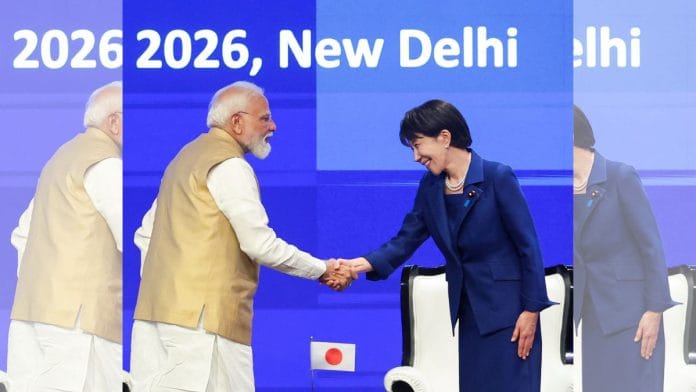


New Delhi: India and Japan Thursday announced the co-production of UNICORN naval radio antennae, a day after Japanese Prime Minister Sanae Takaichi arrived in the national capital on a three-day visit. The two countries also issued a joint statement on Artificial Intelligence, and a joint roadmap for economic security.
The announcements of the various agreements were made following a bilateral meeting between Prime Minister Narendra Modi and Takaichi in the national capital.
“In the defence sector, we have reached an agreement today on the first co-development project between India and Japan. This project, involving a Naval Radio Antenna, will open a new chapter in our defense technology partnership,” PM Modi announced during the Joint Press Statement with his Japanese counterpart.
Modi added: “We will now jointly develop defence technologies that strengthen regional peace, maritime security, and the rules-based order. Through the agreements signed today in the pharmaceutical, medical device, and biotech sectors, we will contribute to global health security.”
The two leaders also held the 16th India-Japan Annual Summit Thursday. The Japanese Prime Minister in her statement to the press said that the two countries will hold a 2+2 ministerial meeting format before the end of this year. The 2+2 format involves discussions between the foreign and defence ministers of the respective countries.
The announcement of the co-production of the UNICORN antennae (Unified Complex Radio Antennae) has been in the works for over two years. The two countries announced a memorandum of implementation (MoI) in November 2024, which allowed for further discussions in this sector. The UNICORN mast is considered among the more technologically advanced antennae in the world, owing to its stealth technology and radio frequency functioning. The masts aid in improving stealth capabilities of naval vessels.
The Indian Navy has been pursuing the induction of the antennae, which is likely to be co-developed by Bharat Electronics Limited (BEL) along with the Japanese firms. Japan for almost six decades banned the export of lethal military equipment to third countries. Takaichi overhauled the legislation in April this year, a move that is set to allow Tokyo to strengthen its partners in a complicated geopolitical reality.
Tokyo is keen to expand its strategic partnership with India, with the UNICORN project the first of potentially new areas of cooperation between the two countries. Apart from the growing strategic security convergence, a large part of the discussions between the two leaders focused on strengthening economic cooperation.
Over 120 agreements between private companies will be signed during Takaichi’s visit to New Delhi. The two leaders also addressed a joint business forum in the afternoon, following the annual summit.
“In today’s era of uncertainty, both India and Japan fully understand the importance of economic and energy security. To this end, we have prepared a Joint Roadmap for economic security today,” said Modi.
He added: “Through this, we will strengthen supply chain resilience in strategic sectors such as semiconductors, quantum technology, and advanced materials…We have also launched a significant initiative on energy resilience to tackle situations like oil shocks.”
Takaichi announced that Tokyo will be working with New Delhi to strengthen India’s strategic petroleum reserves. Energy security has become a key measure of cooperation in recent months, following the shocks to the oil markets following the US-Israel joint strikes on Iran on the last day of February. The effective closure of the Strait of Hormuz by Iran for almost four months saw oil prices increase significantly.
The theme of energy and economic security is seen through the various memorandums of cooperation announced by the two countries Thursday, including agreements in the field of mineral exploration, pharmaceutical and medical devices sector, batteries, expansion of biogas and organic fertiliser production.
The biogas initiative will assist in setting up roughly 1,000 biogas and organic fertiliser plants across India, announced Modi. India and Japan have set a target of increasing Japanese investments to India to 10 trillion yen ($60 billion) in the next decade. Japan achieved its goal of $34 billion investments in India last year, and made the pledge to double this investment going forward.
In the last year, Modi said that over 100 agreements have been signed between firms of the two countries that are likely to see $10 billion in investments flow into India. Japan is one of the biggest investors in Indian businesses, and has also been a key player in development assistance for large-scale infrastructure projects across the country.
Tokyo is the largest overseas donor to India since 1958, with its total disbursement standing at $4.5 billion as of last year. This includes funding for the Ahmedabad-Mumbai High Speed Rail project.
(Edited by Gitanjali Das)
Also Read: Takaichi in Delhi: From China to supply chains, what’s driving India & Japan’s strategic partnership