



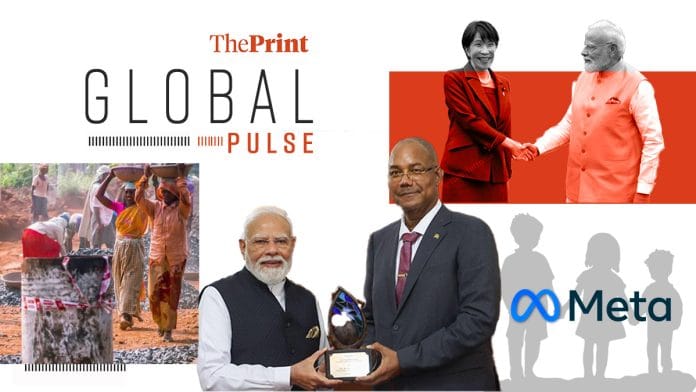

New Delhi: Japanese Prime Minister Sanae Takaichi’s first India visit since assuming office has earned global media attention as the two countries “get friendlier” even though they are “not formal allies”.
Prime Minister Narendra Modi welcomed PM Takaichi in New Delhi Friday. Takaichi’s first visit to India since taking office comes with the promise of 120 deals. Yet, The Economist says that India and Japan may never get truly close.
The reason, it says, is India’s tendency to prize strategic autonomy, and Russia.
“In 2007, Japan’s prime minister, Abe Shinzo, told India’s parliament that the Indian and Pacific oceans were merging into a ‘confluence of the two seas’. Japan’s current leader, Takaichi Sanae, hopes to build upon her mentor’s vision of an open Indo-Pacific. On Thursday, she met Narendra Modi, her Indian counterpart, in New Delhi. Economic security was high on the agenda. The two countries also signed a pact to collaborate on AI and energy,” the column notes.
It further highlights that the two countries have come together against the backdrop of anxieties around Chinese actions. Takaichi started a “spat” with China by saying Japan would have no option other than to get involved if China attacks Taiwan. Although India and Japan are making significant progress on economic ties with projects like the bullet train from Ahmedabad to Mumbai, New Delhi and Tokyo are not formal allies, says the report.
India still strives for strategic autonomy, and has close ties with Russia, on whom Japan has imposed sanctions following the Ukraine-Russia war. “India and Japan are getting friendlier—but may never be truly close,” says the column.
Meanwhile, The Guardian has reported on PM Modi’s “notable penchant for receiving awards”, and highlights how some of the awards he received on his State visits were created just days before he arrived, and he remans the only recipient.
“As critics have pointed out, Modi has shown a notable penchant for receiving awards, at home and abroad, over his 12 years in power,” Hannah Ellis-Petersen writes in the report.
“As Narendra Modi touched down in Seychelles over the weekend, the archipelago nation in the Indian Ocean swiftly bestowed one of its “highest” honours upon the Indian prime minister,” Hannah Ellis-Petersen reports.
“Modi beamed as he accepted the Guardian of the Blue Horizon award from Patrick Herminie, the Seychelles president, complete with a trophy and certificate,” the report adds.
As it turns out, the award was only created three days before Modi’s arrival. He is the only recipient.
Observers also pointed out spelling errors in the certificate of the “highest civilian honour”. While the Seychelles authorities gave a clarification, saying that the working draft was published instead of the final one, the faux pas had already got the Opposition’s attention, says the report.
The Congress said “give him (Modi) any award, and he’ll come running”, the report notes.
“Last month, days before Modi’s visit to Israel, the Israeli parliament quickly created what it claimed to be one of the country’s highest honours, the medal of the Knesset, which was bestowed on Modi when he landed. Again, he is the only recipient to date,” says the report.
In 2019, Modi also became the first recipient of India’s Philip Kotler presidential award, given to the prime minister for his “outstanding leadership of the nation”
“According to the government’s press release, the honour was to be bestowed annually to the leader of a nation. However, no other leader has since been given the award and its website lies dormant,” the report notes.
“It is privately acknowledged that accolades and awards have become an expectation during Modi’s foreign trips. Nilanjan Mukhopadhyay, the author of a biography of Modi, said the global push for prizes was symptomatic of the prime minister’s personality-driven politics,” it adds.
MGNREGA vs VB G-RAM-G
The revamped Mahatma Gandhi National Rural Employment Guarantee scheme came into effect on 1 July under a new name. The Economist analyses whether the Viksit Bharat—Guarantee for Rozgar and Ajeevika Mission (Gramin) (VB G-RAM-G) improves upon the outgoing MGNREGA.
It says that the change of name is not a mere rebrand. “The government argues that its new scheme is an improved version of the old one. Workers can now get 125 days of work, rather than 100, and they will work on a narrower set of tasks to build “productive infrastructure”; many of the previous projects, it argues, were of little real value”.
The Mahatma Gandhi National Rural Employment Guarantee Act (MGNREGA), introduced in 2005, guaranteed 100 days of paid work to any rural household that demanded it.
“Plenty did: in 2024-25, some 60m households were employed on an assortment of projects, from wells and ponds to rural roads. The scheme earned international acclaim for its scale and ambition: the World Bank has called it the world’s largest public-works programme, and the International Labour Organisation has recommended that other developing countries copy it; many, including Bangladesh and South Africa, have done so.”
Now, critics say that the revamp has gutted the scheme of its original benefits, says the report. Nikhil Dey, who was one of main personas in drafting the original scheme, says that the government has essentially removed the legal guarantee of work which made NREGA so unique in the first place, the column notes.
“The issue is how the programme is funded. Under the old law, the central government covered the full wage bill, but the new scheme sets a limited allocation of funds for each state every year—a fixed sum that, once exhausted, leaves the states to cover any further cost,” the column adds.
Taking into account BJP’s remarks on the old scheme, the column admits that the old employment guarantee scheme had its own share of problems—from lack of funds to bureaucratic inertia—but the programme made a positive impact at large scale.
“At a minimum, it gave the poor a cushion during economic shocks (demand for work surged during the pandemic, for example). But it was far more than that. Studies suggest it empowered women and India’s lower castes. It also raised private-sector pay, as employers were forced to put up wages to compete with the scheme.”
Divya Arya, in an investigative piece, reports for the BBC that Instagram “has been running paid adverts promoting child sexual abuse material in India”.
“The ads, seen by the BBC World Service, use terms including ‘rape video’ and ‘child video’ and link users to channels on the messaging app Telegram, where they can buy the material for as little as 99 rupees (about $1),” she writes.
Ads on Instagram are only published after they have been passed through the application’s moderation technology.
The BBC made an alias account on Instagram, and started following pages of women who were dressed in revealing clothes and used sexual innuendo in their posts.
“In less than a week, Instagram started showing advertisements on the feed featuring women offering video calls and showing clearly naked couples having sex. Days later, it began showing adverts of children with adults in sexually suggestive situations, with links to Telegram channels,” Arya reports.
As the report highlights, 30 ads related to child abuse, and 20 ads showing adult pornography showed up on the account’s feed.
In horrific details, BBC reveals that one ad showed a boy and a girl, aged 12, engaging in a sexual act.
Another showed a man with his arm around a girl, with text saying he was 52 and the girl was 12. The link on the ad said, “Click to watch more”.
“The BBC reported an advert to Instagram showing a very young girl in tears, with wording indicating that she had been sexually assaulted. But 24 hours later, Instagram replied saying it hadn’t removed the advert because “our review team found that the advertiser’s ad does not go against our community standards”,” says the report.
When the BBC asked Instagram’s parent company Meta for comment, it said it had already disabled several adverts and suspended the accounts posting them. The company said it had removed additional ads, disabled more accounts and blocked URLs for other content that violated its policies in response to the BBC’s findings.
Telegram said it had removed more than 274,000 groups and channels related to child sexual abuse material in 2026.
(Edited by Ajeet Tiwari)