





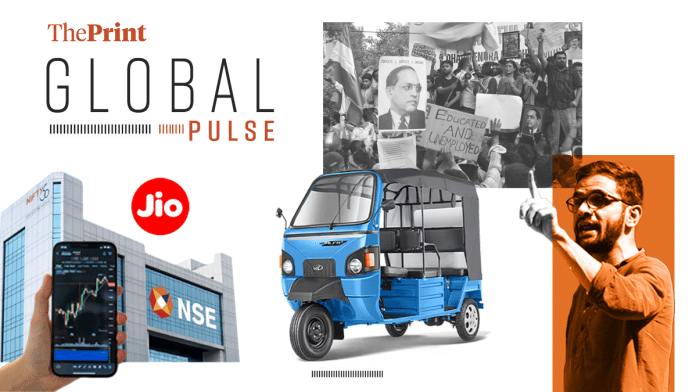


New Delhi: Ten days on, the Cockroach Janta Party is still on the streets, protesting at Jantar Mantar in New Delhi, and demanding Union education minister Dharmendra Pradhan’s resignation. BBC asks why a party—born out of an online satirical movement—is still protesting in over 40 degrees.
“A harsh sun beats overhead and temperatures hover above 40 degrees C. Young men and women stand around in groups; some sit, while others even sleep on the baking-hot road, hemmed in by heavy, yellow, metal barricades erected by Delhi police to contain the crowd,” Geeta Pandey of the BBC reports.
They are demanding Pradhan’s resignation over the NEET paper leak. The protest intensified after Sonam Wangchuk joined the protesters and began an indefinite hunger strike.
“I had just come back from the gym and was playing FIFA on my PS5 when I saw the chief justice’s comment,” CJP founder Abhijeet Dipke told the BBC. CJI Surya Kant likened the country’s unemployed youth to “cockroaches”.
Reacting to the comment, Dipke posted on X: “What if all cockroaches came together?” Since then, Dipke, a postgraduate student at Boston University, has flown back to India and held protests in multiple cities in the country.
“None of this was intended or planned. It was just meant to be satire, but as millions began signing up, people started saying we want to turn this into a serious movement because no other political party is talking about our needs or hopes and aspirations. I was kind of forced into it by our supporters,” Dipke told the BBC.
Pandey writes that youth are supporting the movement because they believe the CJP represents their causes. “CJP is not a political party, and its leaders show no sign of wanting it to become one. Nor is it clear whether its vast online following—22 million on Instagram—can translate into support on the ground,” Pandey adds.
‘Explosion of retail investing in India’
Nikhil Inamdar of the BBC reports that India is quickly becoming a country that is glued to its phones. This is most prominently visible in the two biggest IPOs this year. “India’s largest stock exchange and its biggest telecom operator will both go public by the end of this year in what experts say could be landmark listings for the country’s capital markets,” he writes.
Jio Platforms and National Stock Exchange filed their draft papers last month to go public by the end of this year. Jio is expected to raise around $4 billion from the market at an estimated valuation of $120-160 billion, while NSE’s issue will reportedly offer 6 percent equity for $3.3 billion, valuing at $57 billion.
Inamdar writes that these two listings reveal a new face of digital India where phones and internet have pervaded far and wide.
“Barely 200 million Indians used the internet a decade ago. That number is now inching closer to the billion mark with Jio alone amassing 525 million of those subscribers. They use its data to make payments, watch web shows and shop online.”
Moreover, Indians are now the largest consumers of mobile data globally, leaving advanced markets like the US far behind, the report notes.
The Internet is one arm of the digital revolution, the other is trading. “The rise of the NSE, meanwhile, mirrors the explosion of retail investing in India, as millions of mom-and-pop investors entered the stock market during the pandemic. Fuelled by cheap mobile data and rising smartphone use, the number of online trading accounts surged from about 30 million to more than 200 million,” Inamder notes.
Feroze Azeez, from a wealth management company, told the BBC: “Together, Jio and NSE represent the twin pillars of India’s new economy.”
‘Years in prison have wreaked havoc on my mind’
The Guardian has published an exclusive interview with Umar Khalid, who has been in prison for nearly six years under the UAPA, awaiting trial in connection with the 2020 Delhi riots conspiracy case. Hannah Ellis-Petersen talks to the jailed student activist.
“Khalid, a Muslim and leftwing rights activist, is a particularly fierce critic of the BJP’s Hindu nationalist agenda, which seeks to turn India from a secular country into a Hindu nation. He has accused the Modi government of fuelling the harassment and persecution of the country’s 200 million Muslims as well as other minorities. The BJP has repeatedly denied all allegations of religious discrimination,” she writes.
Khalid is reading Fyodor Dostoevsky in jail, Ellis-Petersen writes. “Even Dostoevsky refers to this state of mind at sunset in his prison memoir… I guess maybe it is because it starts sinking in that another day of your life has been spent in captivity,” he told The Guardian.
“When you are reduced to just an image, either negative or positive, it becomes difficult to maintain not just your humanity but even your sanity at times. Even those who sympathise with you, or portray you as someone larger than yourself, forget that I am a human being with my own share of vulnerabilities, fears and imperfections. And that these long years in prison have wreaked havoc on my mind and body and exacerbated all these anxieties within me,” Khalid tells Ellis-Petersen.
‘Environmental makeover for Delhi’
The author also writes about Delhi’s plans to phase out petrol autos and two-wheelers to control the emission of toxic fumes.
“The unruly chaos of Delhi’s roads would be unrecognisable without the rickshaws and scooters that zip through India’s capital in their millions, emitting toxic fumes in their wake. But now, ambitious policies aim to give the city’s most recognisable vehicles an environmental makeover,” she writes.
On Monday, Delhi’s government announced plans to eventually ban petrol auto rickshaws, scooters, and motorbikes in favour of electric vehicles, which are a much safer bet for the city’s environment.
“Scooters and rickshaws—which largely run on petrol and compressed fossil gas—account for more than two-thirds of the tens of millions of vehicles on Delhi’s roads. Under the new policy, India’s capital will now issue new licence plates only to electric small trucks and three-wheelers, known as e-rickshaws, from 2027, and to e-scooters and electric motorbikes from 2028,” The Guardian reports.
(Edited by Viny Mishra)