





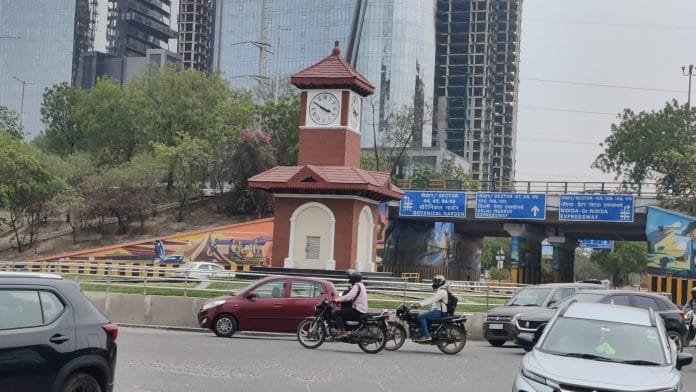


Meet me at the clock tower, said 24-year-old Sneha as she waited for her friend. This was not the iconic clock tower at Chennai’s MGR Central Railway Station, Srinagar’s Lal Chowk, or Lucknow’s Husainabad Clock Tower. It was Noida’s newest landmark—a 75-foot-tall clock tower standing outside the Great India Place Mall, recently inaugurated in Sector 18.
Noida’s beautification drive has expanded beyond wall art, parks, and landscaping. In the last two years, the city has focused on installing aesthetically designed clock and pillar towers that add character to public spaces while creating new landmarks for residents and visitors. Noida has now more than six clock towers of different styles and sizes, built at costs ranging from around Rs 30 lakh to Rs two crore.
“It has become a meeting spot, a resting place, and even a selfie point,” said Sneha as she waited for her friend at the clock tower in Sector 18.
In January, the Noida Authority inaugurated the city’s first red brick-and-granite structure at Sector 128 — a 25-foot-tall red brick-and-granite structure near the Hajipur underpass. However, it was not the first large public clock installed in the city. In 2024, the authority had already installed a pillar clock inside the Biodiversity Park in Sector 91.
“These clocks encourage people to pause for a moment and appreciate their surroundings. Clock towers have always been an identity of cities, and they never go out of style. Adding them was the next step in Noida’s beautification journey,” said Anand Mohan Singh, Deputy Director (Horticulture), Noida Authority.
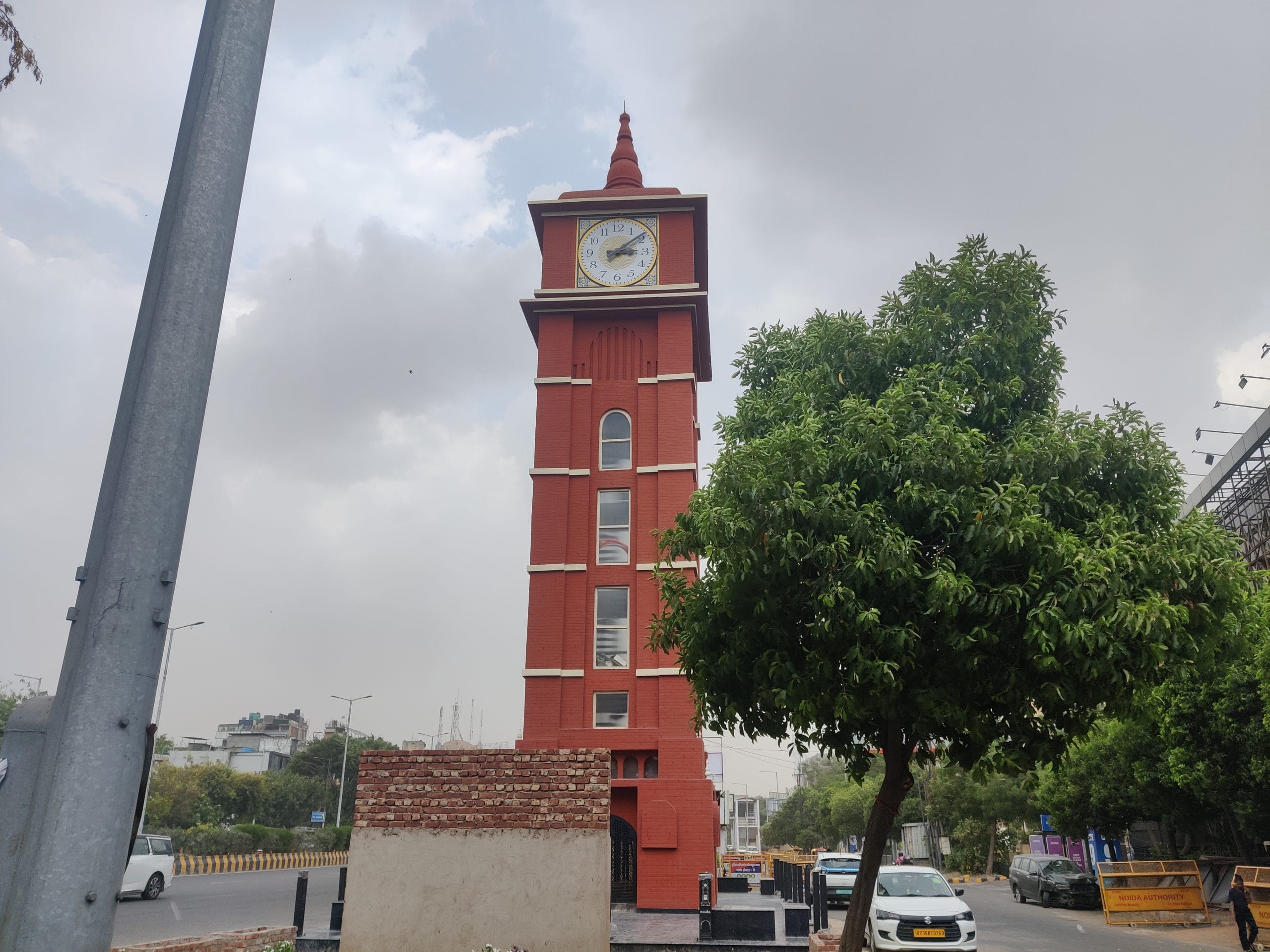
The revival of clock towers is not limited to Noida. Across India, cities have begun restoring historic clock towers while also constructing new ones inspired by traditional architecture.
The Varanasi Municipal Corporation recently installed the heritage-style “Mint House Clock” at the Mint House intersection in Nadesar. The structure reflects the city’s historical heritage while blending it with modern urban development.
Similarly, in December 2025, the Greater Hyderabad Municipal Corporation (GHMC) inaugurated a heritage-inspired Burj (clock tower) at Masab Tank. Designed by Deccan Terrain Heritage, the 20-foot-tall hexagonal structure commemorates 157 years of municipal administration while reviving elements of traditional Deccan architecture.
“Clock towers have historically served as symbols of civic pride and community,” Singh said. “Their return is more than an architectural initiative. It is about revisiting history, learning from it, and passing that legacy on to future generations.”
Also read: Does PM-WANI need a reset? India’s public Wi-Fi is everywhere and nowhere
An association
Every day, for the last 11 years, Gaurav Yadav has driven through Noida’s sectors. As a resident of Sector 51 and a cab driver, he has watched the city’s busiest commercial junction transform before his eyes—the areas in and around Sector 18.
“There was only the police chowki and the mall beside the clock tower of Sector 18,” he recalls. “People would just pass through.” Now, for him and thousands of others who cross this junction every day, a new landmark has risen.
Rising 75 feet above one of Noida’s busiest intersections, the Sector 18 clock tower dominates the skyline long before commuters reach it. It is the tallest and the most expensive clock tower built by the Noida Authority, constructed at a cost of around Rs 2.0 crore and inaugurated in May 2026 after its opening, originally planned for the city’s Foundation Day in April, was delayed.
Painted in a striking shade of red, the tower draws inspiration from Srinagar’s iconic Lal Chowk Clock Tower. The four-sided tower features large clock faces with bold numerals visible from a considerable distance. The clocks operate on a solar-powered mechanism, allowing them to function without relying entirely on the city’s power supply.
Its location is as prominent as its design. On one side lies the bustling Sector 18 market and Atta Market, on the other side stand some of Noida’s largest malls and commercial complexes, including the GIP Mall, drawing office-goers and visitors throughout the day. Roads from the Delhi-Noida border, the DND Flyway, Sector 27, Film City and the Noida Expressway funnel towards this junction, making the clock tower visible from hundreds of metres away as vehicles approach from every direction.
“The focus has always been to install these clock towers where the maximum number of people can see them and connect with them. The idea was to create landmarks that become part of people’s everyday lives,” said Singh.
Around the base of the tower, the Noida Authority has developed a seating area for the public. Black marble slabs curve around the circular plaza, while a green lawn spreads out in front.
“Earlier, I used to wait inside my cab. Now, if a passenger is taking time, I prefer stepping out and sitting here instead,” said Yadav, pointing towards the marble seating around the tower.
The clock has quietly become one of the busiest waiting points in the city.
However, not everyone finds association with these clocks.
“They are placed on such busy roads. Should we first navigate the crowd at roundabouts and other intersections or stop to look at the clock towers?” said 39-year-old Tarun Tiwari, passing near the Sector 128 clock tower on his bike.
Beyond the streets, the clock towers sparked debate on social media, soon after their inauguration.
“It looks horrendous! Total eye sore! Maaf karo bhi @CeoNoida @noida_authority. Aapke architect ne kahan se copy-paste karke beech road mein ye bekar sa clock tower khada kar diya? Itne traffic mein log yahan clock dekhne rukenge? What is the logic behind this? Utter nonsense,” wrote one user on X.
Another user compared the design to the clock tower architecture of Jodhpur, calling the Noida structure a “kabar-like structure.”
Also read: Inside the second partition of India-Pakistan—the full story of the Indus Waters Treaty
Ignored Clocks
In Sector 78, the clock is not placed at a roundabout or a crowded intersection. Instead, it sits inside a neighbourhood park—tucked away from the main road, without a towering structure to make it visible from afar. While the clock towers in Sector 18 and Sector 128 have become landmarks, other installations in Sectors 78, 91, 29, and 39 remain far less prominent.
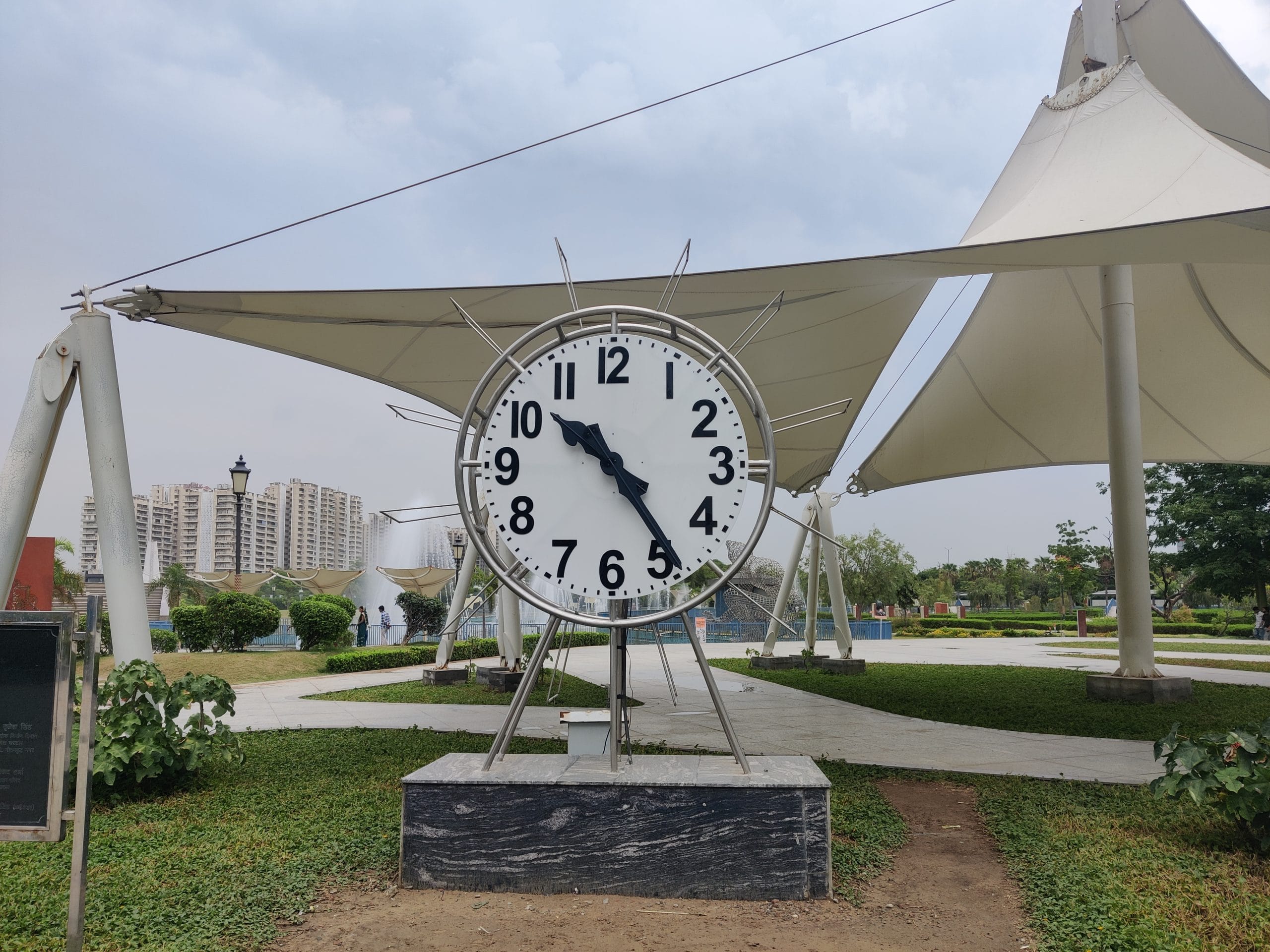
Near Gate No. 2 of the Ved Van Park in Noida Sector 78 stands a black-and-white sculptural steel clock installation, fitted with hanging planters and built at a cost of over Rs 3 lakh.
However, the installation is not always maintained as intended. Several of the decorative planters are missing, and the clock often shows incorrect time. Children can frequently be seen gathering around it for photographs, sometimes rotating the clock hands.
“I am tired of correcting the time and stopping people from touching it, but nobody listens,” said a guard stationed near Gate No. 2, checking tickets at the park entrance. “I fix the time, and then someone else comes and turns the clock hands again.”
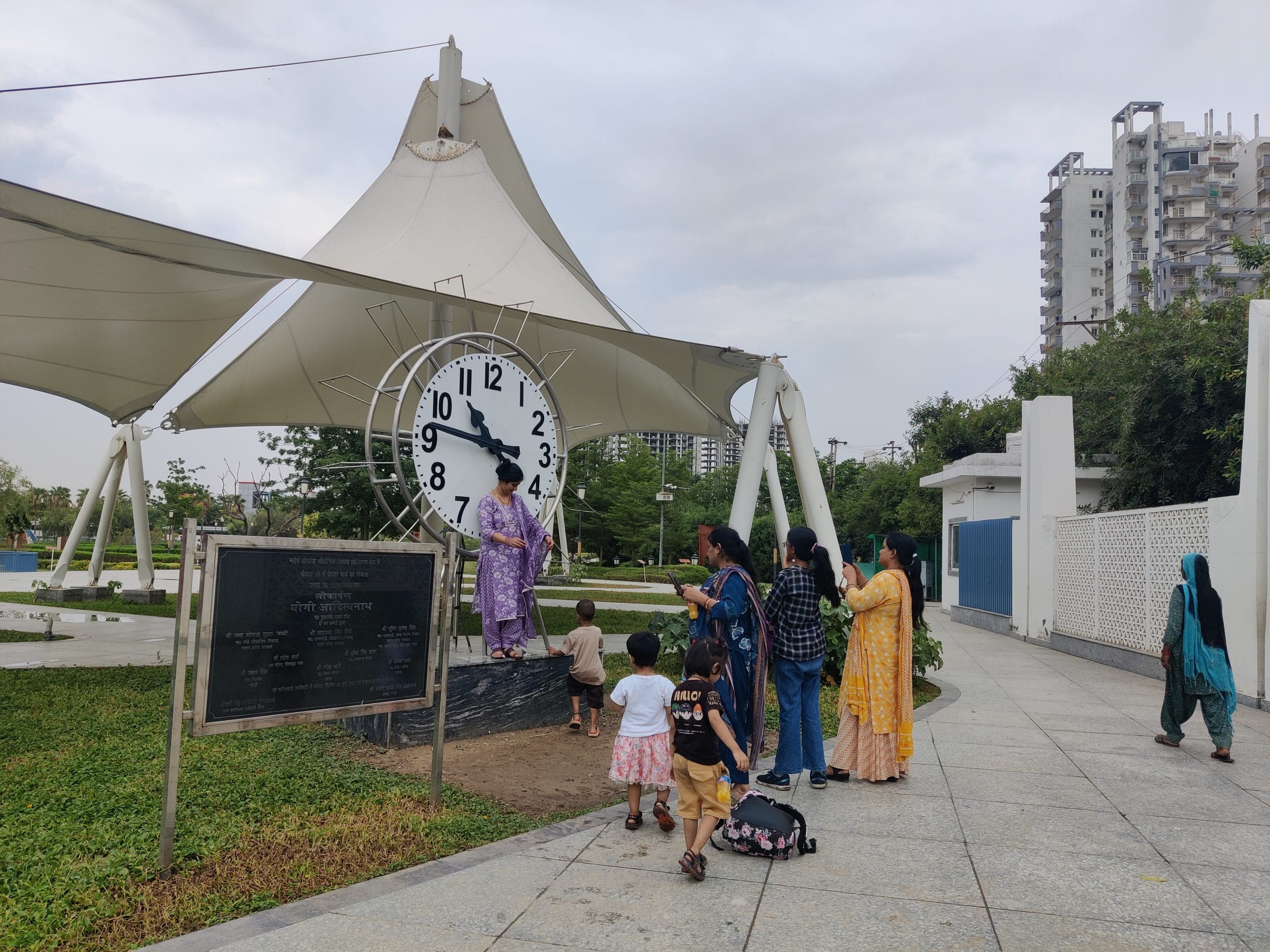
Another clock installation is located inside the Biodiversity Park in Sector 91. Set at ground level and surrounded by floral landscaping, it once stood as a carefully designed green clock feature but now remains largely unnoticed and rarely maintained.
“They should be covered with some protective structure or placed inside a barrier so people cannot touch them,” the guard added. “Otherwise, they will not survive here for long, as people keep damaging them.”
The Noida Authority has approved a comprehensive infrastructure and urban development budget of Rs 10,290 crore for the financial year 2026–27. Alongside large-scale infrastructure upgrades, funds are allocated for beautification projects, intersection redevelopment and annual horticulture maintenance. For the year 2024-25, the authority approved an overall budget of around Rs 7,000 crore. Out of this, Rs 100 crore was specifically earmarked for the Horticulture Department for city-wide greening, park revamps, and maintenance.
Also read: NCR RWAs are tired of handling complaints about beauty parlour, gym and clinic businesses
Who’s behind clock tower comeback
From traditional structures to modern GPS-synchronised designs, all of these projects have been executed by a single company—Medieval India, the firm behind the restoration and creation of several landmark civic clocks, including the iconic Lal Chowk Clock Tower in Srinagar, and new projects awaiting approval in Delhi.
Medieval India – The Architects of Time was officially established in 2008. The company did not begin as an infrastructure contractor, but as a retail venture inside Promenade Mall in New Delhi, where it sold large decorative clocks.
Founded by Samir Bakshi, Ambika Bakshi, and Vishal Bakshi, the family-run business gradually expanded across North India. By 2010, it had retail outlets in major malls including DLF Place Saket, DLF Mall of India, Ambience Mall Gurugram, Elante Mall Chandigarh, and Pavilion Mall Ludhiana.
A key turning point came in 2019, when the company entered institutional projects across defence and academic spaces, including the Indian Military Academy, NDA, IIT Roorkee, BITS Pilani, and multiple naval bases. In 2020, its project at the Rashtrapati Bhavan set a benchmark for civic clock installations in India. For the company, the project at Rashtrapati Bhavan was among the most prestigious government contracts. They were commissioned to install three clocks. The renovation of the Lal Chowk Clock Tower in Srinagar in 2023 brought national recognition, paving the way for its engagement with the Noida Authority in 2024, now one of India’s largest single-city civic clock programmes. Companies International projects followed in countries including Nepal, Bangladesh, Sri Lanka, Thailand, Singapore, Oman, Dubai, and Saudi Arabia.
The company has worked on more than 4,000 installations across 28 states.
“A smartphone tells you the hour. A clock tower tells you something about the city you live in. It says this city has a centre, a sense of permanence, and that it takes itself seriously. The two do not compete—they serve entirely different needs. One is personal and utilitarian; the other is civic and symbolic,” said Samir Bakshi.

The company is also working on proposals with the New Delhi Municipal Council (NDMC), including the Talkatora Clock Tower dial design project based on the Surya Prabha concept with Devanagari numerals, which is currently awaiting final approval.
In recent years, the firm has seen rising demand from municipal bodies, Smart City projects, and institutional clients across India, reflecting a renewed interest in civic clock architecture.
“India’s Smart Cities Mission has rightly focused on digital infrastructure, mobility, and governance systems. But the most lasting urban transformations combine the digital with the enduring. A GPS-synchronised clock tower that also serves as civic art is not a contradiction—it is the ideal: technology made human, infrastructure made beautiful,” Bakshi added.
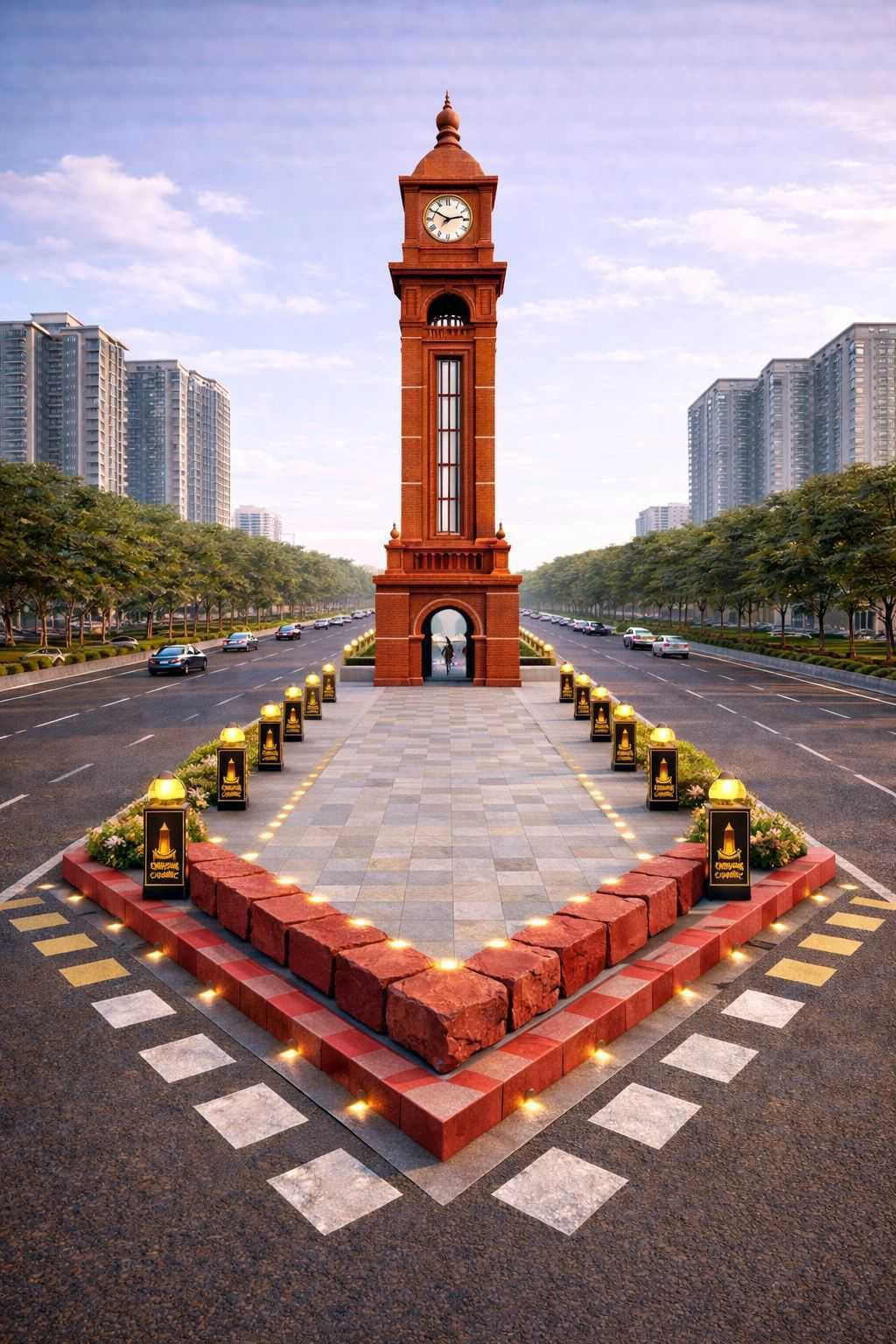
The clock installations across Noida are not the final step in the city’s beautification plan. The Authority has several future upgrades in discussion to further enhance their visual appeal and attract more visitors and daily commuters.
“We are planning to install lights and introduce light shows at night at these clock towers,” said Anand Mohan Singh.
He added that proposals also include increasing greenery around the clock sites. Showing pictures on his phone of proposed landscaping plans, Singh said discussions are currently underway within the Authority, and changes are expected to be implemented soon.
One of the proposed modifications includes transforming the Sector 18 clock tower into a more prominent selfie and public gathering spot by adding decorative wings on either side of the structure.
Also read: How Mehrauli went from cheap real estate & haunted houses to Delhi elite’s hottest party spot
Beautification v/s clock towers
For the Noida Authority, the clock towers are not just standalone installations but repeatedly described as elements of urban beautification, meant to create visual identity points across rapidly growing neighbourhoods.
But historian and Indologist Neeta Dubey sees a very different intent behind them. She traces the idea back to how clock towers historically shaped towns and cities and why the Noida clock doesn’t work for the city or its beautification and stands only as a show of political power.
“Traditionally, such structures helped in town planning. Streets would radiate from a central point, and that point became the identifier of the place. They were not just clocks—they were socio-cultural and economic markers where people gathered, interacted, and even organised political activity”, she said.
But in contemporary Noida, she argues, that original logic has been lost and even the structures are not worthy to stand and admire. Dubey points to the visual dominance of modern high-rise development in Noida, which she believes has further reduced the relevance of these structures.
“When you already have 20–25 storey buildings all around, a clock tower no longer becomes a focal point. It loses its original purpose of visibility and orientation. Today, they function more as meeting points than historical or architectural anchors,” she said.
Dubey rejects the framing of Noida’s clock towers as simple urban beautification, pointing instead to how older examples in Indian cities were organically integrated into their surroundings. She cites structures like the clock tower at Chennai Central Railway Station and heritage clock towers in cities such as Jodhpur, where the architecture blends with surrounding public spaces, markets, and transit hubs, creating a cohesive visual and spatial identity.
“Cities are not made beautiful by placing objects in them. They become beautiful when structures blend into their surroundings and become part of the city’s rhythm. If a clock tower does not integrate into that rhythm, it remains only an object in space, not part of the city’s identity”, she added.
(Edited by Anurag Chaubey)