







New Delhi: In a seismic shift in the geopolitics of West Asia, the United Arab Emirates (UAE) is redrawing its lines of influence in the region. At the heart of Abu Dhabi’s repositioning lies its evolving partnership with Israel.
Its exit from the Organisation of the Petroleum Exporting Countries (OPEC) last Tuesday marked the latest move by the UAE to carve its own vision onto the Arabian Gulf. Another dimension of this shift in West Asia is the growing faultline between Saudi Arabia, the preeminent power in the region, and the UAE, once seen as Riyadh’s closest partner.
Israeli Ambassador Reuven Azar, in an interaction with ThePrint newsroom last week said that the “turning point” in the region was the Joint Comprehensive Plan of Action (JCPOA) signed by the Obama administration with Iran, which worried nations in the region of Iran’s eventual ability to develop of a nuclear weapon.
“Five years before the Abraham Accords, was the first time we understood and many Gulf countries understood we were reading from the same page, when the JCPOA was signed. Because the JCPOA in our perspective is a huge threat for the region. It would only postpone the capability of Iran to have unlimited enriched uranium within 15-20 years, and then would be able to sneak out a nuclear arsenal in a matter of weeks,” Azar said.
He added: “Therefore at that point we started a process of rapprochement with the Gulf countries that culminated in 2020 with the Abraham Accords. I think we will continue to intensify our defence coordination, our intelligence exchanges we have with most Gulf countries. I think we have a common interest to deal with this threat.”
Nadeem Ahmed Moonakal, a research scholar at the International Institute for Iranian Studies (Rasanah) in Riyadh, explained to ThePrint, that even before the Abraham Accords, the UAE had “gradually” built “quiet channels” with Israel, which eventually evolved into a “clear alignment” with Tel Aviv due to “shared security concerns”.
“The convergence of interests and approaches between the UAE and Israel is rooted in both regional geopolitical changes and their evolving foreign policy priorities. In recent years, Gulf states have responded differently to these changes. The UAE has adopted a more assertive and adventurous posture. Abu Dhabi’s policies, especially across the Red Sea and the Horn of Africa, have at times been at odds with other Gulf states,” said Moonakal.
The Accords, according to Moonakal, was less a “departure” from UAE’s foreign policy trajectory, and more of a “culmination” of efforts that had been underway for a while.
The UAE and Israel have developed a close economic partnership, with trade in goods touching $3.2 billion in 2024, according to data published by the United Nations Comtrade database. Abu Dhabi remains Israel’s biggest economic partner in the region. Furthermore, ties have deepened in strategic areas. Israeli arms manufacturer Elbit systems opened an office in the UAE in November 2021.
According to media reports, the UAE was Elbit’s mystery $2.3 billion customer in a defence deal signed last year. In the current conflict between Israel, the US and Iran, Tel Aviv sent its Iron Dome air-defence system to the UAE along with troops to operate it, according to the American news organisation Axios.
The UAE, as ThePrint reported earlier, faced the brunt of Iran’s retaliation during the course of the 40-day war, with Tehran launching over 2,500 drones and missiles at the Emirates. The war has ensured closer Israel-UAE defence cooperation, further embedding Abu Dhabi in the US-security axis.
“At a time when perceptions of Israel have become increasingly negative, the UAE has also faced growing pressure, both in terms of public opinion and regional expectations. The fact that the UAE was among the most heavily targeted by Iran during the recent escalation has deepened concerns over its security, underscoring the fragility of the regional environment and reinforcing the reality that its broader ambitions ultimately hinge on credible deterrence,” said Moonakal.
The evolving UAE-Israel dynamic has set off a ripple effect across the region, as Abu Dhabi has looked to project its own power by moving away from its previous alignment with Saudi Arabia. This comes against the backdrop of Riyadh seeing competition from Abu Dhabi, which has sought to leverage its own economic power and its influence with US President Donald J. Trump, by doubling down on the US-security axis in the region, via its deepening partnership with Israel.
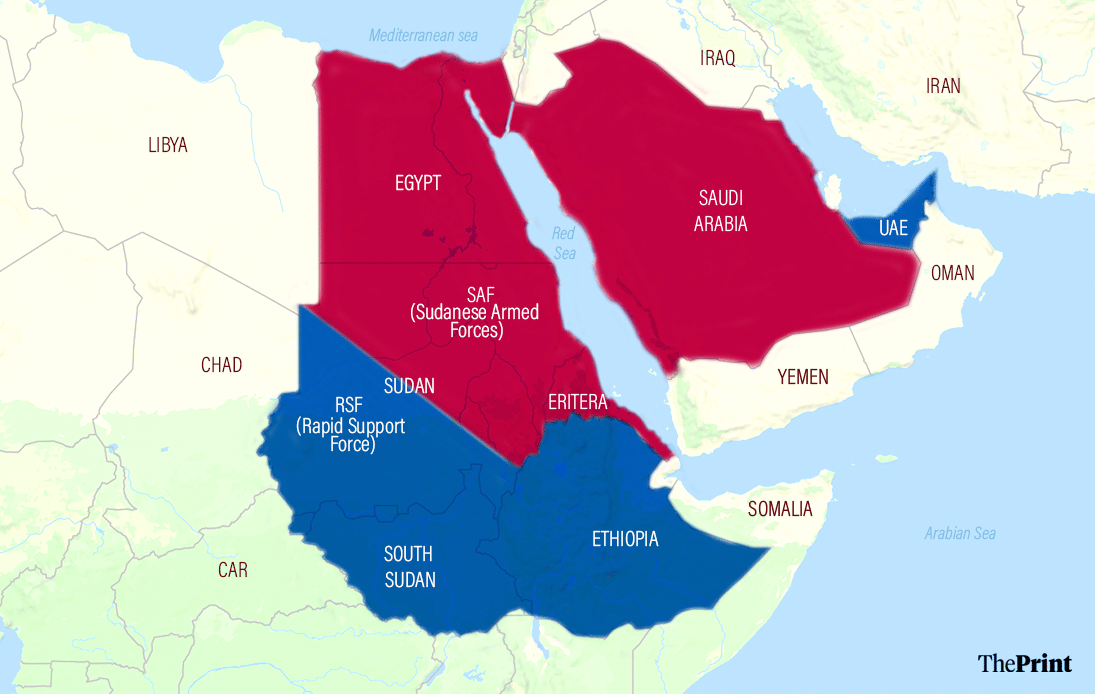
On more than one issue the UAE’s positioning has been at odds with Saudi Arabia, whether in Yemen, Sudan, Somalia and more recently with Eritrea and Ethiopia.
The Emirates was one of the first to sign on to the Abraham Accords in September 2020, normalising ties with Israel. The other country to sign onto the US-brokered agreement is Bahrain, home to America’s Central Command and the fifth fleet.
Also Read: UAE-Saudi Arabia rivalry & what Emiratis’ OPEC exit amid war in Iran means for Gulf’s oil cartel
UAE-Israel ties deepen, so do regional faultlines
In almost every sector of regional competition, the UAE has remained at odds with Riyadh’s interests. In Sudan, the UAE has backed the RSF or Rapid Support Forces—the armed militia—led by General Muhammad Hamdan Dagalo Musa, better known as Hemedti, which is currently in conflict with the Sudanese Armed Forces (SAF), backed by Saudi Arabia.
While the UAE maintains that its role in Sudan is humanitarian, media reports have indicated that the Emiratis have been moving weapons to back the RSF. In comparison, the SAF reportedly was keen on purchasing arms and munitions from Pakistan—a close Saudi ally—until the deals fell through earlier this month.
“I would say Emirati grouses with regard to Saudi Arabia and this idea that whatever happens, the UAE is going to remain in the Saudi strategic shadow in the region goes back to the 70s. Right after the Emirates was created, Saudi Arabia did not recognise the UAE. They didn’t do it until the Emiratis conceded that they would give up all claims on the narrow strip along the eastern coast [Buraimi Oasis dispute], which would have ensured the Emiratis a bridge to Qatar,” Bashir Ali Abbas, a senior research associate at the New Delhi-based think tank Council for Strategic and Defense Research, explained to ThePrint.
He added: “Across the board, you’ve always had grievances in the UAE where they’ve always conceded to the Saudis, especially strategically. And whenever they’ve tried to diverge, the Saudis have reacted very sharply…The cost of this is a quiet build-up strategically in Israel, because it is the only way for them to balance out Saudi hegemony. The UAE quitting OPEC is like that tectonic shift. It’s like a nine-pointer on the Richter scale.”
The competition in the Horn of Africa has heated up in recent months. Ethiopia, which was the centre of a civil conflict between 2020 and 2022 has come back into focus. Ethiopia’s Prime Minister Abiy Ahmed has been a close ally of the Emiratis in the region. In 2020, Abiy along with Eritrea, a country that gained its independence from Addis Ababa in 1993, teamed up to combat the Tigray People’s Liberation Front (TPLF).
The TPLF, located in Ethiopia’s Northern province of Tigray signed a peace deal in 2022—the Pretoria Agreement—which drove a wedge between Addis Ababa and Asmara. Ethiopia, the largest land-locked country in the world by population, lost access to the coastlines after Eritrea’s independence. Abiy’s publicly stated goal of ensuring Ethiopian access to the Red Sea, has set alarm bells ringing within the Eritrean establishment, according to a report by the Brussels-headquartered think tank International Crisis Group.
The report added that the ongoing conflict in Sudan, which neighbours both Addis Ababa and Asmara, has “fuelled” tensions between Ethiopia and Eritrea. Eritrea, and its foe-turned-partner, the TPLF, have tilted towards the SAF, while Addis Ababa has been building secret camps to train the RSF, according to a report by Reuters.
“The UAE’s involvement in Yemen, Sudan, and Libya has often been controversial and has exposed divergences with other gulf powers like Saudi Arabia. For example, in Yemen, tensions emerged over the UAE-backed Southern Transitional Council’s unilateral moves to assert control in the South, which ran counter to Saudi Arabia’s preferences and its support for the internationally recognized government, which Riyadh views as critical for domestic and regional stability,” said Moonakal.
Israel’s buildup in the region
Differences between the UAE and Saudi Arabia have impacted the politics around the Persian Gulf and the Horn of Africa, with Israel slowly building its own capacities in the region. In December 2025, Israel unilaterally recognised Somaliland as an independent country from Somalia, which put Riyadh in a difficult spot.
The UAE did not sign onto an Arab League-Organisation of Islamic Countries (OIC) joint statement condemning Israel’s recognition of Somaliland. It later signed onto a statement with the African Union condemning Tel Aviv. Regardless, Abu Dhabi has announced investments in Somaliland, according to media reports. In January Mogadishu annulled all its cooperation agreements with Abu Dhabi, further highlighting the fracture and competition in the region between various countries.
“In the current context, what we are witnessing is an attempt by Gulf states to expand their bandwidth to engage across multiple theatres and actors simultaneously. This is particularly important as each state recalibrates its foreign policy in response to shifting regional dynamics, evolving threat perceptions, and the limitations of existing security frameworks,” explained Moonakal.
Abbas, while discussing Tel Aviv’s “ultimate objective” of gaining recognition and normalisation of ties with Riyadh, explained that Israel may now be coming to the realisation that this opportunity has “vanished”.
The competition between the UAE and Saudi Arabia does not extend solely to West Asia and the Horn of Africa. There has been geopolitical movement potentially impacting India’s ties in the region, especially as Riyadh moved to sign a defence agreement with Pakistan last year.
India-Pakistan & a West Asia in flux
In the grander scheme of the play, faultlines between the UAE and Saudi Arabia, also play out to an extent in South Asia. Pakistan and Saudi Arabia signed a strategic mutual defence agreement (SMDA) in September 2025, to the surprise of many.
At the same time, India’s ties with the UAE have been deepening. Trade has grown following the signing of a comprehensive economic partnership agreement (CEPA) in 2022. New Delhi, Abu Dhabi and Tel Aviv are also part of the I2U2 grouping along with the US, signalling an alignment of strategic interests between the four countries.
Prime Minister Narendra Modi made a visit to Israel in February, days before the current West Asia conflict broke out. Modi is set to make a quick stopover to the UAE in May, before heading to Europe, as reported first by ThePrint. UAE’s President Sheikh Mohamed bin Zayed Al Nahyan, made a three-hour dash to New Delhi in January, months after the Pakistan-Saudi SMDA was signed.
Even as Pakistan and Saudi Arabia have seen growing defence collaboration, Islamabad’s ties with Abu Dhabi have hit a deep freeze. The UAE called for the return of $3.5 billion from Pakistan last month. The debt, which was first lent in 2018, had been rolled over for years until this March. Pakistan repaid the loan to the UAE earlier this month around the same time Riyadh wrote Islamabad a cheque of $3 billion.
“It is true that India has significantly deepened its engagement with Israel in recent years, particularly in security, defence, and technological cooperation. However, this has not come at the expense of its ties with other Arab powers, including the Gulf states. The GCC remains India’s largest trading partner bloc, which highlights its importance,” explained Moonakal.
He added: “India has also expanded ties with the UAE through constructive engagement, especially in trade, investment, and connectivity. Initiatives such as I2U2 reflect India’s growing interest in new frameworks that bring together economic and technological complementarities. However, the success of such initiatives ultimately depends on a stable regional environment, which in turn requires continued constructive engagement with a wider set of regional actors, especially amid regional and global geopolitical shifts.”
The Saudi-Pakistan alliance has not deterred India from continuing its engagement with Riyadh. National Security Adviser (NSA) Ajit Doval had made a visit to Saudi Arabia last week, as New Delhi continues to engage with Riyadh.
However, for Riyadh, Islamabad offers the Kingdom a strategic opening to China and Turkey. Apart from long-standing military cooperation, which has seen Pakistan deploy some 13,000 troops to the King Abdulaziz air base in recent weeks, according to reports, Islamabad remains an important node for Riyadh’s own ties with Beijing and Ankara.
“The fact that the Pakistanis are the only country, historically, to have had an outsized military presence in Saudi Arabia from the Ayub [Khan] era… It is Pakistan which has long experience in training Saudi troops. There is long-term strategic trust,” explained Abbas.
He added: “Right now, what the Saudis need is a massive ramping up of their military industrial capacities. For Saudi Arabia, their own defence industrial complexes are nascent. Because MBS [Mohammed bin Salman, the Crown Prince of Saudi Arabia] realised that Saudi Arabia might be one of the largest defence spenders in the world, but only spending it on foreign equipment…But here’s the deal, it’s like a truism. It’s not Pakistan alone. It’s China and Turkey as well.”
Islamabad is a “node” between “two defence manufacturing giants”—Beijing and Ankara—highlighted Abbas, adding that Riyadh is taking a gamble on Pakistan’s ability to aid Saudi’s outreach to China and Turkey’s manufacturing heft. Riyadh has also left room to move on in the event that Pakistan is unable to deliver.
The evolution of the UAE-Israel partnership remains key to Abu Dhabi’s aspirations to set its own terms for the future of West Asia, while it continues to project its power across the region, along with the Horn of Africa and the Indian Subcontinent. Coupled with the fracturing of ties with Saudi Arabia, the region is witnessing a growing jockeying between different states to make sense of the unfolding changes in power and order in West Asia.
(Edited by Amrtansh Arora)
Also Read: Iranian, Emirati FMs & Saudis likely to come face-to-face at BRICS foreign ministers’ meet in Delhi