






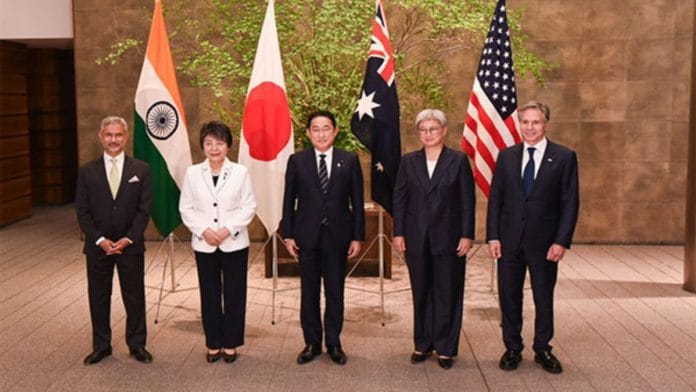


As New Delhi prepares to host the latest edition of the Quad foreign ministers’ meeting on 26 May, the absence of a leaders’ summit looms large. While the easiest conclusion may be that the Quad is experiencing an irreversible drift, such a reading would be tempting yet incomplete.
The optics are certainly less than ideal, but technical-level engagements and functional cooperation across several pillars have continued, keeping the strategic rationale and utility of the grouping intact, even if somewhat shaken.
Emerging literature on the Quad captures this ambiguity and uncertainty. While some emphasise how Washington’s economic coercion and limited strategic bandwidth have not made the functioning of the grouping any easier, others underscore the continued significance of such minilaterals amid shifting political attention caused by simultaneous regional wars and an increasingly fragmented global order. Both assessments contain elements of reality, but for India, the key takeaway is that the Quad’s relevance cannot be measured solely through the calendar of leadership summits or the vagaries of geopolitics.
The geopolitical backdrop is unmistakably messy, despite US Secretary of State Marco Rubio choosing to begin his first day in office with a Quad foreign ministers’ meeting in January 2025. However, the second Trump administration’s preoccupation with trade wars and crises elsewhere has emitted signals of diminishing attention toward the Indo-Pacific. The uneven agenda has certainly generated perceptions of strategic drift, but perceptions do not always translate into policy, and it would augur well for New Delhi to focus on the institutional web of linkages and functional areas of cooperation enabled under the aegis of the Quad.
Angels in the details
The last Quad leadership summit in 2024 in Wilmington, Delaware, described the Quad as “more strategically aligned than ever before” and laid out an extensive scope of cooperation spanning health security, maritime domain awareness, infrastructure, cables, semiconductors, logistics and education. Subsequently, India hosted the 1st Quad Ports of the Future Conference in October last year with participation from 120 delegates representing 24 Indo-Pacific partners.
The discussions “centred on advancing a shared Quad vision for resilient, secure & future-ready ports strengthening collaboration on infrastructure, financing, regulatory frameworks, workforce development, technology, digital ecosystems, cybersecurity & sustainability.”
Initiatives such as the Indo-Pacific Partnership for Maritime Domain Awareness (IPMDA) are not exercises in abstract values but carry tangible, real-world significance by harnessing “innovative technology, such as commercial satellite radio frequency data collection, to provide partners across Southeast Asia, the Indian Ocean region and the Pacific with near real-time information on activities occurring in their maritime zones.”
Operating in concert with the IPMDA will be the Quad Indo-Pacific Logistics Network (IPLN), which enables “Quad partners to leverage shared logistics capabilities in the Indo-Pacific to support civilian response to natural disasters more rapidly and efficiently across the region.”
The July 2025 foreign ministers’ meeting in Washington further launched the Quad Critical Minerals Initiative while reaffirming cooperation on maritime law enforcement, expanded IPMDA activities, and outlining practical next steps on ports, undersea cables, digital infrastructure, AI, agriculture, scholarships, and humanitarian response. In June last year, the Coast Guards of the Quad countries launched the first-ever “QUAD at Sea Ship Observer Mission,” complementing India’s MAHASAGAR vision and national efforts under the Indo-Pacific Oceans Initiative (IPOI), with a focus on “capacity-building, humanitarian outreach, and maritime rule of law.”
The 3rd Quad Counter Terrorism Working Group (CTWG) meeting was held in New Delhi in December 2025, and in the same month, Quad partners successfully conducted their first Field Training Exercise (FTX) at Andersen Air Force Base, Guam, as part of the Quad IPLN. Taken together, these developments reinforce the argument that the Quad’s machinery has continued to function despite bleaker political headlines, and that is precisely why premature obituaries of the grouping could prove misleading.
Sustaining such functional cooperation matters for India far more than the atmospherics because the Indo-Pacific challenges confronting New Delhi are no longer confined merely to the military balance of power, but have become far more comprehensive, encompassing a broad spectrum of non-military domains of competition and cooperation. The Quad’s practical agenda of operationalisation sits at the intersection of security and economics, while its emphasis on interoperability and habits of cooperation in the maritime and logistics domains carries significant long-term importance, particularly when it comes to securing sea lanes of communication (SLOCs).
Also read: The rupee’s decline is part of the solution, not the problem
Coherence in times of churn
The rise of minilateral groupings like the Quad reflects the growing preference for platforms that offer greater traction and flexibility in delivering issue-based cooperation across domains where New Delhi requires trusted partners. As mentioned earlier, these areas, among others, include maritime domain awareness, supply chain resilience, emerging technologies, and disaster response. In an era of geopolitical churn such as the one currently unfolding, issue-based coherence matters more than sheer scale and scope.
America’s strategic distractions in Europe and West Asia, coupled with the growing perception of Washington’s attention deficit, should serve as an even greater reason for partner countries within the grouping to sustain and deepen cooperation. The Quad’s political heft and optics may have weakened, but its practical agenda has not eroded, and this distinction remains germane for New Delhi as it prepares for another round of diplomacy at the foreign ministers’ level.
Framing the Quad as a loosely held architecture focused on functional cooperation fits well within India’s own strategic vocabulary. India has refrained from describing the Indo-Pacific as a strategy and has consistently rejected calls for the Quad to evolve into an “Asian NATO” that would play into China’s narrative that the grouping is primarily aimed at containing Beijing. The structure of the Quad does not negate India’s participation in other forums; rather, it complements New Delhi’s wider networked diplomacy, including its role in BRICS. As External Affairs Minister S Jaishankar noted during an interaction in Washington DC in October 2024, “you would not have had a Quad in the non-aligned era. You would have a Quad in a multi-alignment era.”
Therefore, India’s engagement with the Quad is not a departure from strategic autonomy but an expression of it. In the era of multi-alignment, strategic autonomy means engaging different partners, in different forums, on different issues, without allowing any single alignment to define the trajectory of India’s foreign policy. That is why the upcoming Quad foreign ministers’ meeting matters: it must sustain the practical agenda, functional cooperation, and focus on tangible deliverables.
The logic of contemporary geopolitics calls for recognising the Quad for what it is—an informal and flexible grouping capable of advancing regional coordination, balancing, and the distribution of public goods in an increasingly uncertain Indo-Pacific. New Delhi, therefore, should neither overreact to temporary optical setbacks nor underestimate the long-term value of keeping the Quad tab open.
Monish Tourangbam is a Fellow at the Chintan Research Foundation (CRF), New Delhi. Views are personal.
(Edited by Saptak Datta)