







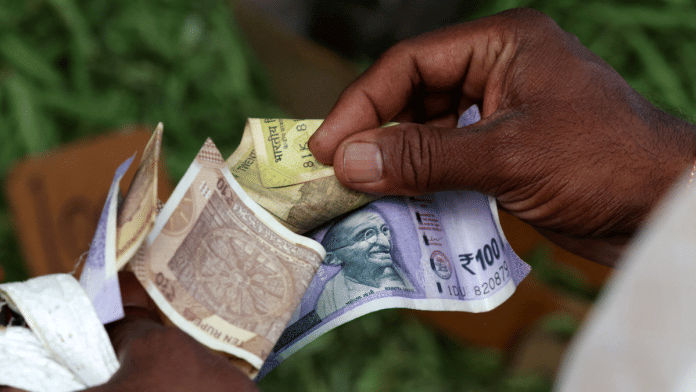


On 12 May, the Prime Minister urged Indians to reduce foreign travel, buy less gold, and cut consumption of imported goods. The appeal came amid the ongoing conflict in West Asia, which has raised India’s import bill and increased pressure on the rupee against the US dollar. The objective was arguably to conserve foreign exchange and limit the rupee’s decline.
Exchange rates are often viewed as symbols of national pride. But a currency is not a flag. It is a price—specifically, the price of one currency in terms of another. And like all prices, it needs to move to balance demand and supply when economic conditions change. During global shocks, a weaker rupee can help the economy adjust by discouraging imports, supporting exports, and attracting foreign capital. Trying to prevent this adjustment can create other economic strains.
A recap of why the rupee is under pressure
India imports nearly 90 per cent of its crude oil and about half of its natural gas needs, making the economy highly vulnerable to global energy shocks. Since the conflict in West Asia began, Brent crude prices have risen from about $71 per barrel to nearly $108—an increase of more than 50 per cent—largely because of disruptions to shipping routes through the Strait of Hormuz. This has sharply increased India’s import bill.
Higher imports widen India’s current account deficit (CAD)—the gap between what Indian firms, households and the government spend on imports and earn from exports. Normally, this gap is financed by foreign investment flowing into Indian financial markets. The war, however, has made global investors more cautious. Since the conflict began, foreign investors have withdrawn around Rs 2 trillion ($21 billion) from Indian financial markets. With fewer capital inflows available to finance the larger import bill, the rupee has come under sustained pressure and has depreciated by roughly 2 per cent since the conflict began.
Also read: The rupee at record low will end India’s cheap- money era
Five myths about the rupee
Before discussing why a weaker rupee might in fact help India right now, it is worth clearing up five common misconceptions.
First, a weaker currency does not necessarily mean a weaker economy. Japan offers a useful example. One US dollar currently buys around 158 Japanese yen—much more than the roughly 96 rupees needed to buy a dollar. Yet Japan is one of the world’s richest economies, with a per capita income of about $35,000 compared to India’s roughly $2,600. The numerical value of a currency tells us very little about a country’s economic strength.
Second, economists estimate that if oil prices remain high, India’s CAD could rise from about 0.8 per cent of GDP in 2025–26 to above 2 per cent next year. This has added to concerns about the rupee. But a CAD is not necessarily a sign of weakness—it needs to be interpreted correctly.
The Balance of Payments has two sides. The current account records trade in goods and services—when India imports oil, dollars leave the country; when India exports software, dollars come in. The capital account records cross-border investment flows—when a foreign investor buys Indian shares, dollars enter the country. By accounting logic, the two sides must always balance. When the current account is in deficit, the gap is financed by net inflows on the capital account—typically foreign investment. The problem arises when capital inflows are insufficient to cover the deficit. That is precisely India’s situation today, and it is what creates pressure on the rupee. How that pressure resolves itself is our next point.
The third misconception is that the RBI must intervene in the foreign exchange market—selling dollars from its reserves—to stabilise a falling rupee. In reality, there are two ways to close the gap between the current account deficit and available capital inflows, and RBI intervention is only one of them.
Consider a simple example. Suppose India’s CAD is $50 billion but foreign investors bring in only $30 billion. This creates an excess demand for $20 billion—in other words, more people want dollars than are available. One option is for the RBI to fill this gap by selling $20 billion from its reserves—this is what happens in a managed exchange rate system. The other option is for the RBI to do nothing and to let the rupee fall. A weaker rupee helps reduce the imbalance by setting in motion several corrective forces that we outline in the next section. The main point here is that the gap between the current and capital accounts can close through the price mechanism rather than through RBI’s reserve use.
This market-led adjustment is often more sustainable because no institution, including a central bank, can reliably determine the “correct” exchange rate. Foreign exchange reserves are finite. If the underlying gap between dollar demand and supply remains large for long enough, defending a particular rupee level can become increasingly difficult and costly.
Fourth, many people assume that the RBI holds foreign exchange reserves primarily to intervene in currency markets and stabilise the rupee. That is not entirely accurate. The word “reserves” itself can be misleading.
Like all central banks, the RBI prints money—the rupee—which appears as a liability on its balance sheet. To back these liabilities, it holds assets. These assets can be domestic, such as Indian government bonds, or foreign, such as US government bonds and other foreign-currency assets. India’s foreign exchange reserves are essentially these foreign assets held by the RBI.
In that sense, reserves are not a separate pool of money kept aside solely to defend the currency. They are part of the RBI’s overall balance sheet and reflect how it chooses to allocate its assets.
The foreign exchange market, meanwhile, functions like any other market. Businesses, banks, importers, exporters, investors, and traders buy and sell dollars among themselves. The RBI is not required to participate in this market. But it often chooses to do so by buying or selling dollars from its balance sheet rather than allowing the rupee to adjust fully to changing demand and supply conditions.
Finally, rupee depreciation is often viewed as inherently harmful for India. Currency depreciation can indeed create problems in countries where governments, firms, or households have borrowed heavily in foreign currencies. This was a major factor behind the East Asian financial crisis of the late 1990s: When local currencies collapsed, the domestic burden of dollar-denominated debt surged.
India, however, is not in that position. Foreign-currency debt across Indian households, firms, and the government remains relatively limited. As a result, the risks associated with a weaker rupee are much smaller than in economies that rely heavily on borrowing in foreign currencies.
Also read: The rupee must fall harder and faster. It’s the path that will lead India to prosperity
Why rupee depreciation is part of the solution
The exchange rate is one of the main mechanisms through which an economy adjusts when foreign exchange demand exceeds supply. In India’s current situation, the rupee is performing exactly that role.
Recalling our earlier example: When there is a $20 billion excess demand for dollars, the most efficient resolution is for the rupee to depreciate until that gap closes on its own—without the RBI having to spend a single dollar of reserves. There are two main channels through which this self-correction works.
First, a weaker rupee makes Indian goods cheaper for foreign buyers, boosting export volumes and bringing more dollars into the country. Simultaneously, imports become more expensive for Indian consumers and firms, dampening demand and reducing the outflow of dollars. Both effects work in the same direction—narrowing the CAD automatically, through the price system, without any administrative intervention or appeal to citizen behaviour.
Second, a weaker rupee can also encourage foreign investment to return. Once the rupee has fallen, the risk of further depreciation diminishes and the prospect of a future recovery improves. Indian stocks and bonds also become cheaper in dollar terms, making them more attractively priced. Together, these forces draw foreign capital back into Indian markets—bringing in precisely the dollars needed to finance the CAD.
Both channels—stronger exports and returning capital flows—work simultaneously and in the same direction. The rupee continues to fall until these self-correcting forces have collectively closed the $20 billion gap. No reserves need to be spent. The market does the work.
One consequence of a weaker rupee is that imports become more expensive, which can add to inflationary pressures. But inflation is better addressed through monetary policy tools—specifically, by the RBI raising interest rates. Attempting to suppress inflation by propping up the exchange rate risks creating larger imbalances elsewhere.
Also read: Modi’s call to cut fuel use wasn’t just about oil—it was about saving the rupee
Prices work better than appeals
The government’s appeal to citizens to spend fewer dollars is well-intentioned, but voluntary behavioural change is an uncertain instrument. A weaker rupee achieves the same outcome automatically and faster. Foreign travel becomes costlier, gold imports dearer, and demand for imported goods softens—all through the price system, without any exhortation. At the same time, exporters gain a natural competitive advantage and Indian assets become more attractively priced for foreign investors.
The rupee’s depreciation, in this context, is not a crisis to be resisted. It is an adjustment mechanism doing precisely what it is designed to do. The appropriate policy response is to allow that adjustment to proceed, while maintaining macroeconomic stability and institutional credibility that will bring foreign capital back over time.
Rajeswari Sengupta is an Associate Professor of Economics at IGIDR, Mumbai. Bhargavi Zaveri-Shah is the co-founder and CEO of The Professeer. She tweets @bhargavizaveri. Views are personal.
(Edited by Theres Sudeep)
Mixed views on this. Since college, when we were taught that a “ weak “ currency is good for exports. Irrespective of which political party or formation is in power, a strong currency signifies that the economy is sound, well managed, harvesting growth opportunities., the government is fiscally prudent. For a long time, China’s success in exports was attributed to “ currency manipulation “. Not acknowledging that it rested on a very globally competitive manufacturing sector.
We need more of such sane articles reaching everyone than those filled with political slugfest. The states intervention creates unnecessary distortion…. like a lie that needs more lies to sustain itself.