





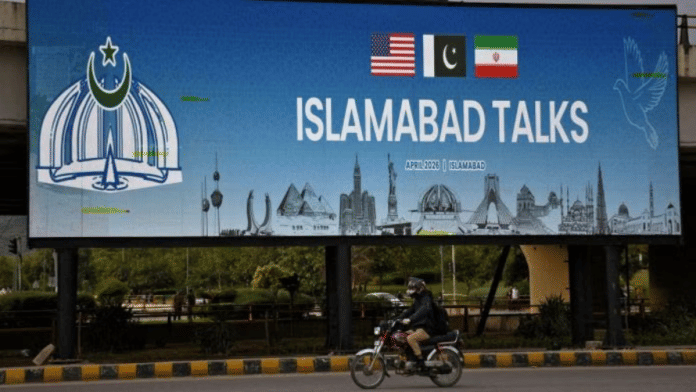


New Delhi: Pakistan’s deepening ties with Saudi Arabia, its “meek response” to Iranian strikes on the UAE and its ambition to play peacemaker between the US and Iran were among the key reasons that prompted Abu Dhabi to demand its $3.5 billion back from Pakistan immediately, according to a report in the Financial Times.
These funds were part of a $6.2 billion external financing support extended by the UAE in 2019 to stabilise Pakistan’s balance of payment crisis. The State Bank of Pakistan announced $3.45 billion was paid back on 23 April.
Analysts say Abu Dhabi’s decision reflects its growing frustration with Islamabad, which signed a mutual defence pact with Riyadh last year, amid a growing rift between the two gulf states.
The rift between Saudis and the Emiratis burst into the open in December and January as the two gulf powerhouses were backing rival factions in the civil war in Yemen.
“The rift is still there, and Pakistan is one area it can play out, and the UAE is much more invested in India anyway,” Neil Quilliam, an associate fellow at Chatham House, has been quoted as saying in the FT report.
Another reason for the UAE’s frustration with Pakistan is its efforts to mediate between US and Iran. “There’s no neutrality in this (from the UAE perspective), there’s no middle ground and if you’re mediating then you are in the middle ground,” he told the FT.
The report also says Pakistan’s “meek response” to Iranian attacks on the gulf states in response to US and Israeli strikes has also annoyed the UAE.
A fifth of Pakistan’s central bank reserves can get drained and a $7 billion IMF bailout programme, agreed in 2024 may get jeopardized if Pakistan fulfilled Abu Dhabi’s demand from internal resources.
However, Saudi Arabia came to its rescue with $3 billion fresh central bank deposits and an extension of $ 5 billion existing loan for more than a year.
Concerns over Saudi financing
While Pakistan’s foreign ministry has described the decision to return the money as a “routine financial transaction” and denied any gap developing between Islamabad and Abu Dhabi, FT cites three Pakistani advisers as saying that the UAE has signalled Islamabad to take a harder line against Iran.
Privately, officials in Islamabad have also voiced frustration over Abu Dhabi forging closer ties with its arch-rival India. Pakistan, since last year, has been trying to secure a roll-over of at least $2 billion of Emirati loans for two years, but Abu Dhabi only allowed monthly extensions since January, the report cites two people familiar with the matter.
The UAE’s decision to seek repayments also surprised the International Monetary Fund as the gulf nation had earlier promised the Fund that it would not seek repayment until the end of Pakistan’s programme in 2027, precondition for the approval of a bailout for Islamabad.
The move has also led to the end of the Pakistani proposal, which according to its foreign minister was agreed with the Emiratis in December to convert $1 billion of debt into investment into military-linked conglomerate, the Fauji Foundation, as that money will now have to be repaid to the UAE.
Meanwhile, concerns are rising over Pakistan’s overreliance on Saudi Arabia, with some observers pointing out that financing from Riyadh is now equivalent to roughly half of Pakistan’s central bank reserves of $16bn.
As the US and Iran agreed to a two-week ceasefire earlier this month, Pakistan stationed troops and fighter aircraft in Saudi Arabia as part of their defence agreement. Riyadh expected this would deter Iran from launching strikes against the Gulf Kingdom but that has not been the case, according to the report.
“The Saudis never had any illusions about Pakistani help and were simply hoping Iran would think twice before attacking them. This proved wrong,” the FT report quotes Bernard Haykel, a professor of near eastern studies at Princeton University, as saying. “Saudi cannot afford to bail out Pakistan.”
(Edited by Ajeet TIwari)