



New Delhi: A little over three years after ethnic conflict between the non-tribal Meiteis and tribal Christian Kukis erupted in Manipur, the state government and security establishment are growing increasingly concerned over the recent spate of incidents in which the Nagas, another tribal community, have clashed with the Kukis.
The Nagas, who constitute approximately 24 percent of Manipur’s population and are concentrated mostly in the hill districts of Ukhrul, Senapati, Chandel, Tengnoupal and Tamenglong, had mostly stayed away from the Meitei-Kuki conflict since May 2023.
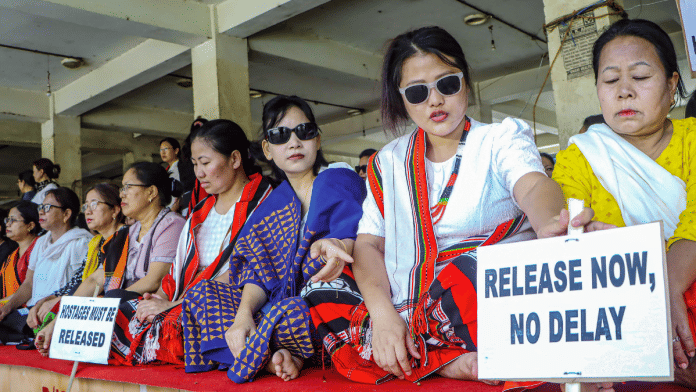
However, since February, there have been at least 17 instances of violence between the Nagas and Kukis, leading to close to a dozen deaths on both sides. Houses belonging to both communities have been vandalised and torched. Last week, tensions flared again after 44 Naga and Kuki civilians were held hostage by either side. While most of the abducted persons have been released, 14 Kukis continue to be held hostage by the Nagas, while six Naga men are allegedly being held by the Kukis.
A senior official in the security establishment told ThePrint that with the recent spike in incidents involving the two communities, their primary concern has now “shifted from Meitei-Kuki to Naga-Kuki”.
“The focus is to stop any such incident between the Nagas and Kukis from spreading. Two companies of the Rapid Action Force have already been moved from the valley to Kangpokpi and Senapati, areas where Kukis and Nagas live side by side,” said the official, who did not wish to be named.
The official added that initially, when the first incident occurred in Litan village in Ukhrul, it was the Tangkhul Nagas who clashed with Kukis. Gradually, however, other Naga tribes such as the Rongmei, Liangmai and Zeliang have also become involved.
According to a senior police officer, one of the first incidents between the two communities began in Ukhrul, when a Naga teacher passing through the area saw a few Kuki youths sitting and drinking. He reportedly asked them to stop, which led to an altercation.
What followed were allegations and counter-allegations from both sides. The Nagas accused the Kukis of extortion, alleged that some among them were linked to militant outfits, and reportedly told them to vacate Ukhrul. The Kukis, in turn, made similar accusations against the Nagas, further escalating tensions.
The confrontation soon spiralled into scuffles and then violence, triggering a cycle of civilian abductions, hostage crises, and the burning of villages that has continued since February.
The concern of the authorities is not without reason. Nagas and tKukis have a history of prolonged conflict. The last major clash, which erupted in 1992, lasted for over five years. Approximately 1,000 people were reportedly killed and several thousand displaced.
In 2016, the United Naga Council blocked National Highways 2 and 37 for 136 days to protest the then Okram Ibobi Singh-led Congress government’s decision to carve out seven new districts in Manipur—Jiribam, Kamjong, Kakching, Tengnoupal, Noney, Pherzawl and Kangpokpi.
The Nagas claimed that the districts were carved out by encroaching on land belonging to their forefathers.
What is behind the Naga involvement
Officials in the Manipur government and security agencies told ThePrint that there is no single reason behind the Nagas getting involved in the conflict with the Kukis now. They said it is a mix of political aspirations, insecurity over losing land and sharing of resources, and the rift within the Isak Muivah faction of the National Socialist Council of Nagaland (NSCN-IM), with breakaway factions like the Eastern Flank allegedly trying to use the conflict to expand their sphere of influence.
“It is very complex. There are multiple factors behind the Nagas getting drawn into the conflict. Besides political aspirations, one reason could be insecurity over their land,” an official said.
The official added that the Nagas are deeply possessive about their land. “Though both communities have lived alongside each other for years, with the Kukis demanding a separate administration, the Nagas could feel threatened that it would mean the Kukis laying claim to their land,” one of the officials said.
Another issue is the sharing of resources between the two communities. Following the displacement of Kukis from the valley areas, many moved to the hills, including regions inhabited by Nagas, putting pressure on local resources. With Kukis now becoming more assertive, tensions with the Nagas have grown, making minor skirmishes in some areas increasingly unavoidable.
“Twenty-five years ago, Kukis used to pay taxes to the Nagas because they were living in Naga villages. They had even given this in writing, acknowledging that they were residing in Naga areas, were grateful for it, and would contribute their share for the use of resources. Now, they are no longer doing that, which has also become a point of contention,” a senior police officer explained.
The officer said that Kukis—who also have militant groups and access to arms—are now asserting their influence more strongly, and their continued presence on what Nagas consider their resources has become a source of resentment.
The officer further explained that the conflict is also driven by economics. The Wangli–Dimapur road has now become a critical route; earlier, Moreh held that importance. Much of the trade— and even some smuggling—passes through this corridor. Control over that stretch has emerged as another major point of contention between the two communities, an intelligence source said.
A section of the government also views the Kuki-Naga clashes as an attempt by vested interests to destabilise the over three-month-old government of Yumnam Khemchand Singh. “Violence had decreased during President’s Rule, but suddenly after the new government was formed, it has reared its head again,” a senior state government official said.
Singh was sworn in as CM after a year of political uncertainty in the state following the resignation of ex-CM N. Biren Singh and imposition of President’s Rule in the state.
Security agencies also blame the rift between the NSCN(IM) and the Eastern Flank—which split from the NSCN(IM) in April 2024—for fuelling the conflict, with both groups allegedly trying to establish dominance in Naga-dominated areas.
“We have received information about the involvement of cadres from different NSCN factions in the recent clashes with Kukis. On 28 March, there was an ambush by a group of NSCN(IM) cadres against the Eastern Flank in Hongbei village in Kamjong district, in which four cadres of the latter were killed,” the security official quoted earlier said.
The official added that three days later, mobs vandalised houses belonging to top NSCN(IM) leaders in Ukhrul, including that of V. S. Atem, deputy of NSCN(IM) general secretary Thuingaleng Muivah. “The rift within the NSCN is spilling out into the open, with different factions trying to establish their hold in Naga areas.”
The NSCN(IM) has been engaged in peace talks with the Government of India for more than two decades. Despite the signing of the Framework Agreement in 2015, the talks have not made much headway.
ThePrint reached out multiple times through calls and WhatsApp messages to Manipur CM Y. Khemchand Singh and deputy CM Losii Dikho, a Naga, for comment, but they did not respond. This report will be updated if and when they respond.
Charges and countercharges
The current clashes involving the Eastern Flank, the National Socialist Council of Nagaland, and Kukis appear to signal a breakdown in the equations that had existed between the two communities until now.
After the 1992 conflict, which dragged on for five years, both communities had reconciled and lived alongside each other in the hills. “Even in Naga-dominated districts like Senapati and Ukhrul, there are Kuki villages. In Kuki-dominated districts too, Nagas live next to Kuki villages. But the dynamics have changed to some extent, with the Eastern Flank, NSCN and Meitei militants attacking vulnerable Kukis and attempting to draw in the Nagas,” Selien Haokip, spokesperson for the Kuki National Organisation (KNO), told ThePrint.
The KNO and the United People’s Front (UPF) signed the Suspension of Operations (SoO), a tripartite agreement with the Centre and the Manipur government, to end hostilities, engage in political dialogue and settle demands for self-governance within the constitutional framework.
According to Haokip, some Nagas are also being instigated by Meiteis. “Kukis and Nagas have coexisted for generations. The 7 February incident in Litan village in Ukhrul district was an isolated case of two drunk men—one Tangkhul and one Kuki—getting into a brawl. Both communities wanted to resolve the issue, but the next day armed Tangkhuls torched our village. The situation deteriorated from there,” he said, adding that the majority of Tangkhuls and the NSCN-IM do not want conflict.
Haokip added, “In pre-colonial days, Meiteis and Kukis had cordial relations. The British lumped them together for administrative convenience. Of late, Kukis have faced repeated provocations. We want peaceful coexistence with our neighbours. However, we have to protect our people and save our villages from being burnt; we have to defend ourselves.”
The Nagas, on the other hand, hold the Kukis responsible for allegedly failing to release six of their people, who were abducted from Leilon village in Kangpokpi district on 13 May.
A.C. Thotso, working committee secretary of the United Naga Council (UNC), told ThePrint that the Kukis have forgotten the hospitality extended by the Nagas to them at the peak of the Meitei-Kuki conflict. “They repaid our hospitality with bullets—playing the victim card while being the aggressor,” he said.
The Kukis, Thotso added, have now started attacking the Nagas and their history by demanding separate administration within the Naga homeland. “They have taken our generosity for granted. What the Kukis are doing now is a serious form of organised and coordinated external aggression in our homeland.”
Thotso further said they have evidence of the involvement of Kuki armed groups that signed the Suspension of Operations (SoO) agreement with the Centre and the Manipur government during the recent attacks on Nagas.
“This has raised serious political questions, suggesting the emergence of a proxy dynamic that threatens our land, identity and the collective rights of the Nagas. This could be a sinister policy to sabotage the long-standing Indo-Naga ceasefire peace process and the Framework Agreement that the NSCN and the Government of India entered into for an enduring peace settlement, and must be viewed with grave concern,” he added.
This is an updated version of the story.
(Edited by Viny Mishra)
Also read: Manipur’s Kuki-Naga hostage crisis drags into 2nd week as talks fail to break deadlock