



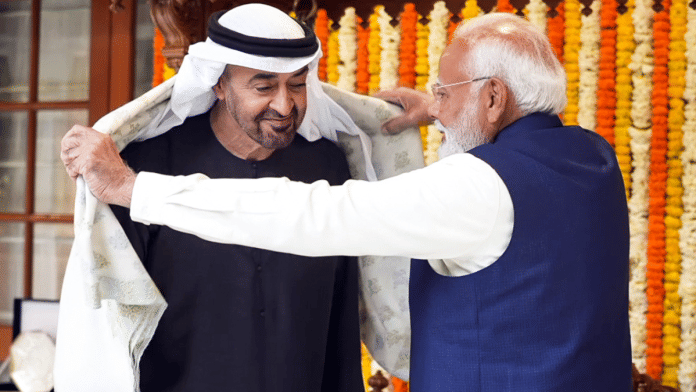

New Delhi: Amid the churn in West Asia, Prime Minister Narendra Modi is set to make a quick stopover in United Arab Emirates (UAE) mid-May before continuing on his visits to multiple European countries, ThePrint has learnt.
His three-hour visit will include a meeting with Emirati President Sheikh Mohamed bin Zayed al Nahyan (MBZ) and is likely to focus on the situation in the region and reliable energy supplies. They will also discuss ways to deepen the economic engagement between the two countries.
Interestingly, PM Modi’s visit comes just months after MBZ made a three-hour standalone visit to New Delhi on 19 January.
The visit had taken everyone by surprise and came just months after Saudi Arabia and Pakistan formally signed a defence pact under which Pakistani fighter jets and personnel are deployed in King Abdul Aziz Air base in the Eastern Province.
UAE is in the thick of the ongoing Israel-US vs Iran war and has witnessed more than 2,500 missile and drone attacks, more than what Israel faced from Tehran.
Incidentally, UAE on Tuesday walked out of the OPEC and OPEC+ over differences with both Iran and Saudi Arabia.
While Saudi Arabia and Pakistan ties have grown stronger, Islamabad’s ties with Abu Dhabi have hit a low. Pakistan was forced to return $3.5 billion to UAE last week after Abu Dhabi insisted on repayment over Pakistan’s parleys with Iran.
For months, ties between Abu Dhabi and other members in the region, particularly Saudi Arabia, have been tense. UAE exited the Saudi-led coalition in Yemen at the end of last year, after Riyadh accused Abu Dhabi of supporting the separatist Southern Transitional Council (STC), which was a constituent part of the internationally-recognised Presidential Leadership Council (PLC) of the war-torn country.
The STC had raised the flag of rebellion against the PLC in the waning months of 2025, while promising independence for Southern Yemen within a few years. The leader of the STC, Aidarus al-Zoubaidi, fled Yemen to UAE via Somaliland, according to Saudi Arabia.
The wider fractures between the UAE and Saudi Arabia will likely impact India’s positioning in the region. India has deepened its engagement with the UAE in recent years, even signing a comprehensive economic partnership agreement (CEPA) in 2022, which has seen an increase in trade between the two countries.
India and the UAE have also been working closely on a deeper logistics network as a part of the larger vision of an India-Middle East-Europe Economic Corridor (IMEC). Saudi Arabia is also a member of IMEC.
India’s National Security Adviser Ajit Doval has also made visits to Saudi Arabia and the UAE in the last week, as New Delhi continues its engagement with West Asian nations. India’s energy security has been heavily impacted by the West Asian war. The effective closure of the Strait of Hormuz by Iran has impacted India’s imports of liquefied petroleum gas (LPG) and liquefied natural gas (LNG).
India has long-term contracts with Qatar and the UAE for the supply of LNG. The UAE faced the brunt of Iran’s retaliation during the 40-day war in the region.
Modi’s quick stopover in the UAE will not be his first visit. In July 2023, the Indian Prime Minister made a brief visit to the country after being the guest of honour at France’s Bastille Day parade.
From the UAE, the Prime Minister is expected to travel to Italy for a bilateral visit, before making visits to Norway, Sweden and the Netherlands. In Norway, Modi will participate in the third India-Nordic Summit. The summit was originally scheduled in May 2025, but was postponed following Operation Sindoor and the 87-hour India-Pakistan conflict.
In Europe, the Prime Minister is expected to discuss multiple issues including the situation in West Asia and the Russia-Ukraine war.
(Edited by Viny Mishra)
Also read: Deepening Gulf tensions laid bare as UAE quits OPEC amid widening rift with Saudi and Iran
India could absorb part of the additional 1.5 million barrels per day that UAE is likely to produce, once it is freed from quotas imposed by OPEC plus.