





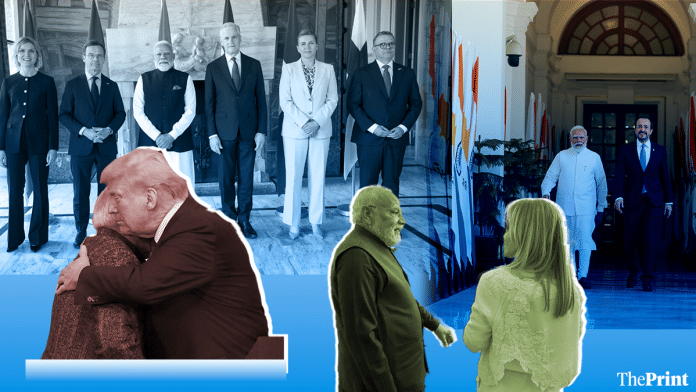


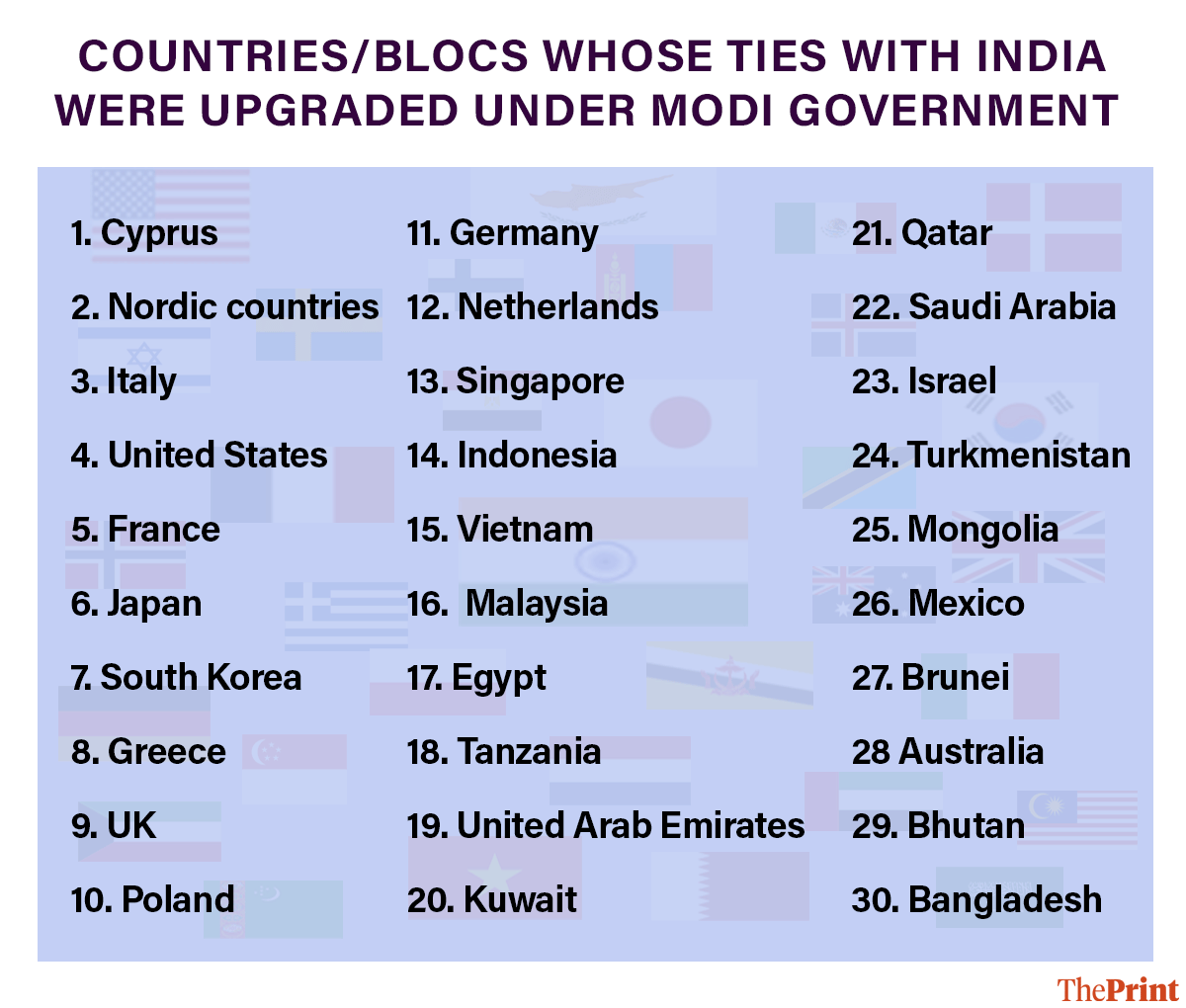
New Delhi: Earlier this week, India elevated its ties to strategic partnerships with Cyprus, Italy, and the Nordic countries. In a joint press statement in New Delhi, India and Cyprus announced Friday they would elevate their relationship to a ‘Strategic Partnership’, a move Prime Minister Narendra Modi said gives “new ambition and new momentum” to bilateral ties.
Over the last decade, New Delhi has expanded its strategic partnerships across geographies and areas such as defence and technology, trade, connectivity, and energy security.
During PM Modi’s visit last Wednesday, India and the Nordic countries decided to elevate their relationship to a Green Technology and Innovation Strategic Partnership in the 3rd India-Nordic summit in Oslo.
A day later, PM Modi and his Italian counterpart Giorgia Meloni elevated India-Italy ties to a Special Strategic Partnership, unveiling a roadmap for cooperation in defence, innovation, manufacturing, logistics, and maritime sectors. Both countries earlier had a strategic partnership.
Till now, India has had a Special Strategic Partnership only with South Korea.
India and the Netherlands also formally upgraded their bilateral ties to a Strategic Partnership during talks between PM Modi and his Dutch counterpart Rob Jetten in The Hague on 16 May.
Before that, on 7 May, India and Vietnam upgraded their relationship to an Enhanced Comprehensive Strategic Partnership during President Tô Lâm’s State visit to New Delhi, signaling a significant expansion of defense, economic, and geopolitical cooperation between the two countries.
India’s strategic partnerships are categorised into different tiers, which include Comprehensive Global Strategic Partnerships, Special and Privileged Strategic Partnerships, Special Strategic and Global Partnership, and Comprehensive Strategic Partnerships.
Terms used to label bilateral ties are political rather than legally defined. Therefore, countries have developed varying tiers and terminology to describe the nature of their relationships.
A comprehensive partnership generally denotes broad cooperation across multiple sectors, though without an especially strong strategic component, while a strategic partnership typically reflects deeper collaboration in specific priority areas such as defence, security, or advanced technology.
Some countries combine the two concepts under the label “comprehensive strategic partnership,” indicating both the breadth and depth of cooperation, including extensive engagement across numerous fields alongside intensified coordination in key strategic sectors.
Other formulations, including “enhanced strategic partnership” or “special strategic partnership,” signal an even higher level of diplomatic engagement.
The meaning of a strategic partnership is ultimately defined by the substance of cooperation carried out under its framework. Some partnerships involve extensive and tangible initiatives, including defence coordination, large-scale economic projects, and institutionalised political dialogue.
Others, however, are viewed largely as symbolic diplomatic gestures intended to signal goodwill, alignment, or shared intent, even when practical cooperation remains limited.
Among the big powers—the US, China, Russia, Germany, and the United Kingdom- India has strategic partnerships with all except China. Over the past decades, relations between India and China have broadened and evolved through a series of high-level diplomatic exchanges.
In 2005, China and India signed the ‘Strategic and Cooperative Partnership for Peace and Prosperity’. During Chinese President Xi Jinping’s visit to India in September 2014, the two countries recast their bilateral relationship as a “Closer Developmental Partnership.”
But India-China ties deteriorated sharply after the 2020 military clashes along the border that resulted in casualties on both sides. Since then, the two countries have undertaken several confidence-building measures.
In this backdrop, ThePrint looks at different categories of partnerships India has with different nations, and what they mean.
Comprehensive Global & Strategic Partnerships
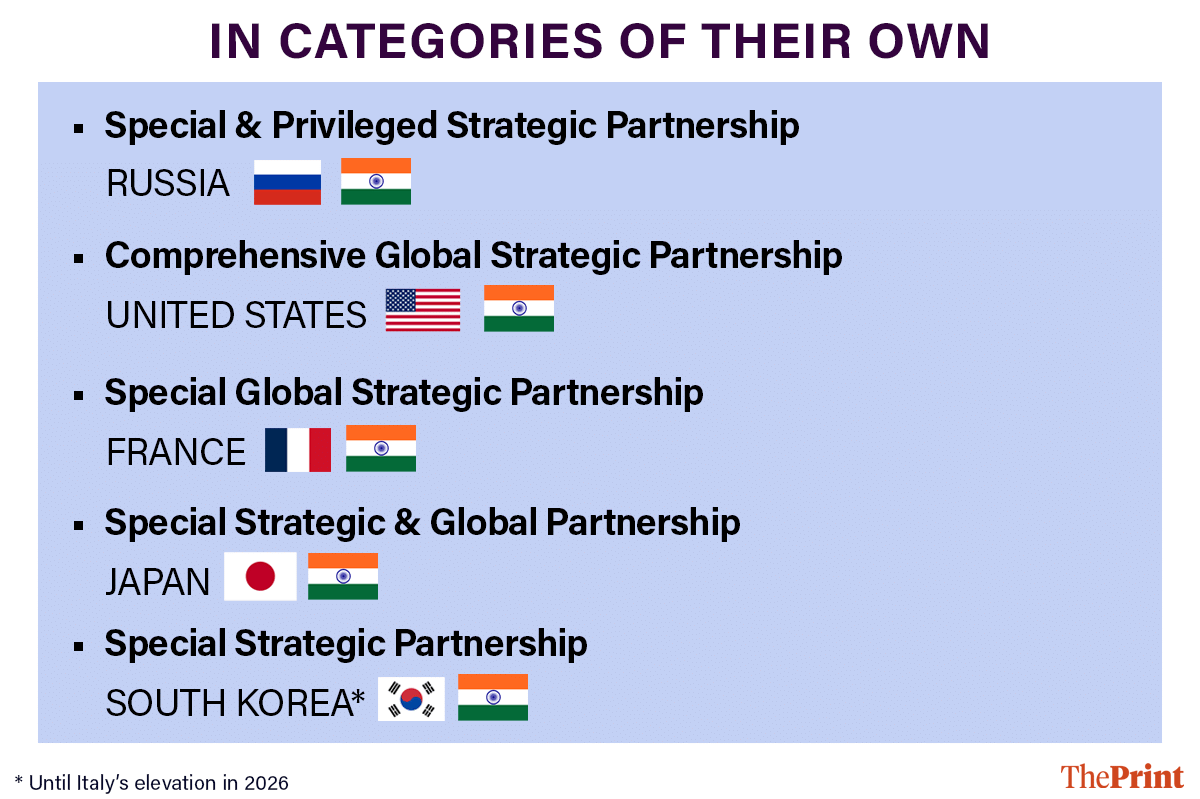
A Comprehensive Global and Strategic Partnership is a diplomatic framework between countries that extends beyond individual sectors such as trade or defence and has cooperation at the global level across political, economic, strategic, technological, cultural, and security domains.
India currently has a CGSP only with the United States, with cooperation covering defence, critical technologies, semiconductors, clean energy, trade, and Indo-Pacific security cooperation. It was officially signed and formalised on 25 February 2020, during US President Donald Trump’s state visit to India in his first term.
In 2024, then US President Joe Biden and PM Modi reaffirmed that the CGSP had emerged as one of the defining alliances of the 21st century, driven by shared democratic values and expanding cooperation across defence, technology, clean energy, and global governance.
Both leaders highlighted growing collaboration in critical and emerging technologies, semiconductors, space, artificial intelligence, cybersecurity, and clean energy supply chains under initiatives such as iCET (Initiative on Critical and Emerging Technology).
They also highlighted deepening defence ties through co-production, innovation, interoperability, and expanded military cooperation in the Indo-Pacific.
However, the relationship has strained under the Trump administration 2.0. Not only had Trump slapped high trade tariffs on India, but he is now being seen increasingly seen close to Pakistan, especially the all-powerful Pakistan Army chief Field Marshal Asim Munir.
For two years in a row, India has failed to hold the Quad Summit it chairs because President Trump and his predecessor Joe Biden did not come down for the meet.
Special & Privileged Strategic Partnerships
This partnership is the highest tier of bilateral diplomatic engagement held exclusively by Russia.
Since the signing of the “Declaration on the India-Russia Strategic Partnership” in October 2000, bilateral ties have expanded across areas including politics, security, defence, trade and economy, science and technology, culture, and people-to-people exchanges.
During Vladimir Putin’s visit to India in December 2010, the relationship was elevated to a ‘Special and Privileged Strategic Partnership,’ along with multiple institutionalised dialogue mechanisms at both political and official levels.
Defence cooperation remains a cornerstone of India-Russia ties, with the extension of the Long-Term Military-Technical Cooperation Pact until 2031.
The two countries are also working toward expanding trade and investment under the Programme for the Development of Strategic Areas of India–Russia Economic Cooperation till 2030, while pursuing a Free Trade Agreement between India and the Eurasian Economic Union.
Special Global Strategic Partnership
India’s first-ever strategic partnership with a Western country was with France, formalised on 26 January 1998. India-France elevated their ties to a landmark ‘Special Global Strategic Partnership’ in February 2026, during President Emmanuel Macron’s visit to India during the Artificial Intelligence Impact Summit.
Building on 25 years of strategic cooperation and the Horizon 2047 Roadmap, both countries agreed to deepen collaboration across key sectors, including defence, civil nuclear energy, space, artificial intelligence, and multilateral engagement.
Special Strategic and Global Partnership
India and Japan elevated their bilateral ties to a Special Strategic and Global Partnership in September 2014 during Prime Minister Modi’s official visit to Tokyo. The agreement was formalised through the Tokyo Declaration issued jointly with then Japanese PM Shinzo Abe.
This marked an upgrade from the earlier “Strategic and Global Partnership” established in 2006 and created a framework for cooperation across key sectors, including defence, security, economic engagement, connectivity, technology, and regional stability.
Special Strategic Partnership
India and South Korea share a Special Strategic Partnership, driven by technology cooperation, electronics manufacturing, shipbuilding, and defence ties.
The India and South Korea Special Strategic Partnership was officially signed on 18 May 2015 during Prime Minister Narendra Modi’s state visit to Seoul.
The talks with Prime Minister Meloni were excellent. Her commitment to furthering the India-Italy friendship is commendable. Bilateral ties between our nations have advanced significantly in sectors like trade, space, technology and more. In order to further deepen linkages, we… pic.twitter.com/0Q6m7C9Sub
— Narendra Modi (@narendramodi) May 20, 2026
Earlier this week, Italy became the second country with which India elevated the ties to the Special Strategic Partnership level.
Comprehensive Strategic Partnership
In Europe, India has elevated ties with the United Kingdom and Poland to a Comprehensive Strategic Partnership, while continuing as a strategic partners with Germany and the Netherlands.
With Greece, in South Eastern Europe, India elevated ties to a strategic partnership in August 2023, reflecting growing alignment in connectivity, maritime cooperation, security, and trade.
India and the United Kingdom launched their Strategic Partnership in 2004, which was upgraded to a Comprehensive Strategic Partnership in May 2021.
India and Germany maintain a long-standing Strategic Partnership built on industrial cooperation, green energy collaboration, advanced manufacturing, and skills development.
India and Germany elevated ties to the Green and Sustainable Development Partnership (GSDP) in 2022 to collaborate on climate action, renewable energy transition, and sustainable urbanisation.
The Indo-German Green and Sustainable Development Partnership (GSDP) was officially signed on 2 May 2022. The agreement was signed in Berlin by Prime Minister Narendra Modi and German Chancellor Olaf Scholz during the 6th Indo-German Intergovernmental Consultations.
In the Indo-Pacific, India and the Association of Southeast Asian Nations elevated ties to an ASEAN-India Comprehensive Strategic Partnership in 2022.
The year also marked the celebration of the ASEAN-India Year of Friendship, commemorating 30 years of dialogue relations. The elevation reflected the growing importance of India’s Act East Policy and expanding regional engagement.
Apart from India, other countries that are part of this engagement include Singapore, Indonesia, Vietnam, and Malaysia.
The bilateral relationship between India and Singapore was elevated from a Strategic Partnership established in November 2015 to a Comprehensive Strategic Partnership in September 2024 during Prime Minister Modi’s visit.
India and Indonesia have a Comprehensive Strategic Partnership, with cooperation that includes maritime security, connectivity, defence, and Indo-Pacific cooperation.
The relationship was first elevated in 2018 during PM Modi’s visit to Jakarta. Bilateral ties were further strengthened in January 2025, when Indonesian President Prabowo Subianto attended India’s Republic Day celebrations as the Chief Guest.
During Malaysian Prime Minister Anwar Ibrahim’s State visit to India in August 2024, India and Malaysia elevated ties to a Comprehensive Strategic Partnership.
African countries
In Africa, India elevated ties with Egypt and Tanzania.
During the January 2023 State visit of Egyptian President Abdel Fattah el-Sisi, New Delhi and Cairo elevated relations to a Strategic Partnership.
The move institutionalised long-term cooperation in political, economic, scientific, technological, defence, security, and counter-terrorism sectors.
India and Tanzania elevated bilateral ties to a Strategic Partnership on 9 October 2023 during the State visit of President Samia Suluhu Hassan to India. The decision emphasised India’s intention to expand maritime, defence, and economic cooperation with Tanzania through a multi-sectoral engagement framework.
Pleased to receive Foreign Minister of Egypt, Dr. Badr Abdelatty. Conveyed deep appreciation for my friend, President Sisi for his crucial role in the Gaza Peace Agreement.
India-Egypt Strategic Partnership continues to grow from strength to strength for the benefit of our… pic.twitter.com/aQQEMfxeRV
— Narendra Modi (@narendramodi) October 17, 2025
In West Africa, India and Nigeria formally established a Strategic Partnership in 2007 during the state visit of then-Prime Minister Manmohan Singh. The partnership was marked through the adoption of the Abuja Declaration, which marked an upgrade in bilateral relations.
Ties with the Gulf
In the Gulf, India elevated ties with Kuwait, signed a Comprehensive Strategic Partnership with the UAE, a strategic partnership with Qatar, and the Strategic Partnership Council (SPC) Agreement with Saudi Arabia.
India and the United Arab Emirates signed the Comprehensive Strategic Partnership in 2017 during the then Crown Prince Sheikh Mohammed bin Zayed Al Nahyan state visit to be the Chief Guest at India’s 68th Republic Day celebrations.
During PM Modi’s visit to Kuwait in December 2024, India-Kuwait relations were elevated to a Strategic Partnership. The new framework seeks to deepen cooperation in political engagement, trade, investment, defence, energy, culture, education, technology, and people-to-people ties.
During the State visit of the Emir of Qatar, Sheikh Tamim bin Hamad Al Thani, to India, an Agreement on the Establishment of Bilateral Strategic Partnership was signed on 18 February 2025 in New Delhi. The agreement aims to deepen bilateral cooperation across political affairs, trade, energy, investment, security, culture, and people-to-people exchanges.
During Prime Minister Modi’s visit to Riyadh on 29 October 2019, India and Saudi Arabia signed the Strategic Partnership Council (SPC) Agreement.
The SPC established a high-level institutional mechanism to steer bilateral ties and deepen cooperation in political, economic, commercial, security, military, and cultural areas. The agreement also seeks to align development strategies and strengthen strategic trust between the two countries.
The Asian alignment
In West Asia, India and Israel elevated bilateral ties to a Strategic Partnership during Prime Minister Modi’s visit in July 2017. The partnership seeks to enhance cooperation in development, innovation, cybersecurity, entrepreneurship, defence, agriculture, and advanced technologies.
In November 2008, ties between India and Oman were upgraded to a Strategic Partnership.
India and Iran elevated their bilateral engagement into a strategic framework with the signing of the New Delhi Declaration in 2003, following the earlier Tehran Declaration of 2001, and included increased cooperation across political, economic, energy, and regional security domains.
In Central Asia, India and Kazakhstan established a Strategic Partnership in 2009 during then-President Nursultan Nazarbayev’s State visit to New Delhi.
Among other countries, India and Uzbekistan officially established their Strategic Partnership in 2011. India and Tajikistan upgraded their bilateral relationship to a Strategic Partnership in 2012 during the official visit of Tajik President Emomali Rahmon to India.
India and Turkmenistan elevated their bilateral relationship to a Comprehensive Strategic Partnership in April 2022 during a bilateral summit in Ashgabat between the Indian President and the Turkmen leadership.
India and Mongolia elevated their bilateral relations to a Strategic Partnership in 2015. The agreement was formally announced on 17 May 2015 during Prime Minister Narendra Modi’s visit to Ulaanbaatar, coinciding with the 60th anniversary of diplomatic relations between the two countries.
In South Asia, ties were only elevated with Bhutan and Bangladesh. India and Bhutan formally upgraded their longstanding diplomatic relationship to a Comprehensive Strategic Partnership during PM Modi’s State visit to Thimphu in November 2025.
India and Bangladesh upgraded their bilateral relationship to a Comprehensive Strategic Partnership on 22 June 2024, during former PM Sheikh Hasina’s State visit to New Delhi. The elevation in ties was formalised through the release of the “India-Bangladesh Shared Vision for Future” document.
India’s close strategic relationship with Nepal was intended to move toward a strategic partnership, but that did not happen.
India and Sri Lanka formally established their Strategic Partnership on 9 June 2010, during a State visit by then Sri Lankan President Mahinda Rajapaksa.
The India-Afghanistan Strategic Partnership was formalised on 4 October 2011, following the signing of the Strategic Partnership Agreement in New Delhi. This made India the first country to sign such an agreement with Afghanistan.
Privileged partnership
India and Mexico established a “Privileged Partnership” in 2007 during the visit of Mexican President Felipe Calderón to India. Later, during PM Modi’s visit to Mexico in 2016, both countries agreed to elevate bilateral ties to a “Strategic Partnership.”
Enhanced Partnership
Also in Asia, India and Brunei elevated bilateral relations to an Enhanced Partnership during Prime Minister Modi’s September 2024 visit.
In South America, India, and Brazil maintain a Strategic Partnership within the framework of Global South cooperation and multilateral engagement.
In Oceania, India and Australia upgraded ties to a Comprehensive Strategic Partnership (CSP) in 2020, building on their earlier Strategic Partnership established in 2009.
(Edited by Ajeet Tiwari)
Also Read: India’s strategic future tied to easing Russia-Europe standoff