






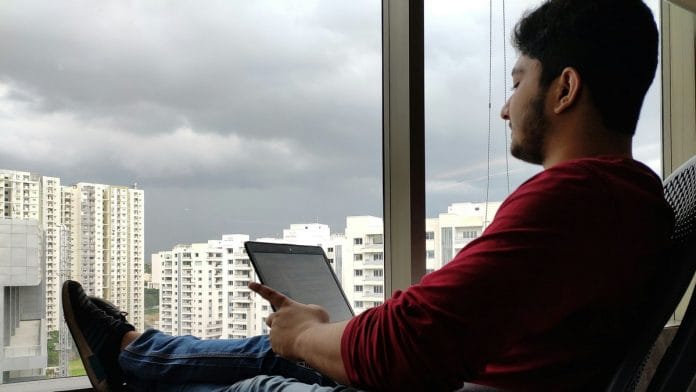


Loneliness is often perceived as a Western problem in India. Something that happens to people living in the ageing societies of Europe or hyper-individualistic America. But slowly, almost imperceptibly, loneliness has become one of the social realities of urban India. The change is partly demographic, but it is also economic. Emotional absence is creating a new “loneliness economy.”
Joint family, shared care responsibility, and community participation were once emotional safety nets. That’s changing. People are now paying for things that the previous generations might have taken for granted.
Loneliness is engendering completely new types of consumption. In Indian cities, businesses today are increasingly moving into the territory of family and community. Senior living communities make the claim of “companionship lifestyles”. Emotional wellness subscriptions are available from start-ups. Internet therapy platforms are growing at a steady rate. Cafés are not just places to get coffee or tea; they are “community spaces.” Belonging is as much a part of co-working spaces’ advertising as productivity.
Yet, even as the market has started responding to the need for connection, the subject is absent from policy discourse. “Emotional infrastructure” is usually not part of governance deliberations. That’s soon going to be a problem.
Also Read: How India’s seniors are fighting loneliness—Love, loss, and logins
The price of disconnection
With economic development has come a reorganisation of human relationships. Nuclear families are gradually replacing joint families in urban India, and migration keeps parents and children apart.
This is happening even as our population ages rapidly. The United Nations estimates that the elderly population in India will grow to almost 347 million by 2050.
In cities such as Bengaluru, Mumbai, Pune, and Gurugram, luxury towers are a growing trend for housing elders who live alone while their children work abroad or in other metros. In Coimbatore and Pune, senior living communities are mushrooming, driven largely by rising life expectancy and changing family dynamics.
For many Indians, growing older involves not just physical ageing, but also a process of “social ageing”, where they gradually withdraw from active social networks.
The density that urban life brings is paradoxically creating disconnection as well. People are living in close proximity, but without emotional closeness. Millions reside in apartment towers where they hardly know their neighbours. Digital communication is constant but there are fewer and fewer meaningful interpersonal relationships.
These days, many young professionals will spend an entire day never interacting with anyone face-to-face, just going through a series of online interactions, delivery orders, and workplace chats. Despite constant digital connectivity, young Indians are facing emotional overwhelm, isolation, and a reduced capacity to establish meaningful relationships.
And so, many turn to the growing market for experiences that simulate connection, from curated communities and wellness retreats to hobby groups, emotional-support sites, and technology for AI companionship.
Now, the emotional impact is emerging as a public-health issue. The World Health Organization (WHO) states that chronic loneliness and social isolation are linked to higher rates of depression, anxiety, cardiovascular disease, cognitive decline, and premature death around the world. Some international studies have compared prolonged loneliness to smoking and obesity. In 2018, Britain even appointed a Minister for Loneliness as evidence grew about the health impact of social isolation.
Rethinking connection
This change is not limited to India. Kodokushi, or lonely death, in which a person dies without anyone knowing, is a problem in Japan too.
For generations, Asian societies took pride in their collectivist cultures, as opposed to the individualism of the West. The emotional architecture of everyday life was created by family networks, neighbourhood familiarity, intergenerational family dynamics, and community rituals. Asian cultures tended to value interdependence, caring, and belonging in a community; Western culture was often caricatured as self-serving and adrift.
But collectivist societies are also slowly morphing under the pulls and pushes of economic mobility, migration, urbanisation, and digital lifestyles. The typical belief that emotional support will naturally be provided by one generation to another within the family is being challenged throughout Asia.
The difference is that some societies have recognised it and are building alternative approaches to re-establish social relationships —forms of “emotional infrastructure.”
Singapore, for one, has scaled up community-based ageing programmes, intergenerational housing, and neighbourhood engagement programmes to ensure that elderly residents are not left alone. In Japan, some municipalities organise “community cafés” and “shared meal programmes” for elderly people who live alone. South Korea has launched a series of “mind health” initiatives that involve counselling, community engagement, and local outreach for socially withdrawn citizens.
These interventions acknowledge that future emotional support systems may not look like those of the past. The ‘joint family’ cannot be conjured up out of nostalgia for a bygone golden era. Urban life, increased workforce participation, migration, and changing aspirations among women have transformed social structures for good. The question is not how to bring back old systems, but how to create new kinds of connectedness for the modern world.
Also Read: Delhi NCR is tackling urban loneliness. It’s called ‘stranger meetups’
How can India build emotional infrastructure?
India has invested in highways, airports, digital systems, smart cities, and financial inclusion. The next challenge is developing emotional infrastructure — public spaces that encourage interaction, networks for older people, intergenerational engagement initiatives, and urban systems that reduce social isolation.
What would such emotional infrastructure be? It might involve neighbourhood community spaces where people see each other not just as strangers, but as neighbours; city-supported social spaces such as community kitchens and cultural centres; housing models that enable intergenerational interaction between students and elderly people; workplace policies that value social health as well as productivity; mental health and wellness services embedded within local neighbourhoods; and urban planning that creates places for people to walk, talk, and relax together rather than simply transact business.
In urban India, community-based organisations, resident welfare groups, senior citizen collectives, neighbourhood associations, self-help groups, and local cultural networks could become important in the reconstruction of social cohesion. In many cases, these institutions can become social bridges, creating the trust, participation, and emotional support that used to be found in extended families and tight-knit neighbourhoods.
Equally important, emotional infrastructure can go beyond institutions. It can be a matter of rebuilding social habits. Community volunteering, residents’ associations, local festivals and events, reading groups, clubs, and participation in civic activities can become as significant to social wellness as roads are to economic wellness.
The lesson that can be taken from other Asian societies is that loneliness cannot be eliminated by technology and the market alone. Apps and services can help mitigate emotional divides for a while, but long-term resilience requires ongoing human relationships and community involvement.
The loneliness economy may be a business opportunity but it is also a social alarm. It can’t just be left to entrepreneurs to cater to these new needs, with friendship becoming just another paid-for service. Eventually, loneliness doesn’t just happen to one person. Rather, it becomes a collective condition — but suffered alone, behind millions of closed apartment doors.
Dr Anuradha P S is a professor in the commerce department at Christ University, Bengaluru. Views are personal.
(Edited by Asavari Singh)
A deeply thoughtful and timely piece that moves beyond the idea of loneliness as a personal struggle and presents it as a societal challenge demanding collective attention. The article powerfully highlights the need for stronger emotional infrastructure in modern life, making it both reflective and socially relevant.