



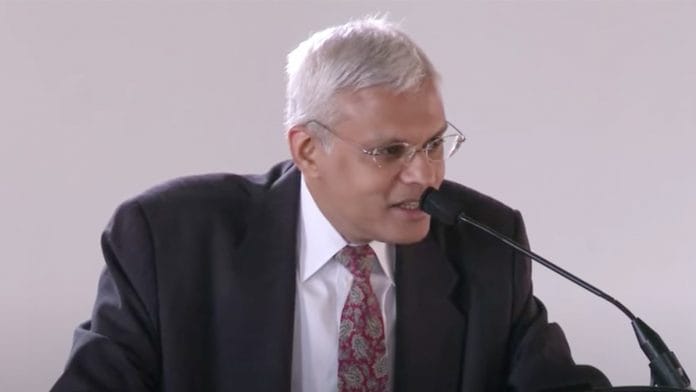
New Delhi: The current US administration under President Donald J. Trump is seeking greater procurement of American weapons systems by India, to replace its dependence on Russia, but New Delhi will “think long and hard” on this, Ashley J. Tellis, the former special assistant to ex-president George W. Bush told ThePrint.
“In the real world of politics, there are linkages that you cannot escape, right? And so the things that we have done in the economic space bleed over into other calculations that our partners have to make,” he said in an exclusive chat on the sidelines of the Global Technology Summit 2025 in Delhi, organised by the Indian Ministry of External Affairs and Carnegie India.
“It’s not surprising to me that what we have done in the tariff world is raising deep questions about American intentions and American credibility. I think the arguments that Secretary (Howard) Lutnick and the president are making with respect to the purchase of American weapons are a little too facile. They don’t appreciate India’s history with respect to its foreign defence partnerships,” added Tellis, currently the Tata Chair for Strategic Affairs at the Carnegie Endowment for International Peace.
Trump imposed a global baseline tariff of 10 percent on all countries in the world on 2 April, and announced a 26 percent additional tariff on India. While the additional tariff has been paused, the “reciprocal” levies introduced by Trump have upended almost eight decades of the international financial order, raising serious questions about the US’ credibility.
Tellis pointed out that there is a perception amongst Trump’s administration that the sale of defence platforms to India are a “substitutability problem”—New Delhi was previously purchasing Russian weapons, and therefore now, it can buy American, thereby changing the status quo in favour of Washington.
Both Trump and his Secretary of Commerce Howard Lutnick in recent weeks have urged India to buy American weapons platforms as a method to reduce the trade deficits between the two countries. In 2023-24, India exported $77 billion worth of goods to the US, while importing $42.1 billion worth of goods.
While India has purchased specific defence equipment from the US, it remains to be seen whether it wishes to procure platforms for its military needs.
“In fact, if you look at India’s defence budget, that defence budget is not deep enough to satisfy their expectations. So there are so many issues that are implicated in this,” said Tellis, while highlighting that current co-production projects, such as the Stryker or Javelin programmes, will “come to maturity”.
“But those are things that are sort of already on the rails. When it comes to buying new platforms with strategic impact, I think India will think long and hard, particularly about what it implies for dependence. Because I don’t think Indian policymakers are in a rush to substitute dependence on Russia with dependence on America. Or for that matter, dependence on anyone else. So this is going to be a very tricky field to navigate,” he added.
India-US nuclear partnership
Almost two decades since the India-US Civil Nuclear deal, there has been minimal cooperation between the two countries in the nuclear energy sector. This has led to India considering amending the Civil Liability for Nuclear Damage Act, 2010, as announced by External Affairs Minister S. Jaishankar Friday.
Tellis, explaining the history of the law’s formulation in 2010, said that it stemmed from India’s own horrific experiences during the Union Carbide–Bhopal Gas Tragedy in 1984.
“When India was working out the civil liability regulations, you had a Supreme Court judgment about the Bhopal tragedy, and it was an awful reminder to the Indian people of what they had suffered in a mass casualty accident. So the political forces that aligned at that time were not in sync with the international standard of channeling liability to the operator. The political pressures were moving in the direction of channeling liabilities to suppliers,” he said.
However, at this moment in time, climate change and the advent of artificial intelligence (AI) has led to consideration for tapping nuclear energy, given the large power needs for the future. This “serendipitious” combination has made India realise that it needs to look abroad for enhancing its nuclear energy capacity, which requires a serious reconsideration of its current regulatory framework.
“India wants to bring these players into the game, and you can’t do that unless you do two things—amend the liability legislation, and amend the Atomic Energy Act, because you are now going to get foreign participation in the programme,” Tellis said.
He added: “This foreign participation, I think, is going to end up through private-private partnerships with Indian joint ventures, which means you have to amend the legislation to allow for private owners and operators of nuclear plants. So for the first time, there’s a constellation of factors that is making a realistic prospect that amendment is plausible.”
(Edited by Mannat Chugh)
Also Read: Jaishankar hints at amending nuclear liability law as India seeks deeper ties with US