



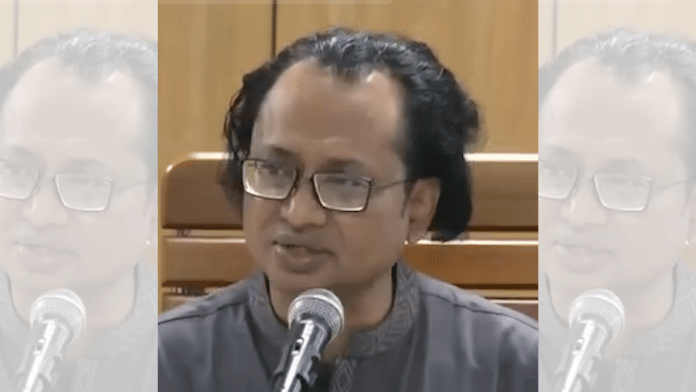
New Delhi: Immigration authorities briefly stopping Bangladesh Prime Minister Tarique Rahman’s adviser Zahed Ur Rahman at New Delhi’s Indira Gandhi International Airport on Monday has drawn attention not only because of the diplomatic furore it created, but also because of the man at the centre of it.
Zahed Ur Rahman, the Bangladesh prime minister’s adviser on policy and strategy affairs, was stopped at the airport on arrival as his name figured on a watchlist of immigration authorities over his anti-India statements in the past. He was leading his country’s delegation to an Indian Ocean Rim Association (IORA) meeting hosted by the Ministry of External Affairs.
Across dozens of videos between 2023 and 2026, Rahman accused India of backing an undemocratic political order in Bangladesh under former PM Sheikh Hasina, manipulating public narratives through its media and treating the country as a dependent state rather than an equal partner.
He even labelled India “the primary enemy of Bangladesh’s future and democracy”.
According to diplomatic sources, Bangladesh had formally informed Indian authorities of Rahman’s visit more than 60 hours before his arrival and a written note was sent to both the Indian High Commission in Dhaka and the MEA. Bangladesh’s High Commissioner to India, M. Riaz Hamidullah, was present at the airport to receive him.
However, Rahman was stopped at the airport for ‘verification’. Rahman Tuesday told Bangladeshi media that he had been treated “poorly” at the airport. “They did not behave properly with me. They were informed beforehand that I’d be travelling to India. If they had an issue with me, they should have solved it beforehand or objected to my visit.”
“The way I was treated,” he added, “I was not offered to sit properly which I thought was not the right way to behave.”
After being held for more than two hours, Rahman was granted a one-time exemption to enter India. By then, however, he had decided to abandon the visit and return to Dhaka.
The incident prompted an immediate response from Dhaka. Bangladesh Foreign Minister Khalilur Rahman described the development as “unexpected and regrettable”, and Dhaka summoned India’s Deputy High Commissioner Pawan Badhe.
Also Read: After Bengal, BJP must secure the Siliguri Corridor, rebuild ties with Tarique Rahman
Zahed’s ‘take’ on India’s diplomacy
Before joining the Bangladesh government earlier this year as the adviser on policy and strategy affairs to Prime Minister Tarique Rahman, with the rank of a state minister, Zahed Ur Rahman had become one of the country’s most influential political commentators.
Through newspaper columns, television appearances and his YouTube channel, “Zahed’s Take”, which remains inaccessible in India, he built a substantial following by arguing that India had long treated Bangladesh as a subordinate partner rather than a sovereign equal.
The channel has around 700k subscribers.
His criticism intensified after the fall of the Awami League government. In several broadcasts, he described India as the principal external force behind what he viewed as Bangladesh’s democratic decline under Sheikh Hasina, arguing that New Delhi’s priority had been preserving a government willing to accommodate Indian strategic interests.
“India actually wanted a slave government in Bangladesh,” he said in an August 2024 programme.
“The core problem lies in how India thinks,” Rahman said during a September 2024 YouTube video titled ‘Dr Yunus asked Sheikh Hasina to stay quiet’. “India itself has engineered this hostile environment, turning the situation into one where countless people harbor animosity toward it.”
Rahman frequently referred to Bangladesh as having been treated like a “vassal state”, “tributary state”, or even a “colony”, alleging India had failed to recognise Bangladesh’s sovereignty and political aspirations.
“India will not look at us as a colony,” he said in a September 2024 video. “India will not look at us as a tributary state; that is all we are asking for.”
His criticism also extended to Indian media coverage of developments in Bangladesh. In multiple YouTube videos, he argued that sections of Indian media were promoting a politically motivated narrative that portrayed Bangladesh’s uprising as an Islamist movement rather than a broader popular revolt.
He also accused media organisations close to India’s ruling Bharatiya Janata Party of fueling anti-Bangladesh sentiment. In an August 2024 video, he called Indian media’s coverage of communal violence in Bangladesh “a historic stupidity”, claiming that would lead to deterioration of ties.
Some of his most controversial comments involved suggestions that discussions within India on the treatment of Hindu minorities in Bangladesh could eventually be used to justify “intervention” in the country.
In a September 2025 video, he said, “An unstable and ‘civil-war’-like situation in BD is India’s favorite thing.”
In a January 2026 video, he further added, “India never wanted any country in this subcontinent, including BD, to stand as independent and sovereign nations. It always had a tendency to dictate and colonise through hegemony.”
In multiple videos released in the run-up to the elections, Rahman upped his criticism of New Delhi. “India does not want to see an elected democratic govt. in BD, because it only wants a dictator like Sheikh Hasina or someone similar to her to rule BD,” he said in one of the videos.
Delicate moment in India-Bangadesh ties
The episode comes at a delicate moment in India-Bangladesh relations, which have shown signs of improvement in recent months but continue to be weighed down by unresolved disputes.
For nearly two years, ties between the neighbours remained strained following the ouster of former prime minister Sheikh Hasina in August 2024. Hasina fled to India after student-led protests brought an end to her government, triggering a prolonged period of tension between New Delhi and the interim administration headed by Muhammad Yunus.
Relations began to improve after the election of Prime Minister Tarique Rahman in February. However, one of the most contentious issues has been that of illegal Bagaldeshi immigrants being “pushed back” from India, with Dhaka objecting to it.
The dispute erupted in late April when Bangladesh summoned India’s Deputy High Commissioner, Pawan Badhe, over remarks by Assam Chief Minister Himanta Biswa Sarma suggesting that individuals who had allegedly entered India illegally were being sent back to Bangladesh.
(Edited by Ajeet Tiwari)
Also Read: Why a Bangladesh-born billionaire is investing in India instead of his homeland