



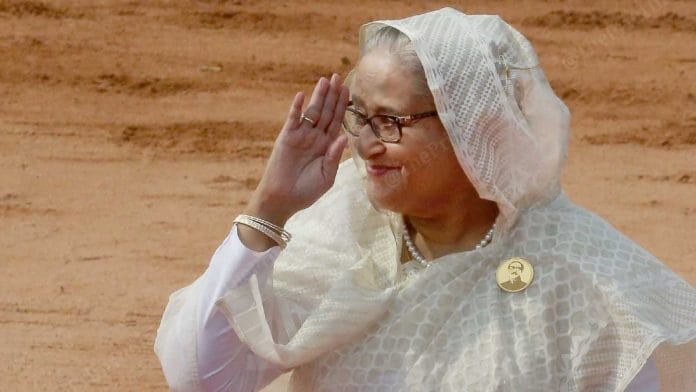
New Delhi: Former Bangladesh Prime Minister Sheikh Hasina has described former Chief Adviser Muhammad Yunus as both a “beneficiary and active participant” in what she alleges was a political project to damage Bangladesh, while accusing militants, religious extremists and other forces of exploiting her ouster.
In an exclusive interview with ThePrint, Hasina described the current situation in Bangladesh as a “national crisis” and called for a full, independent investigation into the anti-quota protests that eventually forced her out of power in August 2024.
Hasina, who fled Dhaka for New Delhi, said she intends to return in December and fight the legal cases pending against her, including the death sentence handed down by Bangladesh’s International Crimes Tribunal in absentia.
Underlining that she had no idea she would end up in India, the 78-year-old challenged the Tarique Rahman-led Bangladesh Nationalist Party (BNP) government to lift the ban on her party, the Awami League, and then call a general election.
“I have said that I intend to return to Bangladesh around December. The specific date, time and route will be announced at the appropriate time. Bangladesh is passing through a grave national crisis. Democratic space has been closed. The judiciary is being used for political revenge. Media freedom has been restricted. Law and order have weakened. Minorities feel unsafe,” Sheikh Hasina told ThePrint.
She added: “This is no longer only an Awami League issue. It is a national crisis. One of the country’s largest political forces has been banned. Millions of its supporters have been denied normal political rights. A country cannot return to stability by excluding such a large section of its own people.”
The former Prime Minister indicated that she cannot “remain away when” the people of Bangladesh “are passing through such a painful and dangerous period”.
Hasina had fled Dhaka for New Delhi in August 2024. Her ouster came after over a month of demonstrations led primarily by students, first against the quota instituted for family members of former Liberation War fighters, that eventually led to the demand for her resignation.
Hasina attempted to violently curb the protests, with the United Nations indicating that at least 1,400 people were killed as a result of state action, with thousands injured. She was tried in absentia by the International Crimes Tribunal in Bangladesh and was sentenced to death in November 2025 for crimes against humanity committed by the state in attempting to put down the protests.
“A death sentence imposed in absentia through a politically motivated process cannot be treated as justice. I was not given a genuine opportunity to defend myself through a normal, impartial and credible judicial process,” said Hasina to ThePrint.
She added: “The illegal interim government altered the framework, restructured the tribunal, appointed politically biased prosecutors and judges, and staged a kangaroo trial where basic legal safeguards were ignored. So yes, I will challenge the verdict. I will face the cases through law, but law must mean justice, not political revenge.”
Also Read: Sword of Hasina hangs over Bangladesh’s India policy as Tarique juggles pro & anti India powerplay
‘Did not plan to leave Bangladesh for India’
Sheikh Hasina said that she “did not plan to leave Bangladesh for India”. According to her, the events of 5 August, 2024 and her intention to “to prevent greater bloodshed” led to her departure for New Delhi.
“Events moved very quickly, and my foremost concern was to prevent greater bloodshed in an already dangerous situation. I am not preparing to return because the situation has become easy. I am preparing to return because Bangladesh cannot be left to fear, revenge and instability. The question is whether Bangladesh can recover its democracy, secular character, law and order, economy and future,” said Hasina.
She added: “The security situation has not improved. In many ways, it has worsened. Law and order have weakened, extremist groups have gained confidence, minorities feel unsafe and Awami League leaders and workers continue to face persecution.”
The former Prime Minister’s continued stay in India and public statements have ruffled feathers in Dhaka. Ties between India and Bangladesh, which were stabilising over the last six months, have been gravely impacted by her press conference in New Delhi on 5 August.
Prime Minister Tarique Rahman was expected to visit India in August or September, but the visit appears to have been deferred indefinitely, with Dhaka asserting that Hasina’s return is a necessary condition for any future visit.
Hasina warns against calling Yunus a ‘puppet’
Hasina warned against describing Yunus as a “puppet”, calling the label “simple”, while pointing to a more dangerous reality of him being “both a beneficiary and an active participant in a political project that damaged Bangladesh”.
“Under his rule, Bangladesh was pushed toward the rule of militants and terrorists. Extremist forces regained space. Anti-Liberation War forces became emboldened. The secular foundation of the state was attacked. Minorities, cultural activists, journalists and pro-Liberation War citizens became unsafe,” said Sheikh Hasina.
The former Prime Minister added: “Who benefited from his rule? Those who wanted the Awami League removed from politics. Those who wanted the Liberation War spirit weakened. Those who wanted extremist forces to regain space. Those who wanted Bangladesh to become unstable, dependent and easier to influence.”
Asked whether she believed that the protests that culminated in her ouster were backed by external agencies, Hasina underlined that a “full answer requires a credible independent investigation”.
“But the pattern is clear. What began as a quota reform issue was turned into a one-point campaign to remove an elected government. Violence spread in a coordinated way. Police stations, public infrastructure, media houses, government offices and symbols of national development were targeted. Weapons were looted. Prisons were attacked. Militants escaped. Propaganda moved with unusual speed and discipline,” she said.
She added: “Muhammad Yunus himself described the movement as “meticulously designed” and spoke of a “mastermind”. This was not a purely spontaneous protest. Several forces benefited from that operation: opposition political actors, extremist groups, militant networks, those who wanted to erase the Awami League, and external interests that prefer a weak, divided and unstable Bangladesh.”
The former Prime Minister remains convinced that given Bangladesh’s strategic positioning between India and Myanmar, a stable Dhaka “matters geopolitically”.
“That is why the full truth must be investigated. The people deserve to know who planned, financed, encouraged and protected the violence,” she said.
The interim government took over from Hasina’s government in the middle of August 2024. Yunus was at the helm of affairs until February 2026, when a general election brought Tarique Rahman and the Bangladesh Nationalist Party (BNP) to power.
Hasina’s challenge to BNP
Sheikh Hasina categorically rejected the results of the February election, deeming it as neither free, fair, inclusive nor credible. She pointed to the restrictions against the Awami League from contesting the general election as one that “denied real choice” to the voters.
“I do not recognise the February election as a free, fair, inclusive or credible, democratic election. A vote held after banning one of the largest political parties cannot express the will of the people…If the BNP believes it truly has the people’s mandate, then lift the ban, release political prisoners, withdraw the false cases and allow an inclusive election. Let the people decide freely. That is the only result that can carry democratic legitimacy,” said Hasina.
The statement obfuscates to an extent the Awami League’s own record of holding elections that have been considered neither free nor fair by the international community. The last election Hasina won, in January 2024, was questioned by a number of countries including the US, as falling short of international standards.
Hasina described the day in May 2025 when the Yunus government, under the Anti-Terrorism Act, banned Awami League from carrying out any political or cyber activities as a “black day for democracy”.
‘Stable ties not a favour to India’
Hasina remains optimistic of the endurance of the India-Bangladesh relationship.
The relationship, she said, is “not built on one government or one moment of tension. They are rooted in history, geography, the Liberation War, security, trade, rivers, culture and the daily lives of people on both sides of the border”.
“A stable relationship with India is not a favour to India. It is in Bangladesh’s own national interest. India is our largest neighbour. Our rivers, borders, markets, energy cooperation and security concerns are deeply connected. Responsible leadership in Dhaka must handle this relationship with maturity and confidence, not with slogans or hostility,” said Hasina.
She added: “On migration, I would follow the same approach: joint verification, regular communication between authorities, stronger action against trafficking networks and forged documents, and practical cooperation between border agencies.”
The former Prime Minister called for the issues surrounding illegal migration to be dealt with “quietly, legally and responsibly”.
India has consistently raised the issue of illegal migration, while Bangladesh has pointed out the challenges it faces over verification of nationality.
The two countries have not held a consular dialogue for many years, including during Sheikh Hasina’s tenure in power.
(Edited by Amrtansh Arora)
Also Read: Bangladesh is moving beyond Hasina. But where is its foreign policy headed?