



New Delhi: On 15 September, Saudi Arabia said its air defences destroyed a Houthi drone over Mecca, warning any attack on two holy mosques and pilgrims to be a “red line”. Two days later, the Kingdom said the debris from the intercepted drone killed one and injured two others.
The Iran-backed Houthi militia, however, denied these charges. “There is no threat from Yemen to the holy sites. Our operations target its oil facilities and military bases…,” Houthi military spokesperson Abdul Malik Al Houthi said.
Apart from receiving solidarity from several countries, Riyadh has not yet gotten what it needs the most—military support from its partners with whom it has security agreements, chiefly Pakistan.
Pakistan Prime Minister Shehbaz Sharif condemned the purported Mecca attack as “dastardly and heinous” and called for “maximum restraint”. The security and sanctity of Haramain Sharifain (the two holy sanctuaries of Mecca and Medina) is “a duty that every Pakistani carries close to their heart”, he said 18 September.
Defence minister Khawaja Asif and military spokesperson Lt. Gen. Ahmed Sharif Chaudhry followed Sharif in singing the same tune.
The mere lip service in this juncture comes despite Saudi Arabia’s recent efforts, as seen in signing of the Mecca pact, at diversifying its partners to meet security requirements and to hedge against the potential disengagement of the US, the traditional security guarantor in West Asia.
Mecca Pact: Dead on arrival?
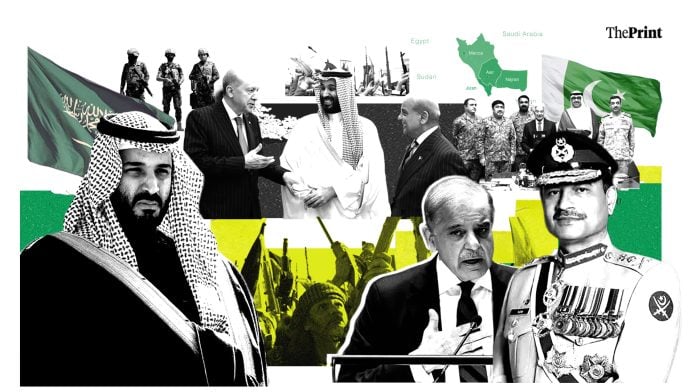
Saudi Arabia, Pakistan and Türkiye signed the Mecca Joint Defense Agreement on 7 August. Yet, neither Ankara nor Islamabad has provided tangible support, even when the city of Mecca—where the trilateral pact was signed—was allegedly attacked.
Like Sharif, Türkiye condemned the attack and reiterated its call for immediate cessation of these attacks, calling for de-escalation. Both Pakistan and Türkiye appear to be avoiding getting drawn into Saudi Arabia’s war.
Some observers are pointing to the current tensions as the first test of the Mecca Pact, while others noting that the agreement is yet to be institutionalised and ratified by signatory countries.
Officials from Pakistan and Türkiye anonymously told The Associated Press that they have not received a Saudi request for support in response to the Houthis’ escalation.
Major General Raza Muhammad (retired), who also served as a former ambassador of Pakistan, told ThePrint that the Mecca Agreement is purely defensive in nature.
“It predicates on collective deterrence against aggression in any of the partner countries. When the Kingdom of Saudi Arabia (KSA), Türkiye or Pakistan are directly attacked or their territorial integrity is breached, then the other partners will most likely react after collective decision.”
He added that the KSA is prepared to take on the Houthis and has been doing so for long. “The newer equation that complicates the situation is the US-Houthi ceasefire deal, and the US president’s refusal to act against them kinetically.”
Last Thursday, Saudi Crown Prince Mohammed bin Salman called US President Donald Trump twice, urging him to launch strikes against the Houthis as the Iran-backed group closed in on a vital Red Sea chokepoint, according to an Axios report. Trump declined.
Almost a week later, Reuters reported that American officials met Houthi representatives in Oman, wherein they secured reassurances for the safe passage of its shipping vessels through the Red Sea. With no ally coming to aid, Saudis have resultantly been left in the lurch.
Also Read: Saudi firm bets $200 mn on Afghanistan’s energy sector. Can it succeed where Chinese failed?
Pak-Saudi collab
More than the Mecca Pact, which is just over a month old, it is Pakistan’s support, or the lack of it, that arguably carries more weight today. Exactly a year ago, Saudi Arabia signed a bilateral pact with Pakistan called the Strategic Mutual Defense Agreement (SMDA).
Moreover, there is a long history of Saudi Arabia soliciting Pakistan’s help on the Yemen front, and its reliance on the Pakistani security umbrella goes back decades.
For decades, Pakistani troops have been present in Saudi Arabia, with Islamabad training thousands of Saudi armed personnel since the 1960s. In 1967, the two sides signed the first formal defence cooperation agreement.
American expert on West Asia Bruce Riedel, in a 2008 Brookings commentary, noted that Pakistan helped the Royal Saudi Air Force (RSAF) to build and pilot its first fighter jets in the 1960s and the Pakistani Air Force pilots flew RSAF Lightnings that repulsed a South Yemeni incursion into the Kingdom’s southern border in 1969.
Pakistani support to Saudi Arabia during the seizure of the Grand Mosque of Mecca nearly 47 years ago, and the subsequent 1982 bilateral security cooperation agreement, further solidified their defense ties.
The 1980s saw Pakistan-Saudi ties growing from strength to strength. Saudis not only covertly funneled aid and money through Islamabad to build up the Afghan mujahideen fighting Soviets in the 1980s, but also pumped money into Pakistan’s Sunni madrassas and religious institutions, exporting the orthodox Wahhabi version of Islam.
During the 1990-91 Gulf War, Pakistani troops were reportedly present in the Kingdom to help Saudis cope with threats and instability arising from its neighbours.
In an article ‘Pakistan and Saudi Arabia: Deference, Dependence and Deterrence’, academics Marvin G. Weinbaum and Abdullah B. Khurram wrote that in 2011, when an anti-government uprising erupted in Bahrain, a key ally of Saudi Arabia, Saudis turned to Pakistan for support.
“Pakistani military advisors are believed to have been present during the Saudi military’s incursion in Bahrain, and recruitment efforts have been made to enlist qualified Pakistanis in the Bahraini National Guard,” they wrote in the article published in the Middle East Journal.
Former Saudi intelligence chief Prince Turki bin Faisal once described Saudi-Pakistan ties as “probably one of the closest relationships in the world between any two countries”—a remark that has since become an oft-quoted illustration of their relations.
Yet, in April 2015, Pakistan’s parliament voted unanimously against joining the Saudi-led military coalition in Yemen that was fighting the Houthi rebels. Saudi Arabia had asked for Pakistan to provide ships, aircraft and troops for its campaign, but Islamabad insisted on “neutrality” in the conflict. The banned terrorist group Lashkar-e-Taiba had criticised this move by the Pakistan government.
That did not become an impediment when former Pakistani army chief General Raheel Sharif took over as the military commander of the Saudi-led Islamic Military Counter Terrorism Coalition (IMCTC) in 2017, and is still serving the post to date.
In 2018, Pakistan deployed a contingent on a ‘training and advisory’ mission in Saudi Arabia, raising speculation that it could be used against the Kingdom’s military campaign in Yemen. Islamabad maintained that it would not be deployed “outside” Saudi borders.
In 2019, too, when the Houthis attacked the Saudi state-owned oil company Aramco’s pumping stations, Pakistan’s support was restricted to words of solidarity.
Also Read:Is the China-Pakistan arms nexus exporting authoritarianism? The case of the JF-17
What Pakistan is doing today
Direct military assistance from Pakistan has not been forthcoming despite Khwaja Asif remarking that it is time to implement the Mecca Pact and Lt. Gen. Chaudhry declaring that Pakistan will go to any extent for the security of Haramain Sharifain and Saudi Arabia. Instead, Pakistan army chief Field Marshal Asim Munir urged Iran to rein in Houthi attacks on Saudi Arabia.
Theoretically, the Saudi-Pakistan SMDA is not a classical mutual defense treaty of the likes the U.S. signed in the Cold War era.
“Its classified nature (notwithstanding the publicised mutual defense component) means that its credibility as a deterring instrument is low,” West Asia expert Bashir Ali Abbas, a senior research associate at the Council for Strategic and Defence Research (CSDR), told ThePrint.
“Practically, historic Pakistani assistance to Riyadh for its Yemen conflict has been capability assistance rather than direct intervention. The SMDA has done little to change this historical position in the one year that it has been active.”
Moreover, the Saudi-Houthi kinetic conflict began with the Saudi-led intervention in 2015.
“Any mutual defense agreement of the SMDA kind is meant for scenarios where a partner state is attacked, not when it attacks an adversary. NATO inaction in the US-Iran war is an example. The most recent escalation, too, was triggered by a Saudi-backed Yemeni government strike on Sanaa in July,” Abbas told ThePrint.
Sanaa is Yemen’s capital city controlled by the Houthis, who took it over in 2014.
Today, there are an estimated 8,000 troops currently stationed in the Kingdom, adding to thousands of Pakistani troops who were already there, as per a Reuters report in May. Pakistan has deployed a full squadron of around 16 aircraft, mostly JF-17 fighters, and two squadrons of drones, added Reuters.
The report cited a security official privy to the confidential SMDA, stating, the pact provides for the possibility of deploying up to 80,000 Pakistani troops to help secure the Kingdom’s borders alongside Saudi forces.
Indeed, in April 2026, the Saudi defence ministry announced the arrival of a military force from Pakistan at King Abdulaziz Air Base in accordance with the SMDA.
“The force, which includes fighter and support aircraft from the Pakistani Air Force, aims to strengthen joint military coordination and elevate operational readiness between the Saudi and Pakistani armed forces to further support regional and international security and stability,” the Saudi Ministry of Defense said.
Beyond this deployment, Pakistan has not publicised its role in the latest round of clashes between Saudi Arabia and the Houthis. The posturing comes even as there is a fear of a return to full-scale war that remained largely frozen since a UN-brokered truce in 2022.
(Edited by Tony Rai)
Also Read:CIA’s declassified 9/11 briefs lift veil. Osama’s quest for ‘dirty bomb’, friction with Mullah Omar