


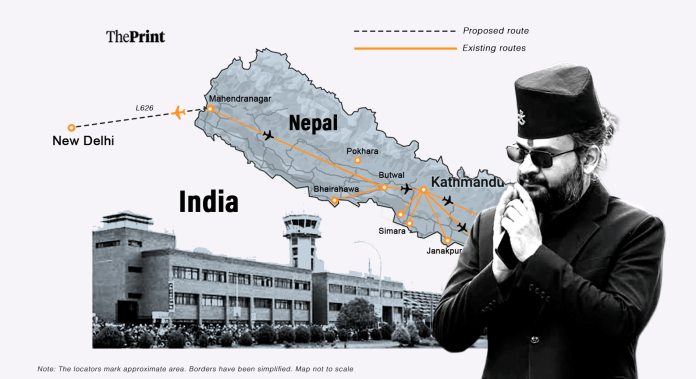
New Delhi: New air routes and airspace have been a contentious issue in India-Nepal relations. Nepal’s request for additional airspace has featured in several high-level meetings, even nearing resolution more than once, only to get stalled yet again.
With Nepal PM Balendra Shah set to visit New Delhi on 22-23 November, talks to resolve longstanding disputes over cross-border air routes are reportedly high on Nepal’s agenda.
Airlines flying from major destinations to Nepal depend heavily on a narrow set of entry routes, forcing some aircraft to take longer journeys and adding to operating costs. As a result, Gautam Buddha International Airport in Siddharthanagar and the Pokhara International Airport, both intended to transform the country’s aviation and tourism sectors, have struggled to attract sustained international traffic.
Kathmandu has long argued that Indian restrictions are undermining the commercial viability of its aviation investments. Its approach has been to persuade New Delhi to open additional points along their shared border through which international aircraft can enter Nepal.
But for New Delhi, the negotiations involve not only aviation corridors and commercial calculations but also military sensitivities, security clearances, air traffic management, and the ability of Nepal’s aviation institutions to handle additional flights safely.
The Rt. Hon. Prime Minister, Mr Balendra Shah, departed for New Delhi today on a two-day State Visit to India.
He was seen off at the Airport by Hon. Biraj Bhakta Shrestha, Minister for Energy, Water Resources and Irrigation; Hon. Sudhan Gurung, Minister for Home Affairs; Hon.… pic.twitter.com/PNLcN9TbPM
— PMO (@PM_nepal_) November 22, 2026
The talks have also become entangled in a broader strategic relationship in which China’s growing economic presence in Nepal has introduced a layer of suspicion.
For Nepal, the immediate focus is the L626 route, which connects Kathmandu with Delhi through Mahendranagar in western Nepal and Pantnagar in Uttarakhand. Nepal wants permits for international aircraft to use the corridor in both directions. At present, it is available only for outbound flights from Nepal.
While Nepali media reported that a Civil Aviation Authority of Nepal delegation travelled to India last week to discuss opening of additional airspace and to “accommodate India’s request to use Nepali airspace for international flights operating to and from Bagdogra,” sources cited by news agency ANI refuted it Sunday, stating, “there are no such proposals”.
Reports in the Nepalese media earlier suggested that India had indicated its willingness, at least in principle, to consider additional access, including arrangements involving the western route. But it has also sought reciprocal permission for aircraft operating to and from Bagdogra airport in West Bengal to use a portion of Nepalese airspace.
Kathmandu has not rejected the proposal. Instead, it has requested further technical details, particularly because Bagdogra also functions as a military airbase, under the IAF’s Eastern Command.
Also Read: Army chief in Nepal, clamour grows for Gorkha recruitment under Agnipath
Expansion without enough air routes
Nepal’s campaign for additional air entry points began in 2009, when it started planning international airports in Bhairahawa and Pokhara. Bhairahawa received international status in May 2022, while Pokhara International Airport was inaugurated in January 2023. Together, the projects were built at a cost of more than 60 billion Nepalese rupees.
These projects were intended to reduce the pressure on Kathmandu’s Tribhuvan International Airport, encourage tourism beyond the capital, and establish new international connections. But their success depended on something Nepal could not arrange by itself: access to the surrounding Indian airspace.
Under the existing arrangement, most international flights arriving from the west must enter Nepal through the Simara corridor, the single air corridor, before proceeding towards Kathmandu.
Although aircraft departing Nepal can use several different exit points, the limited availability of alternative entry routes has constrained its ability to make fuller use of airspace.
The L626 corridor is particularly important because it offers a shorter connection between Kathmandu and Delhi. The route is approximately 20 miles shorter than the existing B345 corridor, which connects Kathmandu with Delhi through Bhairahawa and Lucknow.
More importantly, opening L626 to inbound flights would allow international aircraft to travel through approximately 291 nautical miles of Nepalese airspace, compared with about 100 nautical miles on the B345 route.
Nepal’s Tourism Ministry estimates suggest that aircraft approaching Pokhara from western destinations must travel an additional 185 km because alternative entry routes remain unavailable.
Limits of airspace argument
Of the 28 international airlines serving Nepal, approximately half enter through the eastern side. An Indian aviation official questioned whether the Simara corridor was sufficiently congested to justify an immediate expansion of access.
According to the official, the existing route operates below the traffic levels normally considered manageable under international aviation standards. Even a substantial increase in traffic, the official suggested, would not necessarily create congestion.
The official’s broader argument is that the construction of an international airport does not automatically provide a country with the personnel, systems and regulatory infrastructure required to operate a larger aviation network.
Air traffic controllers, technical personnel, airport security arrangements and regulatory oversight must expand alongside physical infrastructure.
In Nepal’s case, the official said, India’s assessment must consider not just the neighbour’s demand for additional routes but also its ability to provide reliable air traffic control and maintain aviation safety.
The official suggested the possibility of a gradual approach. India has previously proposed allowing smaller turboprop aircraft, including ATRs, to use lower-altitude airspace as an initial step. Such an arrangement would allow Nepal to demonstrate ability to manage additional traffic before seeking access to higher-altitude corridors used by larger commercial jets.
But, the lower-altitude proposal did not progress because Nepal did not accept the initial arrangement. The question now, the official said, is whether Nepal has since invested sufficiently in aviation infrastructure and personnel to justify reconsidering the proposal.
A decade of unfinished agreements
During Prime Minister Narendra Modi’s visit to Nepal in August 2014, the two governments agreed that opening additional entry points through Janakpur, Bhairahawa and Nepalgunj would improve connectivity, reduce flight times and lower costs.
Six months were set for the respective authorities to open the additional entry points but the deadline passed without an agreement. In 2016, the two countries agreed in principle to allow two-way operations through L626. An assessment suggested that the route could benefit both sides and support the development of a wider regional aviation corridor.
Nevertheless, India sought further internal consultations. Its concerns included the strategic significance of military installations in the Gorakhpur region, where fighter aircraft exercises are regularly conducted. Opening additional air corridors in the vicinity required assessments that went beyond ordinary commercial aviation considerations.
In February 2017, the countries agreed to establish a joint technical team to examine the feasibility of the proposed routes. By April 2018, India appeared more receptive to opening western entry points following discussions on aviation safety.
But, geopolitical tensions soon complicated the negotiations. In September that year, Nepal withdrew from a planned joint military exercise involving BIMSTEC countries. Kathmandu’s participation in a separate military exercise with China, known as Sagarmatha Friendship-2, heightened sensitivities in New Delhi.
Subsequent discussions on safety assessments lost momentum. Meetings in 2019 and 2023 failed to produce a comprehensive agreement. The negotiations yielded limited progress in 2023. India agreed to permit inbound aircraft to use the L626 corridor at altitudes between 15,000 and 24,000 feet. The arrangement was never formally concluded.
The distinction between an agreement in principle and an operationally approved aviation procedure has repeatedly complicated the negotiations. Even when political leaders agree on a proposal, it must still pass through the relevant technical, military and regulatory authorities before airlines can use an air corridor.
The question of reciprocal access
The latest negotiations have introduced a new dimension to the dispute: emergency access to each other’s airspace. Nepal has requested permission for aircraft approaching Bhairahawa to enter Indian airspace when weather conditions or other emergencies require them to divert. India has made a comparable request involving Bagdogra.
Such arrangements, often described as near-border operations, are intended to allow aircraft to use neighbouring airspace in exceptional circumstances, particularly when adverse weather makes a planned landing difficult.
For Bhairahawa, which lies close to Uttar Pradesh, such permission could improve operational flexibility. Nepal has already sent a draft agreement through its foreign ministry and is awaiting a response.
India, meanwhile, has formally requested access to Nepalese airspace for flights operating to and from Bagdogra. Kathmandu has indicated that it is open to considering the proposal but wants further technical information.
A separate Indian request involving Raxaul is also under discussion.
The negotiations, therefore, contain an element of reciprocity. Both governments are seeking arrangements that would make their respective aviation networks more flexible, while retaining control over sensitive sections of their national airspace.
Under the 1944 Chicago Convention, States exercise complete and exclusive sovereignty over the airspace above their territory. The question, therefore, is not simply whether New Delhi is willing to grant access, but under what conditions and with what safeguards.
China’s shadow over the negotiations
India has withheld permission for Himalaya Airlines to operate flights to New Delhi since 2015, citing Chinese ownership in the airline.
And now, the dispute has acquired an additional strategic dimension because of China’s involvement in Nepal’s aviation infrastructure. Pokhara International Airport was built with Chinese financing, while Northwest Civil Aviation Airport Construction Group, a Chinese contractor, constructed Gautam Buddha International Airport in Bhairahawa.
The sensitivities were particularly visible during Modi’s visit to Nepal in May 2022. On the day Bhairahawa’s international airport was inaugurated, the PM flew over the facility but landed in Lumbini instead.
#WATCH PM Narendra Modi received by Nepal PM Sher Bahadur Deuba on his arrival at Lumbini
PM will visit Mahamayadevi Temple on #BuddhaPurnima today
(Video source: DD) pic.twitter.com/4TSOCIBu8T
— ANI (@ANI) May 16, 2022
The episode generated speculation about whether China’s involvement in the airport had influenced the decision.
“The involvement of Chinese investment in Nepal’s airport infrastructure inevitably raises questions about India’s security concerns. New Delhi has been clear that its reservations extend beyond the commercial operation of these facilities,” global affairs commentator Rishi Gupta told ThePrint.
“There are broader questions about the nature of activities taking place at the airports, the extent of Chinese involvement in their operations, and whether that presence could have implications for India’s security interests during a crisis,” Gupta added.
India’s former Ambassador to Nepal, Ranjit Rae, agreed and argued that India should help Nepal find practical and “creative” solutions to make the two airports operational, particularly given the financial obligations Kathmandu has incurred.
The above-mentioned Indian aviation official, however, cautioned against treating Modi’s Lumbini diversion as evidence of a political decision against a Chinese-built airport.
Flight arrangements and security clearances, the official argued, are determined well in advance. A head of state cannot simply arrive near an airport and decide whether to land based on the identity of its contractor. The official suggested that the diversion may have resulted from security concerns identified during the advance assessment.
Beyond the politics of access
The negotiations have also exposed a deeper problem: the absence of sufficiently coordinated infrastructure planning between two countries whose economies and geography are closely connected.
India-Nepal relations observer Navita Srikant asserted that aviation connectivity requires more than diplomatic goodwill.
Air corridors depend on mutual trust, defence clearances, institutional capacity and political commitment. The two countries need to treat aviation as part of a wider framework of regional economic integration rather than as a series of isolated negotiations, she suggested.
Her argument also raised questions about Nepal’s decision to construct two international airports before securing a comprehensive understanding with India over the air routes needed to operate them given their commercial prospects remain closely tied to decisions taken in New Delhi.
“Nepal must not merely benefit from India’s connectivity and infrastructure investments; it must participate in the value chains and economic opportunities they generate. An open border demands sensitivity, balance and economic inclusion on both sides,” she told ThePrint.
The same logic, she said, applies to India. A more connected Nepal could benefit Indian businesses, improve regional tourism and strengthen economic links across the Himalayan region.
But such cooperation requires both sides to move beyond the language of concessions and grievances.
“The relationship does not need another doctrine. It needs political will, mutual accommodation and reflection on the geography we share—shared skies, shared mountains and shared rivers,” Srikant told ThePrint. “Civilisational relations must transcend transactional arbitrage and deliver tangible, shared prosperity.”
Also Read: Sugauli Treaty missing? Nepal can’t confirm where 1816 document is amid Lipulekh border row
What Balen can realistically achieve
Preparations for Balen Shah’s visit suggest that aviation will form part of a wider bilateral agenda. The Nepalese PM is expected to hold a one-on-one meeting with Modi, followed by delegation-level discussions covering economic cooperation, connectivity and other bilateral issues. A Nepalese delegation is already in New Delhi to discuss the proposals, including officials from the ministries of tourism, external affairs, and civil aviation.
“Nepal’s new government has quite a clear approach. It does not appear to be approaching the relationship with the historical baggage that has often characterised bilateral engagement,” Gupta said. “Its priority seems to be putting business and economic cooperation at the centre of the relationship. The early engagement by Nepal’s tourism minister is an indication of that intent.”
The visit is expected to feature announcements involving Indian assistance and infrastructure projects. These could include a direct railway connection between Ayodhya and Janakpur, a police academy building in Panauti, a bridge in Darchula, and an Integrated Check Post in Bhairahawa.
“Expect India to demonstrate some flexibility during the visit. New Delhi may be more forthcoming with financial assistance, development cooperation and other economic concessions. But a major breakthrough on aviation may prove more difficult,” Gupta said.
The most realistic outcome, according to the aviation official, could be a formal approval of the lower-altitude arrangement discussed in 2023, followed by a period of observation during which both countries assess its operational performance.
Such an agreement would not immediately open the L626 corridor to unrestricted two-way commercial traffic or resolve the broader question of western entry points. But, the official argues, would establish a practical starting point.
(Edited by Tony Rai)
Also Read: Nepal’s ruling RSP is caught in a power tussle—PM Balen vs party chief Lamichhane