



New Delhi: The Himalayan range has long been a natural frontier. Now it is becoming something else: a ripe playground for hydropower and there is one country that outpaces all—China.
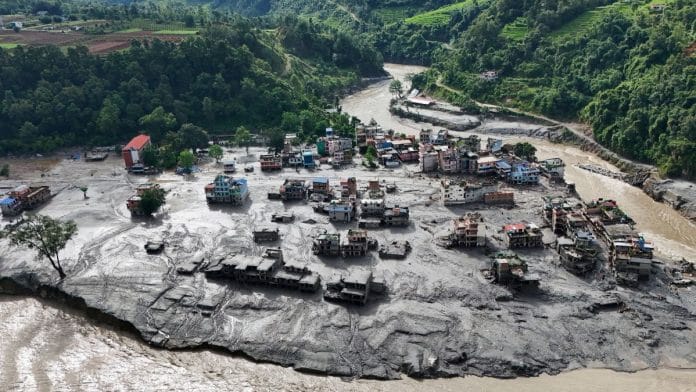
The floods that tore through Nepal this week have spotlighted the risks of these projects, which are getting harder to ignore. The immediate question is not simply how much electricity the Himalayas can produce, but what happens when an increasingly engineered mountain landscape collides with a less predictable climate.
Across the whole Hindu Kush Himalaya, there are 550 hydropower projects underway, planned, or under construction in China, India, Pakistan, Nepal and Bhutan combined, tapping into an estimated 500 GW of potential energy, according to the International Centre for Integrated Mountain Development’s new Hindu Kush Himalaya Assessment report.
While China does not necessarily lead the region in sheer number of hydropower projects, its buildout in Tibet and southwestern China remains the fastest-growing and largest by scale in Asia.
The Nepal disaster exposed a fact that is easy to forget when looking at hydropower statistics from a distance: in the Himalayas, the infrastructure built to harness water is often located directly in the path of water’s most violent movements.
Asia’s water towers and hydroelectricity
The Himalayas and the Tibetan Plateau function as Asia’s great water towers, feeding the Indus, Ganges and Brahmaputra systems and sustaining hundreds of millions of people downstream. A 2020 Wiley study of the Indus-Ganga-Brahmaputra river basins showed just how crowded the Himalayan hydropower landscape has become and how it is the site for more disasters in the future.
Researchers counted 110 large hydropower projects already built across the Karakoram-Himalaya-Tibet region, alongside 132 across the wider Indus-Ganga-Brahmaputra basins, though many of the associated reservoirs store relatively little water and do little to regulate river flow compared to dams downstream in the plains. Another 29 large storage projects are now planned for the mountain zone alone, part of a broader wave that includes at least 100 proposed dams taller than 50 meters — structures researchers flag as carrying real seismic and failure risks in one of the world’s most earthquake-prone regions.
Four major projects are already under construction, including India’s Lower Subansiri and Pakistan’s Diamer Basha, while ten more are at an advanced planning stage.
The Himalayan huddle
The “Third Pole” — the Tibetan Plateau and surrounding mountains — is the world’s largest freshwater reserve outside the polar regions and the source of some of Asia’s biggest river systems. Hydropower capacity across these basins more than tripled between 2000 and 2020, with rapid expansion in the Indus, Ganga and Brahmaputra basins, supplying electricity to hundreds of millions of people, according to the Wiley study.
China has already built several large dams in Tibet, including the Zangmu Dam on the Yarlung Tsangpo, completed in 2015, followed by the Jiexu and Jiacha dams. These projects are part of a broader campaign to harness the region’s rivers for energy security.
And then there is the project that changes the scale of the argument.
The Yarlung Zangbo hydropower project, near the Great Bend in Tibet’s Nyingchi prefecture, broke ground in July 2025, close to the disputed border with India’s Arunachal Pradesh. Five cascading hydropower stations are planned along roughly 50 kilometers of gorge, where the river drops about 2,000 meters. The project is expected to require tunnels ranging from roughly 20 to 60 kilometers to divert water around the bend. Its planned capacity is 60,000 megawatts — about three times that of the Three Gorges Dam, the biggest in the world and roughly six times India’s entire existing installed hydropower capacity. Its estimated cost ranges from about $137 billion to $170 billion.
Politics, power and water
For China, it is an extraordinary renewable-energy project but for India and Bangladesh, it is also a question about power. China sits upstream of many of the rivers that sustain India, Pakistan, Bangladesh and much of Southeast Asia. The Tibetan Plateau is the source of the Brahmaputra, Indus, Sutlej, Mekong, Salween, Yangtze and Yellow Rivers. Dams constructed there can influence the timing and volume of water before it reaches downstream countries.
India has substantial hydropower infrastructure of its own across Jammu and Kashmir, Himachal Pradesh, Uttarakhand, Arunachal Pradesh and Sikkim. Projects such as Tehri, Nathpa Jhakri and Subansiri Lower have made India a major regional hydropower player. But the scale is different.
Indian projects have generally been smaller and more fragmented across states and river basins. Increasingly, newer proposals such as Upper Siang are viewed not merely as energy investments but as strategic responses to China’s expanding upstream infrastructure.
The most persistent concern surrounding the Yarlung project, however, is geological. The Tibetan Plateau was created by the collision of the Indian and Eurasian tectonic plates millions of years ago. That collision has not stopped. The Indian plate continues to move toward the Eurasian plate, making the Himalayas one of the world’s most earthquake-prone regions.
A New York Times report last year noted that such seismic activity threatens dams. The concern was increased by the magnitude-7.1 earthquake that struck near Shigatse in early 2025, killing more than 120 people. Chinese officials said cracks appeared in five hydropower dams in Tibet after the earthquake.
Chinese hydrology and geology journals, including Shuili Xuebao, or the Journal of Hydraulic Engineering, and Dizhi Kexue, or Geological Science, have examined the engineering challenges surrounding the project, such as tunneling through permafrost, controlling unstable sediment and mitigating seismic risks.
Researchers at the China Institute of Water Resources and Hydropower Research have also studied the possibility of reservoir-induced seismicity and noted the project’s location along the collision boundary of the Indian and Eurasian plates.
Hydropower meets hydropolitics
Of the five countries along the Himalayan arc, only Nepal and Pakistan have opened their hydropower sectors to Chinese state capital and contractors. India prohibits Chinese investment, technology and engineering firms in its hydropower sector, a restriction rooted in the unresolved border dispute and hardened after the 2020 clashes in Ladakh. Bhutan’s hydropower industry is financed largely by India, and Bhutan has no formal diplomatic relations with Beijing.
China’s South Asian hydropower footprint is therefore concentrated in two very different places. In Pakistan, it has taken the form of enormous, capital-intensive projects under the China-Pakistan Economic Corridor. The 720-megawatt Karot project on the Jhelum, financed by China’s Silk Road Fund, began commercial operations in 2022. The 884-megawatt Suki Kinari project in Khyber Pakhtunkhwa finally reached commercial operation in September 2024 after falling more than three years behind its original schedule.
Three other projects — the 1,124-megawatt Kohala, 700-megawatt Azad Pattan and 640-megawatt Mahl —all in the Jhelum river remain under construction or are stuck in financing limbo. Pakistan’s chronic power-sector debt has slowed development, while China Three Gorges Corporation has not committed fresh capital to the country since 2016, redirecting newer investment toward solar and wind projects in Egypt and Jordan.
Nepal presents a different model: smaller, more numerous projects scattered through fragile valleys.
The 60-megawatt Upper Trishuli 3A was financed by an Export-Import Bank of China loan and completed in 2019. The 78-megawatt Sanjen Khola project was built by China Harbour Engineering Company and connected to the grid in 2025. Both were damaged in this week’s disaster.
Nepal’s proposed 1,200-megawatt Budhi Gandaki storage project has endured a different kind of turbulence. Its contract with China Gezhouba Group has been awarded, revoked and re-contested amid transparency and procurement disputes. A proposed 156-megawatt storage project on the Madi River, meanwhile, has advanced only to the feasibility stage, with PowerChina involved in the study.
Taken together, China’s hydropower footprint in the Himalayan countries of South Asia remains only a fraction of the region’s total buildout. The Chinese projects anchor some of Pakistan’s largest generation assets, form an early and contentious layer of Belt and Road energy diplomacy in Nepal, and, with Medog, represent an entirely different order of ambition for the future.
But before the future arrives, adaptation, preparation and early warning systems need to be in place for the communities that pay the price. Nepal was a lesson in real time.
(Edited by Ratan Priya)