



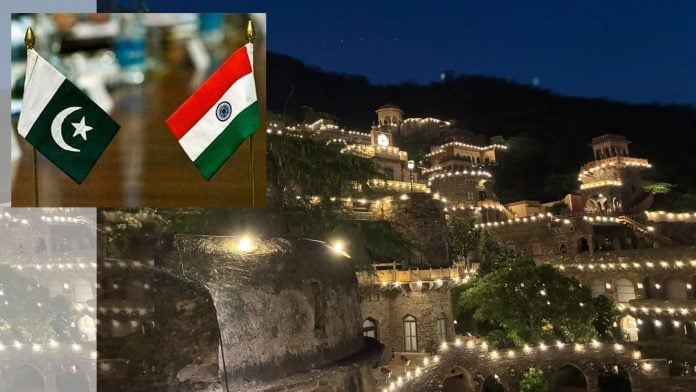
Neemrana: Nestled among the Aravalli hills in Rajasthan, a few hours from New Delhi, lies an imposing fort with a storied history, looking over an industrial zone. The Neemrana Fort Palace, which traces its roots to the 15th century, had begun to crumble and crack by the 20th century before a restoration project in the 1980s helped establish it as a luxury hotel.
Within half a decade of being reopened to the public, the fort hosted an important diplomatic effort—a dialogue between civil society members of India and Pakistan, amid yet another period of soaring tensions between the two neighbours.
The discussions, assisted by the US at the beginning, began in 1991 and marked one of the earliest Track II diplomatic efforts between the two countries, which had by that time fought three wars against one another.
The dialogue, as former High Commissioner of India to Pakistan Ajay Bisaria notes in his book Anger Management, began at “American nudging and given the gathering crisis in Kashmir”.
“The ‘Neemrana Dialogue’ at a fort in Rajasthan began in October [1991] as a ‘Track Two’ accompaniment to the stuttering official dialogue. One of the proposals of the [Robert] Gates Mission had been to promote a ‘non-official dialogue’ so that the two sides could communicate when official exchanges collapsed,” Bisaria wrote in the book.
Expanding on the development of the Track II mechanism in the last 35 years, Bashir Ali Abbas, a research associate at the Council for Strategic and Defense Research, tells ThePrint that prior to 2019, delegations in Track II processes “used to be larger, featuring individuals across the political divide on either side”.
“This made Track IIs unique forums even for one side. Because it featured both fierce government critics as well as its staunch backers in the same delegation, both presenting their own lines of reasoning to explain India’s positions,” said Abbas.
He added: “This didn’t just reflect a united front but showed how varied ideological constituencies could converge to serve and defend the national interest. But perhaps most importantly, it undercut any Pakistani effort to exploit the public positions of government critics in India, to serve Pakistani arguments. This went both ways.”
However, much like the larger India-Pakistan relationship, the Neemrana dialogue and a raft of Track II dialogue formats have waxed and waned in their utility. T.C.A. Raghavan, a former Indian High Commissioner to Pakistan, tells ThePrint that the Neemrana dialogue was funded by a third country in the beginning and eventually managed by the foreign officers of India and Pakistan.
“For a number of years, the Neemrana dialogue was taken over by the respective foreign officers. The dialogue came to an end around 2017 when both foreign offices decided to stop funding it,” said Raghavan.
The former high commissioner points out that the efficacy of such dialogues depends on the value placed by the “participating countries”.
Also Read: Let’s keep Pakistan, Bangladesh out of our politics. It undermines India’s strategic interests
The rise and fall of Track II dialogues
Track II diplomacy is a unique feature developed in the late 1970s as government-to-government discussions among the world powers of the day were minimal during the Cold War.
The purpose was to have civil society members, retired government officials, retired military officials, and academics to possibly meet and find different solutions to the issues facing the governments of the day.
As Bisaria notes in Anger Management, Benazir Bhutto, then 35, came to power as Pakistan Prime Minister in December 1988 with some intention to deal with India albeit in a manner different from Zia ul Haq, who served as President from 1978 to 1988. Within weeks of her ascension to power, India’s then Prime Minister Rajiv Gandhi visited Pakistan for the fourth SAARC (South Asian Association for Regional Cooperation) Summit, marking the first visit by an Indian leader to the country in almost three decades.
The Gandhi-Bhutto thaw was quickly destablised as Benazir, facing mounting domestic pressures, decided to take a tougher stand on Kashmir. Within weeks of an election in 1989, the new Indian government led by V.P. Singh faced a crisis—the kidnapping of the daughter of the then Union Home Minister Mufti Mohammed Sayeed with Pakistani involvement, notes Bisaria.
At the same time, the insurgency in Kashmir intensified, with Islamabad denying any role in the situation, while Bhutto continued to heighten the rhetoric against India. The insurgency in Kashmir led to the eventual exodus of Kashmiri Pandits.
By the middle of 1990, the tensions between the two neighbouring states led US President George H.W. Bush to delegate Robert Gates, who would later become a Secretary of Defence, on a secret mission to de-escalate the situation.
The mission, the US claims, was a success in preventing a potential nuclear conflagration in the region. While Bisaria calls the claim exaggerated, the outcomes of the Gates mission led to the eventual beginning of the Neemrana dialogue the following year, in 1991.
The dialogue featured a number of issues at the time, including Kashmir, boundary issues surrounding Sir Creek and cross-border terrorism. Eventually, the foreign offices handled the dialogues. Other formats have also been established, often assisted by third countries.
A number of Track II formats have been held since Operation Sindoor in 2025, with the more serious ones held in a couple of cities in West Asia, and one in Thailand.
A Track II round was held at Neemrana in 2018, but since then, for the better part, these civil-society led dialogues have been held in third countries given the difficulties of travel between India and Pakistan.
Also Read: India’s invitation to Pakistan for SCO forum may be an obligation, but it’s a step forward
The efficacy of Track II
As ties between India and Pakistan have taken a downturn, especially since the abrogation of Article 370 of the Indian Constitution in August 2019, communication channels between the two governments have remained minimal.
In the absence of official communication channels, there are those who consider Track II formats as important to keep a track of the temperatures within both countries. As Abbas explains to ThePrint, the objectives today are “far from seeking dispute resolution or changing established Track I positions”.
Bisaria says these formats are useful for a “temperature check of the subterranean happenings between both countries”, and underlines the importance of both India and Pakistan engaging in “some format or the other”.
However, the former envoy highlights the importance of these dialogues occurring discreetly, to ensure the efficacy of the conversations, as also to avoid them getting caricatured in the media as “romanticism” or “worse”.
In the past, Abbas points out, Track II formats acted as a “non-governmental supplementary channel to Track I diplomacy”. In the India-Pakistan case, he says, it aided in dispute resolution. In the past, outcomes of the Chaophraya Dialogue—a Track II format held in Thailand—was publicised.
“However, the Track I channel largely disappeared post-2019, incrementally falling to near zero, meaning that India-Pakistan Track IIs were no longer supplementary but had to re-define their role. First, these channels morphed into avenues for more crisis management than dispute resolution, with a focus on preventing inadvertent escalation,” said Abbas.
He added: “Second, both in the lead-up to and following 2025, at least some Track II channels now serve as the main organised communication avenue between both states, with delegations exchanging views and briefing the governments on both sides as a purely voluntary effort.”
However, Abbas points out that the opening of the Kartarpur corridor, allowing Indian pilgrims to visit the gurdwara in Pakistan, was taken up seriously during the Chaophraya format of Track II dialogues and then taken up by both governments, before its eventual opening.
As India-Pakistan’s Track II dialogues have evolved from the fort of Neemrana, they have come to occupy an important avenue for both sides to keep an eye on the other, with little government-to-government communication.
Nevertheless, Raghavan tells ThePrint that Track II as a format is a “very poor substitute for diplomacy”. As neighbours, he says, there must be some diplomatic engagement—especially with “bad neighbours.”
(Edited by Sunanda Ranjan)
Also Read: Pakistan is running out of neighbours to shut its borders on