




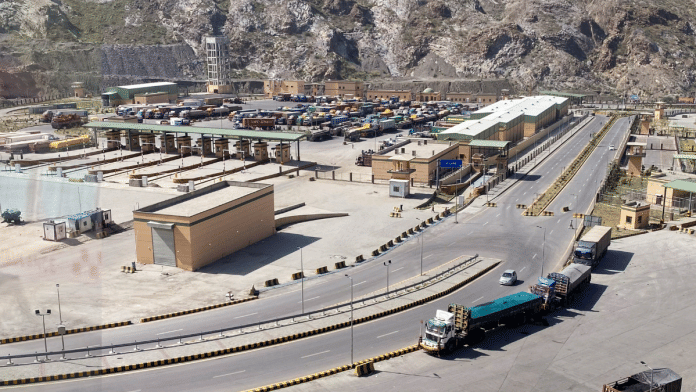

Pakistan shares a land border with four countries. Trade across each is in trouble: recently suspended with Iran, frozen with India for years, at a year-long standstill with Afghanistan, and limited with China. A country whose reach has extended far beyond its region — even becoming a mediator in a defining conflict of this century and aiming to be a security provider in West Asia — is struggling to manage its immediate neighbourhood.
Around mid-October, reports emerged that Pakistan had shut key border crossings — Gabd-Rimdan and Taftan — used for trade with Iran. The two countries share a border stretching more than 900 km, most of which runs through Pakistan’s restive Balochistan province. At the time of the closure, a Pakistani official described it as a “temporary measure to improve border management to support counterterrorism efforts”. But there are indications that Pakistan made this move under American pressure to squeeze Iran dry.
Earlier this month, the US Treasury Secretary Scott Bessent said he was working with Pakistan and Turkey to cut off Iran’s land routes. On 23 October, the Wall Street Journal reported that Iraq and Pakistan were closing key land routes into and out of Iran, adding to the pressure from a US naval blockade and sanctions on airlines that had severed most of Iran’s shipping and air routes. Whether or not the border closures were a direct result of US pressure, their timing has fuelled speculation to that effect.
Has Pakistan reopened the border with Iran?
A week after the closure, reports indicated that Pakistan had reopened the Gabd-Rimdan crossing, through which thousands of tonnes of LPG enter the country. The reversal coincided with a visit to Tehran by Pakistan Army Chief Field Marshal Asim Munir, for a meeting involving Iran and the signatories to the Mecca Pact.
The border closure had sent LPG cylinder prices soaring in Pakistan, with traders warning of further increases and the risk of an energy crisis. Iran’s ambassador to Pakistan clarified that there were no restrictions on Iranian goods being exported to Pakistan. He said changes to Pakistan’s E-Form procedure for imports from Iran had created a situation in which traders were “effectively and literally unable to dispatch cargo from Iran to Pakistan”. Addressing reports that trucks carrying LPG had crossed into Pakistan, the envoy said they had yet to be unloaded or cleared, despite having been there for weeks.
The closure came months after Tehran and Islamabad agreed to enhance border trade and push towards a $10 billion bilateral trade target. Pakistan had been cushioning Iran from the full weight of the American blockade. Intelligence suggests that Pakistan had passively allowed Iranian vessels through its Exclusive Economic Zone to circumvent US naval blockade. Islamabad also opened six land routes linking the ports of Karachi, Port Qasim and Gwadar at Gabd and Taftan so that Tehran could import goods from third countries. After showing its usefulness, Pakistan may have shut the crossings, possibly under American pressure. But, as soon as Iran showed it had leverage and could inflict costs, Pakistan reopened the borders, with Munir’s visit to Iran possibly doing the work.
However, in the absence of concrete evidence linking the closure to US pressure, Pakistan’s stated security and technical rationales remain plausible. Baloch militancy straddles the border, affecting Pakistan’s Balochistan province and Iran’s Sistan-Baluchestan province. In January 2024, the two countries even exchanged missile strikes over the issue, but swiftly reverted to rhetoric about their “brotherly relations”.
Also read: Asim Munir has plucked the last thorn from Pakistan’s democratic rose
Different borders, similar tales
Some commentators have noted that Iran followed Pakistan’s playbook. For years, Islamabad has weaponised trade routes and Afghanistan’s economic dependence on Pakistan as leverage to bludgeon the Taliban into reining in the Pakistani Taliban. Iran, meanwhile, may have threatened to redirect its LPG exports.
After relations with the Taliban deteriorated, Pakistan repeatedly ordered border closures, reopening them when tensions eased. However, trade between Afghanistan and Pakistan has remained at a standstill since the deadly clashes in October 2025. Although Afghanistan is more dependent on Pakistan economically, the latter has not gone completely unscathed. Khyber Pakhtunkhwa, which borders Afghanistan, has been reeling from the blowback of dormant cross-border trade.
Beyond the domestic repercussions, the disruption has severely affected Pakistan’s exports to Central Asia via land routes. Afghanistan offers the shortest overland route, while alternatives are both time-consuming and exorbitant. Pakistan has reportedly been routing goods through Iran to bypass Afghanistan, meaning the recent closure of crossings with Iran may also have disrupted its trade with Central Asia.
Meanwhile, trade between India and Pakistan has remained frozen following a series of events in 2019. After the Pulwama terror attack in February that year, India withdrew Pakistan’s Most Favoured Nation (MFN) trading status and imposed tariffs of up to 200 per cent on imports from Pakistan. In April 2019, India also suspended trade across the Line of Control (LoC), citing concerns about its misuse by unscrupulous elements and terrorist organisations based in Pakistan. In August that year, Pakistan announced a complete suspension of trade with India in response to New Delhi’s revocation of Article 370 in Jammu and Kashmir.
Although formal trade relations remain frozen, the two countries have continued to trade through informal and indirect channels involving third countries, including the UAE, Sri Lanka and Singapore. Following the April 2025 Pahalgam attack, the main Attari-Wagah land border crossing, which India had used to conduct trade with Afghanistan via Pakistan, was also shut.
Pakistan’s trade relationship with China presents a somewhat different picture. Overland trade takes place via the Karakoram Highway, which cuts through the Khunjerab Pass. However, trade volumes remain limited for several reasons, particularly weather-related disruptions in a geologically active region. Militancy and political instability along the route, including protests and sit-ins, have also been cited as reasons the highway has failed to deliver the desired economic dividends. Geography, however, remains the bigger barrier.
So, is Pakistan becoming isolated in its own neighbourhood? It has signed defence agreements such as Mecca and Badr, stretching from the Gulf to Southeast Asia. The question is how a country whose defence and diplomacy are faltering at home can seek to provide security and diplomatic support to others beyond its immediate region. Pakistan continues to pursue this role despite its domestic and regional troubles — and, arguably, partly because of them.
Pakistan was ranked the world’s most terror-affected country in the 2026 Global Terrorism Index. Indeed, all its neighbours share security concerns. Pakistan says it is itself a victim of terrorism and has accused India and Afghanistan, and at times Iran, of sponsoring anti-Pakistan groups. It has made no such accusation against China, but Chinese nationals have been attacked in Pakistan. Beijing has urged Islamabad to strengthen their security and has reportedly grown hesitant about committing further investments to the country.
To cut a long story short, whether Pakistan is a victim or a perpetrator, trade, investment and trust with most of its neighbours have withered. In India’s case, these ties are close to nil, but India can heave a sigh of relief (albeit cautiously), for a Pakistan preoccupied on its western frontier means it has less bandwidth for trouble on its east. On Pakistan’s part, the closures mean it may soon run out of neighbours against which it can shut its borders—as well as neighbours willing to keep those borders open or functioning effectively.
Bantirani Patro is a staff writer at ThePrint. She tweets @bantirani_patro. Views are personal.
(Edited by Prashant Dixit)