



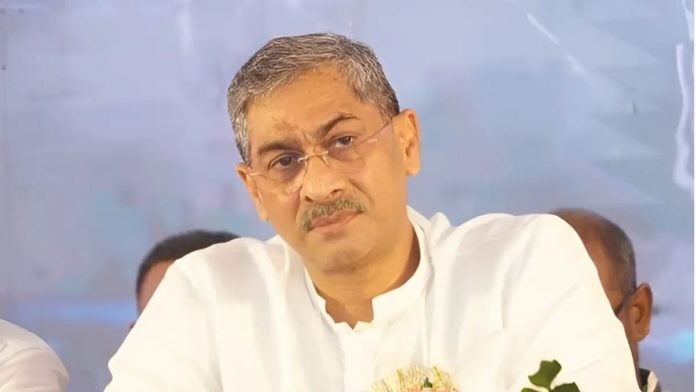
New Delhi: India should include the 1977 “guarantee clause” in a renewed Ganga Water Treaty, thus assuring minimum flow of water downstream, Bangladesh Minister of Water Resources Shahid Uddin Chowdhury Anee has told ThePrint in an exclusive interview.
The 1996 Ganga Water Treaty is set to expire this December, and both countries are gearing up for discussions on renewing it. The guarantee clause assured a fixed minimum flow of water to the downstream country, in this case Bangladesh, during the river’s leanest part of the dry season—from 21 April 21 to 31 May.
Anee said that the clause was part of the 1977 agreement that his country signed with India, but was omitted from the 1996 treaty. “One of the things that we want when the treaty is renewed is the guarantee clause. It’s a high priority for us. The renegotiated treaty should consider the interest of both the countries,” Anee said.
The minister added that Bangladesh and India continue to have good understanding and that the renewal of the Ganga treaty with the guarantee clause will further “strengthen the friendship between the two countries”.
“We are very positive,” Anee said, adding that the Joint Rivers Commission (JRC) will meet soon to discuss the nuts and bolts of the treaty.
The JRC, set up in 1972 and headed by water resources ministers of both the countries, last met in Kolkata in May for technical discussions on treaty renewal.
Also Read: Bangladesh’s Indemnity Act shields murderers from courts. It’s impunity institutionalised
What 1996 treaty mandates
The 1996 treaty was signed in Delhi between then Indian Prime Minister H.D. Deve Gowda and his then Bangladesh counterpart Sheikh Hasina for sharing the Ganga waters at Farakka, which is the last control structure on river in India, during the lean period from 1 January 1 to 31 May 31 on a 10-day period basis as per the formula provided in the treaty.
That formula dictates an equal share for both countries if the flow in the river is 70,000 cusecs or less. If the flow is between 70,000 to 75,000 cusecs, Bangladesh will get 35,000 cusecs while India gets the remaining share. If the flow in the river is over 75,000 cusecs, India will get 40,000 cusecs and Bangladesh gets the remaining.
The treaty also provided a formula to share the Ganga water during the leanest part of the dry season, between 11 March and 10 May. During this period, both the countries get 35,000 cusecs each during three alternate 10-day periods.
The treaty does not, however, provide for a fixed minimum flow for Bangladesh when the river’s flow at Farakka is exceptionally low. It states that in the event the flow at Farakka falls below 50,000 cusecs in any 10-day period, the two countries will enter into “immediate consultations to make adjustments on an emergency basis”, in accordance with the “principles of equity, fair play and no harm to either party”.
The Bangladesh water resources minister said that those in power in Bangladesh in the last 17 years did not consider the interest of the people of the country. “But our government led by Tarique Rahman is different. We have the people’s interest in mind and will ensure that it gets reflected when the treaty comes up for renewal. All these issues will be discussed in the JRC meeting.”
Pushback from stakeholder states
Even though India and Bangladesh are yet to begin formal discussions to renegotiate the treaty, there is already pushback in India from stakeholder states like Bihar, which is pushing for scrapping of the treaty.
Rajya Sabha member and Janata Dal (United) national president Sanjay Kumar Jha has called for scrapping of the treaty.
Taking to social media platform X, Jha wrote last month, “Thirty years of data show the serious ecological and economic costs of the 1996 Indo-Bangladesh Ganga Water Treaty, particularly for Bihar. With the treaty expiring on December 12, 2026, the JD(U) position is clear: it must not be renewed in its present form. India should allow it to lapse and negotiate afresh based on the scientifically assessed water needs of Bihar and other basin states up to 2050, with Bihar firmly at the decision-making table.”
The delay in starting discussions with Bangladesh on renewing the treaty has also come under flak from a parliamentary panel. The Standing Committee on External Affairs in its Action Taken Report on the ‘Future of India-Bangladesh relationship’ tabled in Parliament on 30 July recommended that the “Government of India should initiate bilateral discussions with Bangladesh at the earliest, to avoid any vacuum in the post 2026 period”.
The committee has further recommended that the renewal process should be guided by “updated hydrological data, climate change projections, and the need for equitable and sustainable utilisation of river waters”.
“In this regard, the committee emphasises that consultations with concerned state governments, particularly West Bengal and Bihar, may be continued to ensure that national- and state-level interests are aligned in formulating India’s position during the negotiation process,” the panel, led by senior Congress leader Shashi Tharoor, said.
(Edited by Nardeep Singh Dahiya)
Also Read: Amid chill in ties, India holds up approval for Bangladesh’s appointment of next High Commissioner
How come India guarantee something over which it has no jurisprudence. How much water a river has depends on rains and weather. It has to be by percentage of water volume as it is done in most river water sharing by neighboring countries worldwide.