





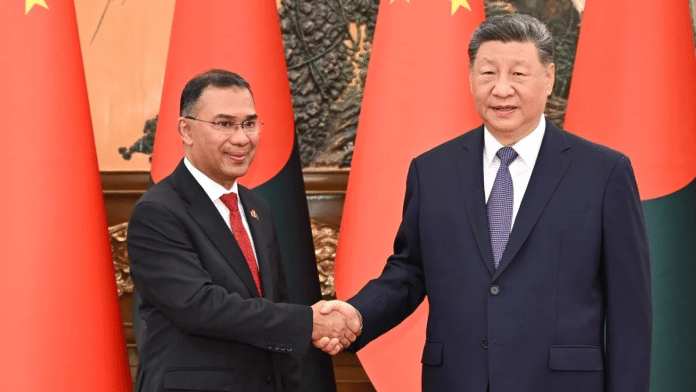


New Delhi: As Dhaka and Beijing deepen ties, India is watching with caution China’s proposal to develop a China-Myanmar-Bangladesh Economic Corridor (CMBC), an initiative proposed during Bangladesh PM Tarique Rahman’s maiden state visit to Beijing.
During the visit, Beijing proposed a transport corridor linking China’s Yunnan Province with Bangladesh through Myanmar, providing overland access to the Bangladeshi ports of Chittagong and Mongla. It was not mentioned in the joint communique issued by both countries but was discussed, local reports said.
The proposal builds upon the existing China-Myanmar Economic Corridor, an approximately 1,700-kilometre network stretching from Kunming to Myanmar’s coast that serves as one of the key components of China’s 2013 Belt and Road Initiative.
Responding to questions on the corridor Friday, India’s Ministry of External Affairs said it was monitoring developments closely.
“We closely follow developments in the neighbourhood and take appropriate measures when needed,” MEA spokesperson Randheer Jaiswal responded during the ministry’s regular media briefing.
The proposal revives an idea first conceived more than two decades ago in 1999 under the Bangladesh-China-India-Myanmar (BCIM) Economic Corridor initiative. India gradually disengaged from the project as concerns grew over the strategic implications of China’s Belt and Road Initiative and as India-China relations cratered.
For New Delhi, the implications extend beyond trade. Transport infrastructure increasingly serves strategic as well as commercial purposes, raising concerns about the gradual emergence of an integrated Chinese logistical network stretching from Yunnan Province to the Bay of Bengal and potentially expanding Beijing’s influence along India’s eastern maritime approaches.
Bangladesh has, however, not formally endorsed the proposal. Speaking at a press briefing on 27 June, Bangladesh Foreign Minister Khalilur Rahman said Dhaka was “currently examining” the plan and had “taken no position” on it.
He further added that any overland connectivity through Myanmar would remain explicitly conditional upon the restoration of peace and stability in Rakhine State.
Growing China-Bangladesh ties
The proposed CMBC would extend China’s existing China-Myanmar Economic Corridor westward into Bangladesh. The proposed corridor continues into Bangladesh, eventually connecting Chinese trade to the ports of Chittagong and Mongla.
During Rahman’s visit to Beijing, Bangladesh also signed a memorandum of understanding with China Civil Engineering Construction Corporation to develop the China-Bangladesh Mongla Port Economic Zone adjacent to the country’s second-largest seaport.
The agreement effectively replaces a project that had originally been reserved for Indian investment under a bilateral initiative launched during PM Narendra Modi’s visit to Dhaka in 2015.
The Chinese agreement follows the decision by the Yunus-led interim administration in 2025 to delist the proposed Indian economic zone after the Indian government-nominated Hiranandani Group failed to begin construction within the stipulated two-year period.
The proposed corridor would provide southwestern China with a significantly shorter overland route to the Indian Ocean, reducing Beijing’s dependence on the Strait of Malacca, through which a substantial portion of China’s energy imports and exports currently passes. It also would connect Yunnan to global shipping routes.
The project however depends on Myanmar’s political and security situation.
Rakhine State, through which the corridor would pass, is now largely outside the effective control of Myanmar’s military government. The Arakan Army, an ethnic armed organisation, controls approximately 14 of the state’s 17 townships. The military junta formally retains Kyaukphyu, where the proposed deep-sea port is located, the state capital Sittwe, and the island township of Manaung.
Even so, Kyaukphyu itself is under active siege conditions. Arakan Army forces are reported to be operating within roughly two kilometres of key junta naval installations and other strategic infrastructure, making the area better described as contested than securely under government control.
The deteriorating security environment has already affected Chinese investments. A China-backed power plant at Kyaukphyu which is a $140 million facility operated through a joint venture between Hong Kong-listed VPower Group and the Chinese state-owned China National Technical Import and Export Corporation (CNTIC) was dismantled and relocated starting late 2024. The relocation accelerated sharply in early 2026 as fighting moved closer to the site.
The power plant had already suspended operations in late 2023 after Myanmar’s military government failed to provide adequate natural gas supplies and was unable to make electricity payments in US dollars.
The Kyaukphyu deep-sea port project itself has experienced repeated delays. Initial memorandums of understanding were signed with China’s CITIC Group in 2009, and the project was formally awarded through an international tender in December 2015 at an estimated cost of $7.3 billion. The civilian government had then in 2018 re-negotiated the agreement to 1.3 bn dollars.
(Edited by Viny Mishra)
Also read: China is expanding influence in Myanmar, Bangladesh. India has a geography advantage