






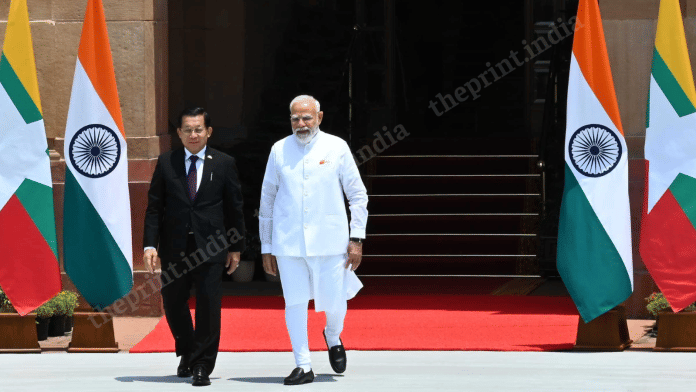

The recent visits of Myanmar President U Min Aung Hlaing to India and China, and Bangladesh Prime Minister Tarique Rahman to China must be read together. They are not isolated diplomatic events. The visits point to a larger Chinese attempt to expand influence across India’s eastern neighbourhood, from Myanmar’s Bay of Bengal coast to Bangladesh’s ports, rivers, power networks, defence procurement, and political establishment—and an Indian effort to address that outreach.
Myanmar’s president visited India from 30 May to 3 June as his first foreign destination after assuming office. He then travelled to China from 15 to 19 June. Three days later, Bangladesh’s prime minister, despite an earlier invitation from Prime Minister Narendra Modi to visit India, chose China for his first major strategic outreach after assuming office. This diplomatic choreography carries meaning. Myanmar signalled balance; Bangladesh signalled recalibration; China signalled ambition.
For India, the concern is not merely that China is engaging its neighbours. Every sovereign country has the right to diversify partnerships. The concern is that Beijing’s role in both Myanmar and Bangladesh may gradually affect India’s border security, Northeast stability, Bay of Bengal posture, connectivity projects, migration pressures, defence planning, and regional influence.
Yet, the picture is not one-sided. China may offer finance, weapons, and infrastructure, but India remains indispensable to both Myanmar and Bangladesh because of geography, history, culture, markets, rivers, energy, medicine, connectivity, and people-to-people linkages.
Myanmar goes India first, but China still looms large
Hlaing’s decision to visit India before China was symbolically important. India’s official statement placed Myanmar at the confluence of India’s Neighbourhood First, Act East, and MAHASAGAR policies. The visit began at Bodh Gaya, underlining Buddhist and civilisational links. The agenda covered border security, Kaladan Multi-Modal Transit Transport Project, India-Myanmar-Thailand Trilateral Highway, Rupee-Kyat settlement, healthcare, rare earths, cyber security, maritime cooperation, and capacity building.
Myanmar is the only ASEAN country sharing a land border with India. It is also India’s land bridge to Southeast Asia. The 1,643 km India-Myanmar border passes through Arunachal Pradesh, Nagaland, Manipur, and Mizoram. Instability in Myanmar directly affects insurgency, narcotics trafficking, refugee flows, weapons movement, cross-border ethnic tensions, and internal security in the Northeast. Therefore, Myanmar’s assurance that its territory would not be used against Indian security interests was important. Although large parts of Myanmar’s borderlands are outside effective central control, India’s engagement with Naypyidaw is necessary, even if uncomfortable. India cannot secure its four border states if it ignores whoever controls official power in Myanmar.
Also read: Modi and Seychelles team up for blue economy and climate aid. Not just fish & ships
Myanmar’s mistrust of China
Myanmar’s relationship with China is deep but uneasy. The Myanmar military has depended on China for diplomatic cover, arms, trade, and engagement with ethnic armed organisations. Yet, the country’s political and military elite have long mistrusted Beijing. This mistrust is rooted in five issues: rare earth extraction in Kachin, the stalled Myitsone Dam, the China-Myanmar oil and gas pipelines, Chinese influence over ethnic armed organisations, and reported border encroachment concerns in northern Shan State.
In Kachin, rare earth extraction, mainly that of dysprosium and terbium, has become a major source of resentment. Myanmar has emerged as a key supplier of heavy rare earths. Reuters reported in May 2026 that Kachin is particularly significant because it produces about half of the world’s heavy rare earths. The problem is that much of this extraction feeds Chinese supply chains while leaving Myanmar with ecological damage. Investigations by Global Witness and others have described toxic mining practices, water contamination, destroyed hillsides, and serious local environmental degradation in Kachin.
The Myitsone Dam is another symbol of mistrust. Suspended in 2011 after public outrage, the project was widely seen in Myanmar as one that would damage the Irrawaddy River System while sending most of the electricity to China. Beijing has periodically pressed for a reconsideration of the project. For many in Myanmar, Myitsone represents an unequal bargain: Myanmar bears the environmental and political cost, while China receives the strategic and energy benefit.
The China-Myanmar oil and gas pipelines from Kyaukphyu to Yunnan also illustrate this imbalance. They give Beijing an overland energy route from the Bay of Bengal to southwest China, reducing its dependence on the Malacca Strait. Myanmar receives transit revenue and some infrastructure, but local communities have complained about land acquisition, limited compensation, and inadequate development benefits. The pipelines cut across Myanmar, and in a way, question the country’s sovereignty.
Beijing officially supports Myanmar’s sovereignty, but Chinese-origin arms and China-linked supply networks have long been associated with armed groups along the Myanmar-China frontier, especially the United Wa State Army and groups operating in northern Myanmar. There are also local media reports alleging Chinese border fencing or encroachment in parts of northern Shan State, including areas around Chinshwehaw, Kyukok-Pansai, and Namtit. These reports reflect deeper anxieties around sovereignty in Myanmar. Even a perception that China is altering facts on the ground can provoke nationalist resentment.
Beijing’s Myanmar policy is driven by hard interests: access to the Bay of Bengal, Kyaukphyu port, oil and gas pipelines, the China-Myanmar Economic Corridor, rare earths, border stability, and leverage over ethnic armed organisations. For India, this means that Myanmar will remain a competitive space. India’s advantage is not money. Instead, it is geography, Buddhist ties, healthcare, education, border relevance, and Myanmar’s own desire not to become a Chinese dependency.
Rahman’s China visit and the Bangladeshi message to India
Bangladesh requires equal attention because its China outreach affects India even more directly. By choosing Beijing before New Delhi for his first major strategic engagement, Rahman and Dhaka have sent a political message. The idea is to show autonomy from India and signal that the new dispensation would not be seen as dependent on its giant neighbour.
During the visit, Bangladesh and China elevated ties and signed 17 MoUs, including government-to-government, investment, and party-to-party agreements. Discussions covered infrastructure, trade, industrial modernisation, education, health, media, green technology, artificial intelligence, port development, and the Teesta river project.
China’s attraction for Bangladesh is easy to understand. It offers quick infrastructure finance, defence equipment, industrial investment, political engagement, and diplomatic balancing space. It is already an important defence supplier to Bangladesh. Reports of Dhaka considering Chinese J-10CE fighter aircraft must be read in that context. Even if not finalised, the proposal signals that Bangladesh is exploring higher-end Chinese defence platforms.
This raises a hard question. Bangladesh’s economy has faced inflation, employment stress, foreign exchange pressure, and dependence on external support. In such a situation, large fighter purchases could appear strategically ambitious but economically questionable. Bangladesh has legitimate defence modernisation needs. Its Forces Goal 2030 for Forces Modernisation (formally adopted in 2017) still remains active, albeit the focus has shifted toward a proactive, deterrence-driven approach known as “Smart Defence”. The deeper question is: against whom is this capability being built?
Geography cannot be ignored. Bangladesh is surrounded overwhelmingly by India. Its land border with the country is 4,096.7 km, while its border with Myanmar, at 271 km, is much shorter. China can supply aircraft, missiles, and radars, but it cannot provide Bangladesh a real geographical security cover in any crisis involving India.
Also read: India’s fuel story shouldn’t come at the cost of food security
Why India matters more to Bangladesh in the long run
India’s importance to Bangladesh is structural. China may provide finance and weapons, but India provides the geography of survival. Bangladesh’s water, power, climate future, medical access, trade routes, people-to-people movement, cultural identity, and regional security are all linked far more closely with India.
The first issue is water. Bangladesh is a lower riparian country in the Ganga-Brahmaputra-Meghna basin. Its rivers, floods, silt, agriculture, fisheries, inland navigation, and drinking water security are tied to flows that pass through or are affected by India. The two countries share 54 of the 57 transboundary rivers of Bangladesh, including the Ganga, Teesta, Feni, Manu, Muhuri, Khowai, Gumti, Dharla, Dudhkumar, and Kushiyara systems. China cannot solve Bangladesh’s river problems. It can offer engineering contracts, but it cannot provide basin-level cooperation. Only India can meaningfully cooperate with Bangladesh on river water sharing, flood forecasting, embankment management, siltation, inland waterways, and climate adaptation.
The Teesta issue is a good example. China can propose river management projects, but the core political and hydrological issue remains between India and Bangladesh. A Chinese-built Teesta project cannot substitute for a durable India-Bangladesh understanding on water flows. Bangladesh’s long-term water security therefore requires cooperation with India—not strategic posturing as seen in the agreement signed during Rahman’s China visit.
The second issue is power. Bangladesh has benefited significantly from electricity imports and energy cooperation with India. Indian power supplies, cross-border transmission, private-sector energy links, and regional grid possibilities are far more practical for Bangladesh than distant Chinese assurances. India can provide electricity, grid balancing, renewable cooperation, and regional energy trade. China can build power plants, but it cannot replace India as the most logical partner—the energy geography favours New Delhi.
The third issue is climate displacement. Bangladesh is one of the world’s most climate-vulnerable countries. Sea-level rise, cyclones, river erosion, salinity intrusion, and flooding could displace large populations over time. The climate stress is not merely a Bangladeshi problem; it has implications for India’s border states, especially West Bengal, Assam, Meghalaya, Tripura, and Mizoram. China cannot absorb Bangladesh’s climate pressures, manage migration, or stabilise border communities. India and Bangladesh will have to cooperate on climate adaptation, early warning systems, disaster response, embankments, river management, resilient agriculture, and orderly border management.
The fourth issue is medical dependence. Bangladeshis have long travelled to India for healthcare. Indian hospitals in Kolkata, Chennai, Delhi, Hyderabad, Bengaluru, Mumbai, and Guwahati are accessible, culturally familiar, and often more affordable than alternatives in China, Southeast Asia, or the West. For ordinary Bangladeshis, India is not an abstract strategic partner; it is where families go for cancer treatment, cardiac care, organ-related procedures, orthopaedics, diagnostics, and specialist consultations. China cannot replicate this social familiarity, language comfort, medical accessibility, and proximity.
The fifth issue is connectivity. Bangladesh’s future prosperity depends on roads, railways, inland waterways, ports, airports, and regional trade. India can connect Bangladesh to Nepal and Bhutan, beyond just the Northeast. It can help Bangladesh become a logistics hub between the subcontinent and Southeast Asia. Rail links, road corridors, inland waterways, coastal shipping, border haats, and port access all depend primarily on India-Bangladesh cooperation. China can build infrastructure inside Bangladesh, but it cannot offer the same regional market access.
The sixth issue is sea and air connectivity. Bangladesh’s maritime future lies in the Bay of Bengal, where India is the dominant resident naval power. China can help develop ports, but it cannot alter the maritime geography of the Bay. Any increased Chinese maritime presence in Mongla Port would force India to take countermeasures. This would reduce Bangladesh’s strategic comfort rather than increase it. Similarly, aviation, tourism, cargo, and business flows are more naturally linked with India because of proximity and passenger demand.
The seventh issue is history and culture. India and Bangladesh share the legacy of 1971, Bengali culture, language, literature, music, food, family linkages, and civilisational continuity. China has no equivalent emotional or historical connection. India’s relationship with Bangladesh has irritants, but it also has depth. That depth cannot be manufactured by infrastructure loans.
Chinese military can’t guarantee Bangladesh’s security
A larger Chinese military footprint in Bangladesh may appear attractive to sections of Dhaka’s strategic community as a balancing tool. But it cannot guarantee Bangladesh’s security. Bangladesh’s geography makes India unavoidable. Any attempt to use China as a military counterweight would increase Indian suspicion, harden borders, complicate river and transit cooperation, and reduce the trust required for daily stability.
China is geographically distant. In a real crisis, Chinese military support would be constrained by distance, the operating environment in the Bay of Bengal, Indian naval capabilities, regional politics, and escalation risks. China may sell defence equipment, but Bangladesh will still have to live with India every day. Therefore, Bangladesh’s wisest long-term policy is not to militarise its China relationship, but to use China for economic diversification while keeping India as the central pillar of regional stability.
Also read: Why Arunachal’s anti-conversion law has become Pema Khandu’s biggest political tightrope
Impact on India’s Northeast
For Northeast India, these developments are immediate. Myanmar affects Manipur, Mizoram, Nagaland and Arunachal Pradesh through insurgency, refugees, narcotics, and ethnic linkages. Bangladesh affects Assam, Meghalaya, Tripura, Mizoram and West Bengal through migration, trade, river systems, connectivity, smuggling, and cultural ties.
If China deepens its role in both Myanmar and Bangladesh, India’s Northeast could face strategic pressure from both east and west. Chinese influence in Myanmar could affect Kaladan, the Trilateral Highway, border insurgencies, and narcotics flows. The same in Bangladesh could affect India-Bangladesh connectivity, border management, Teesta politics, defence anxieties, and Bay of Bengal security.
But the Northeast can also become India’s answer to China. If India develops the region as a genuine bridge to Bangladesh, Myanmar, and Southeast Asia, it can convert vulnerability into advantage. Better roads, railways, airports, border trade, medical corridors, education hubs, tourism, and cultural exchanges can make the Northeast the centre of India’s eastern diplomacy.
How India can balance Chinese influence
With Myanmar, India must look for an early completion of connectivity projects, build on Hlaing’s assurances on borderland security concerns, expand Buddhist diplomacy, support healthcare and education, and maintain pragmatic contact with all relevant actors without undermining Myanmar’s sovereignty. While it is not a zero-sum-game, India must also capitalise on the immense distrust of China in Myanmar.
India must not overreact to Bangladesh’s China outreach or Myanmar’s China dependence. With Bangladesh, it must rebuild trust with the new government. It should move forward on water (Ganga and Teesta) dialogue, power trade, medical access, connectivity, disaster management, border stability, and market access.
New Delhi will have to show Bangladesh that its development is safer, cheaper, and more sustainable when linked with India rather than strategically mortgaged to China. India must also avoid treating Bangladesh only through the lens of illegal migration and political suspicion. Security concerns are real, but so are the opportunities. A stable and prosperous Bangladesh is one of India’s greatest strategic assets. A resentful Bangladesh drifting toward China would be a major strategic setback.
For India, the challenge is to convert the natural advantages it has with both countries into active policy. Geography alone is not enough. India must deliver faster, listen better, complete projects, manage borders firmly, and make the Northeast the heart of its eastern strategy. If it does so, China’s influence can be balanced. If it delays, Beijing will continue filling every vacuum.
The author is the former Director General of Assam Rifles. He is currently the Vice Chancellor of St Mary’s Rehabilitation University, Hyderabad. Views are personal.
(Edited by Prasanna Bachchhav)