





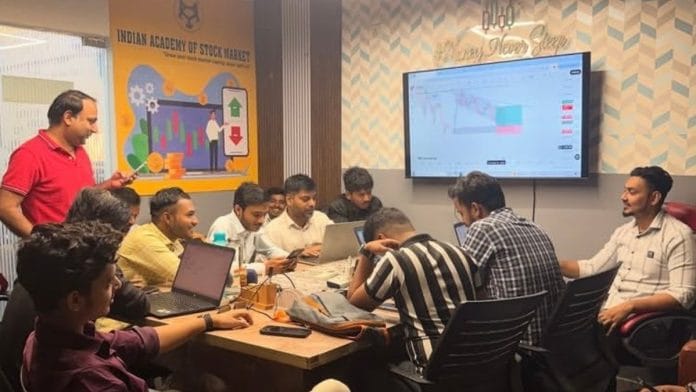


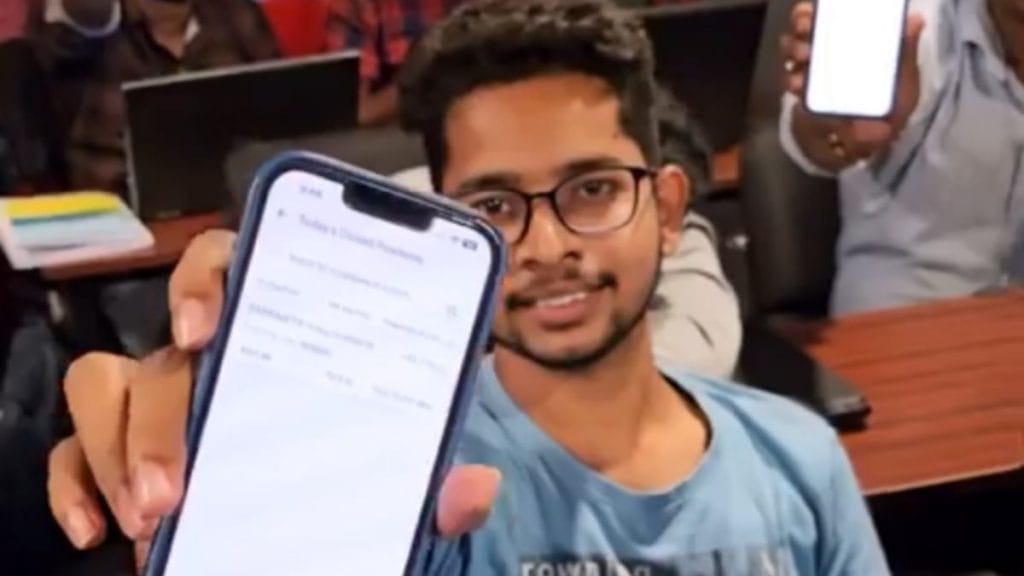
New Delhi: One morning, 18-year-old Piyush refreshed his trading account and watched an Rs 1,800 trade turn into a profit of Rs 24,000 in just a month. A trading academy in Delhi’s Uttam Nagar, part of a coaching boom built on India’s growing appetite for the stock market, helped him mint the profit.
“I felt excited that at such a young age, I had made so much profit,” he said.
The course cost Rs 28,000 for three months and now the teenager has settled into a new routine. Around 11 every morning, he sinks into a recliner, props open his laptop and spends the next nine hours tracking the market. On the large screen in front of him, red and green candlesticks flicker relentlessly as students scan charts for opportunities to put into practice the strategies they have spent weeks learning.
The room speaks ambition’s language. Slogans such as “Bold Moves, Big Success” and “Grind Now, Shine Later” line the walls. For Piyush, who works part-time as a DJ while pursuing an open college programme in Meerut, the promise is simple: learn the market and a financially independent life could be yours.
He is not alone.
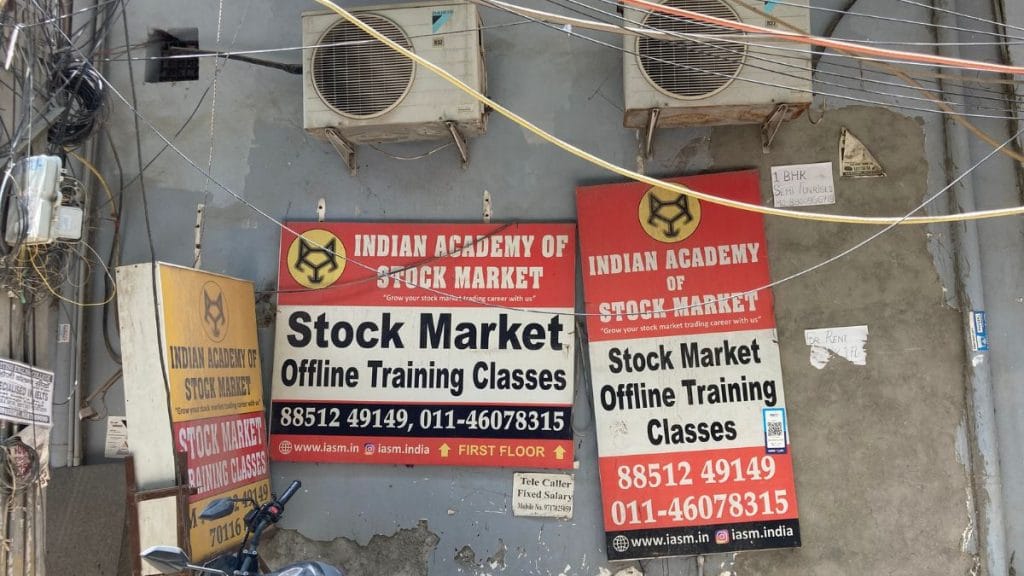
Across Delhi-NCR, trading academies have become the newest addition to neighbourhoods already crowded with coaching centres promising a better future. From Uttam Nagar in west Delhi to Laxmi Nagar in the east, classrooms teaching options strategies and risk management now sit alongside institutes preparing students for engineering entrances, government jobs and language tests. The trend has trickled in smaller towns as well. In cities such as Lucknow, Prayagraj, Raipur, Jaipur, and Bhubaneswar, traders are turning their market experience into coaching businesses, offering everything from Rs 9 introductory webinars to mentorship programmes costing over Rs 1 lakh. Others have abandoned brick and mortar centres, migrating to digital rooms, while many cater to both audiences.
Since the pandemic, retail investing has exploded as smartphones, online brokerages and social media brought financial markets within easy reach of millions of first-time investors. Demat accounts have grown from 4.1 crore in March 2020 to over 17 crore today, while a growing share of new traders are young and come from smaller towns.
Now, a parallel coaching industry has emerged to teach these new players how to succeed. The names of these institutes promise certainty but also invoke the bull of a rising market: Mad Over Trading, Trading Bulls, Bull’s Eye Trading.
Its advertisements fill Instagram Reels and Telegram channels with promises of financial freedom, while classrooms promise to turn beginners into full-time traders in a matter of weeks. An Instagram page leads to a YouTube channel, a YouTube channel to a Telegram group, and the Telegram group may lead to a course.
But the boom has also drawn increasing scrutiny. SEBI data shows that 91 per cent of individual traders in India’s equity derivatives market lost money in FY25, but more than 75 per cent of them kept coming back. Trading institutes continued to mushroom and regulators tightened rules around trading. Educators and market veterans warn the problem is the lack of financial education in India and the industry’s promise of quick money.
Suny Patwal, a Bengaluru-based market analyst and trader who previously worked with JP Morgan and Danske Bank, says this growing trend of trading classes is concerning.
“Most of the people who come to these institutes have one aim: to make money,” the 42-year-old said. “Earlier earning money was tied to stable jobs and experience, but that perception has shifted with the rise of quick-profit narratives.”
A dream of financial freedom
For nearly two decades, 36-year-old Shyam Kumar Shah has earned a living repairing mobile phones.
His rented shop in Delhi’s Ansari Nagar pays the bills, but it also keeps him awake at night. If he has to return to his native Darbhanga in Bihar, he isn’t sure the business will survive. Two of his children are already in school and a third will soon join them. The search for another source of income has become less an ambition than a necessity.
And this brings him to a trading academy tucked away in a lane in Dwarka Mor.
“Everyone is in need of money. If my business fails, I may have to shift to my village,” he said. “But if I have trading knowledge, I can do that. It is better to have this as a backup.”
The counselling session resembles those at any coaching institute. A printed sheet listing different courses is placed before him, fees are circled in pen and promises explained one by one. After months of drifting through YouTube videos and online trading classes, Shah has decided an offline classroom may finally give him the confidence to enter the market.
He is not an anomaly.
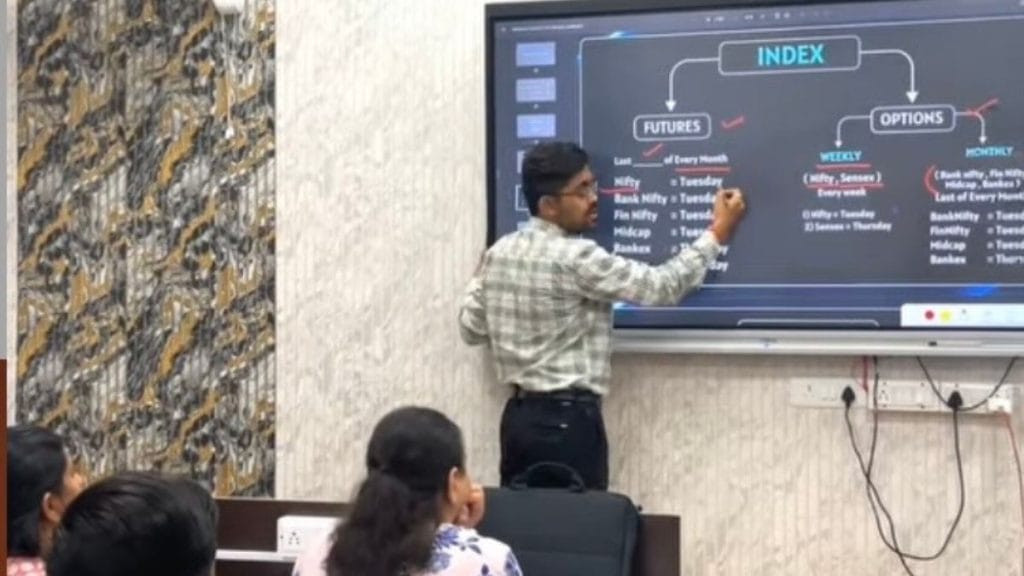
Inside the academy’s live trading room, students from different generations sit shoulder to shoulder, united less by experience than by aspiration. Teenagers who have barely left school study alongside shopkeepers, salaried professionals and small business owners. Some hope to build a career, others are looking for a second income.
It was a late Diwali evening in 2024 when Abhay Singh, then 24, first found himself drawn into the world of trading after he heard his friend had just earned Rs 8.5 lakh on a trade.
“When I got to know about his profit, I found it very exciting. I thought if such a thing was possible, it would be so amazing,” he said.
A Computer Science graduate from the University of Delhi, Abhay’s new curiosity sent him scrolling through multiple trading courses until he settled on a pre-recorded programme. Soon, he had questions the screen couldn’t answer. He bought a live course from the same instructor for Rs. 15,000. The classes stretched six weeks into the sluggish winters. A year later, he enrolled in another course — this time on cryptocurrency trading.
He saw decent profits in the first three months and then in 2025, he switched to Futures and Options trading. Soon, he grew critical of the classes that got him interested. Today, he trades rarely, mostly in crypto only when something catches his eye.
“No one can actually teach you trading,” he said with disdain in his voice. “It is the market that teaches you. These coachings cannot develop your psychology and, according to me, most of them are more active in disturbing that psychology. Not all but most of them.
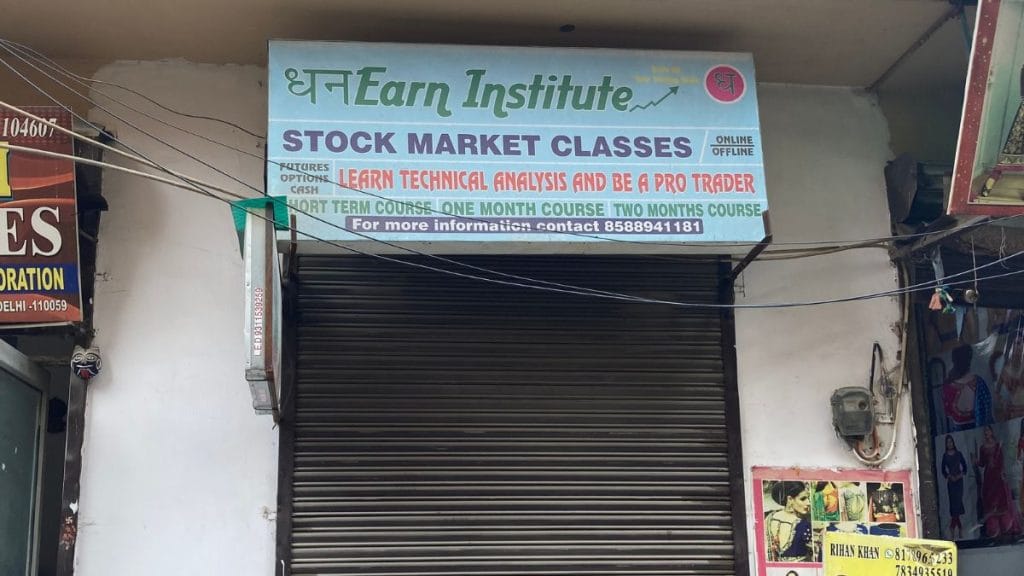
From a rented shop in Delhi’s Uttam Nagar, Karan Saluja’s trading institute ‘Dhanearn’ is already planning its move to the main road for better visibility. Photo: Preksha, ThePrint
Now, Abhay works as a Python- developer in a Noida based company and says often the promise is that trading can replace a person’s 9-to-5 job.
“I started this because I got excited when my friend booked a huge profit. At that time, I didn’t think about the amount he had invested to make that profit,” he said.
Suny Patwal knows the problems of the trading world well. When he started out, he spent over Rs 9 lakh on trading courses — domestic and international — chasing an edge he couldn’t find. He eventually built his own system, but looks back on that spending with disappointment.
“When people enter the stock market, they are hopeful. But life doesn’t work that way. There is no trader in the world who makes money in all trades — there cannot be,” he said. “In trading, even if you do everything right, you might make a loss.”
But there is a catch now. People are paying for hope, not courses. The dream is that this time, with the right mentor and the right classroom, something will finally click.
“There is nothing wrong with teaching. But to follow it up with how it will turn your life around — that is wrong,” Patwal said. “People don’t want to be taught candlesticks. They want to learn how to make money from that. So, what they want is being given to them.”
Teaching the market
If students are buying the dream of financial freedom, a new generation of traders has built a business selling the roadmap.
Most of these academies are run by self-taught traders who spent years navigating the markets before turning their experience into a classroom. Many continue to trade even as teaching has become an equally important source of income.
Dinesh Verma, 27, is one of them. His first investment of Rs 800 earned him a Rs. 1,400 profit which led him to give trading a shot.
A mechanical engineer by training, Verma discovered trading in 2019 with a simple goal: to make money. He learnt through books, YouTube videos and late nights that often stretched until 4 am. Trading remained a side pursuit while he worked first as an engineer and later as a quality analyst, where he also trained new employees. Teaching, he realised, came naturally.
In 2021, he rented a small room tucked inside Uttam Nagar and opened a trading academy. The monthly rent was Rs 15,000. Four or five students enrolled through word of mouth, paying fees as low as Rs 1,500. For nearly two years, the institute lost money.
The turning point came when he quit his job.
Without office hours competing for his attention, Verma began trading and teaching full time. The academy moved from a lane to a prominent spot on the main road. Monthly rent crossed Rs 50,000. Today, he employs receptionists, mentors and assistants, while courses range from Rs 25,000 to Rs 50,000 for personalised mentorship. He has dozens of students every month now.
Growth, he says, has little to do with the classroom alone.
“The basis of profit is getting more students,” Verma said. “For that, they have to be shown profit. Sometimes students cannot tell if that profit is fabricated.”
He pauses and says it is “definitely” profitable.
“But there is also a lot of dikhawa (showoff),” he said. “In this industry, showing profit gets you more profit.”
His academy reflects how quickly the business has professionalised. Receptionists greet walk-in enquiries and counsellors explain fee structures. Social media interns are hired to produce a steady stream of videos. Former students return as mentors, while others branch out to open academies of their own. Three of Verma’s former students now run institutes elsewhere in Uttam Nagar.
The classroom, too, resembles a conventional coaching centre. Teachers are addressed as “Sir” and “Ma’am”. Students can pay simply to join live trading rooms without enrolling in a course. Admissions remain open throughout the year.
“Trading is like a sport. You can only learn by practising,” Verma said. “The environment should motivate someone to make money. Either you become the right trainer, or you hire one.”
Education ends, advice begins
The rapid growth of trading academies has also drawn increasing regulatory scrutiny.
Many institutes prominently advertise certifications from the National Institute of Securities Markets (NISM) as a marker of credibility. But in a January 2025 order, the Securities and Exchange Board of India (SEBI) sought to draw a clearer line between education and investment advice.
The regulator said that people engaged solely in securities education cannot provide investment advice or recommendations without the required registration, nor can they make explicit or implied claims about returns. It also barred educators from using market-price data preceding three months to predict future prices or recommend specific securities through videos, screen shares, talks or similar content.
Yet even as regulations tighten, the appetite for learning trading continues to grow.
Every day, aspirants arrive through Instagram Reels, YouTube channels and Telegram groups, hoping that the right mentor or strategy will help them beat the market.
The boundaries become even blurrier when it comes to children.
Many academies admit minors under the banner of skill development. While SEBI allows minors to hold demat accounts only through a guardian, they cannot independently undertake regular trading. In practice, academy owners say students often use family members’ accounts, practise on paper-trading platforms such as TradingView and FrontPage, or graduate to proprietary trading firms that provide capital after candidates clear an evaluation.
Dinesh Verma sees little problem with introducing teenagers to the markets early. The youngest student at his institute, he says, joined at the age of 12 with his parents’ consent and Rs 1.5 lakh in trading capital. According to Verma, the amount has since grown to Rs 2 lakh.
“I have observed that Gen Z is very sharp,” he said. “I think they should learn trading. If someone had taught us under the right mentor earlier, we would have succeeded quicker. I will be teaching my kids too when I have them.”
Also Read: The Reading Room phenomenon across small-town India. Built for the exam generation
A parent’s wager
The decision to enter the market is rarely made by young traders alone. Behind many of them are parents weighing aspiration against stability and deciding how much risk they are willing to underwrite.
Dalip Singh, 43, knows what it means to build a livelihood the slow way.
After leaving school in Class 8, he has spent the last two decades running a handicrafts business in Delhi, creating the kind of financial stability that took years to achieve. He knew little about trading until his son, Piyush, came home convinced he had found his future.
“We thought he is just 18. If he wants to do this, we should support him,” Dalip said.
Support, however, comes with a deadline.
He has given his son two years to see whether trading works. Then, he wants to set up a disposable goods business for Piyush, with trading remaining, at best, a second source of income.
“It is important to have a strong business,” he said. “In business there is risk sometimes. In trading there is risk every day.”

For now, Piyush trades with savings from his work as a part-time DJ and money his parents have set aside for him.
“I want to make a career in full-time trading. I always wanted to be in business or something like this,” he said. “I never wanted to do a job and work under someone.”
If he succeeds, Dalip says, the family is willing to invest more. If he loses, they will absorb the setback together.
“Loss can happen anywhere,” he said. “But it is important to take a chance for profit as well.”
That balancing act is precisely what worries market analyst Suny Patwal. He understands why young people are drawn to trading, particularly at a time of economic uncertainty, but questions whether it is being presented as an alternative to stable employment.
“If the reason they are getting into trading is because they are unable to find jobs, that should not be the case,” he said. “Trading is not regular income, so one will end up in a lot of mess.”
He is even more sceptical about children being introduced to the markets.
“At that age, one is not psychologically or emotionally mature,” Patwal said. “They (trading institutes) are pushing a burden in the name of collecting fees. It ends up being a knife to a child’s throat.”
(Edited by Stela Dey)
The next Kota !!
Only thing is, people involved are grown ups and they’ll invest all their life savings and go bust! More of the same – domestic violence, suicide etc.
What are the regulators doing?
Can anyone start any of these “so called institutes”?
The name institute is wrong for this very dodgy places.
Luring poor people who have aspirations but the government is not bothered… very vulnerable.