



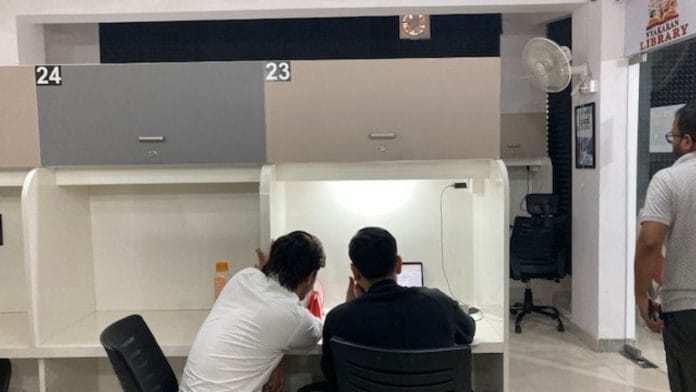
New Delhi: At 11 every morning, 18-year-old Pihu leaves her house in Delhi’s Najafgarh, walks into a cramped “library”, and slips into a reserved cubicle and stays there till evening preparing for law entrance exams. She has a room at home but does not have privacy or uninterrupted time.
“Whenever I was studying, my grandmother would call me for some work, even if I had done everything,” she said. “My home environment is good, but interruptions were difficult to escape.”
The “library” she joined nearly five months ago had no books to borrow. Instead, it offered what thousands of young Indians are now paying for: a desk, Wi-Fi, air-conditioning, silence and, increasingly, distance from home.
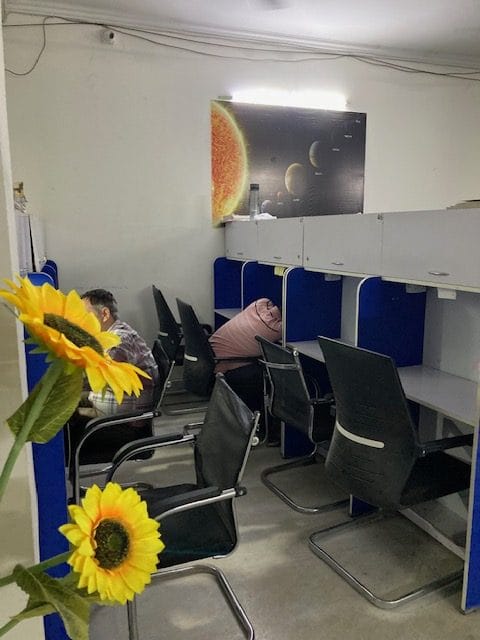
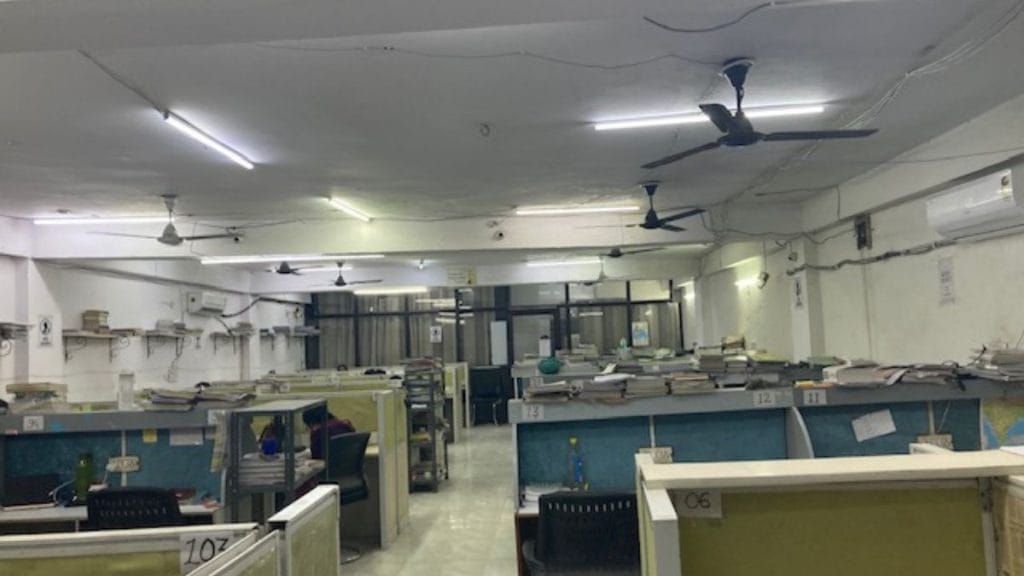
Across Delhi, and smaller towns in Haryana and Uttar Pradesh, these private ‘reading rooms’ are mushrooming inside residential colonies and commercial lanes. Packed with cubicles, CCTVs, and charging points, they provide long hours of uninterrupted silence to a generation of middle-class aspirants preparing for competitive exams such as UPSC, SSC, railways, NEET, CUET and banking services.
The boom accelerated after the Covid-19 pandemic normalised online coaching and self-study, creating a parallel ecosystem to India’s coaching industry. For students who cannot afford coaching packages running into lakhs — or simply do not have the space, internet, privacy or quiet needed to study at home — these ‘reading rooms’ have become rented spaces of aspiration. Many come to prepare for examinations while some see it as an escape from crowded homes, domestic chores, social surveillance or the constant interruptions of joint-family life. Several spend 10 to 14 hours a day here, studying, scrolling, eating and sometimes even sleeping at their desks.
This is also a new business model in small town India — sandwiched in hole-in-the-wall establishments like gyms, coaching centres and photocopy shops. Some libraries even offer free trial days.
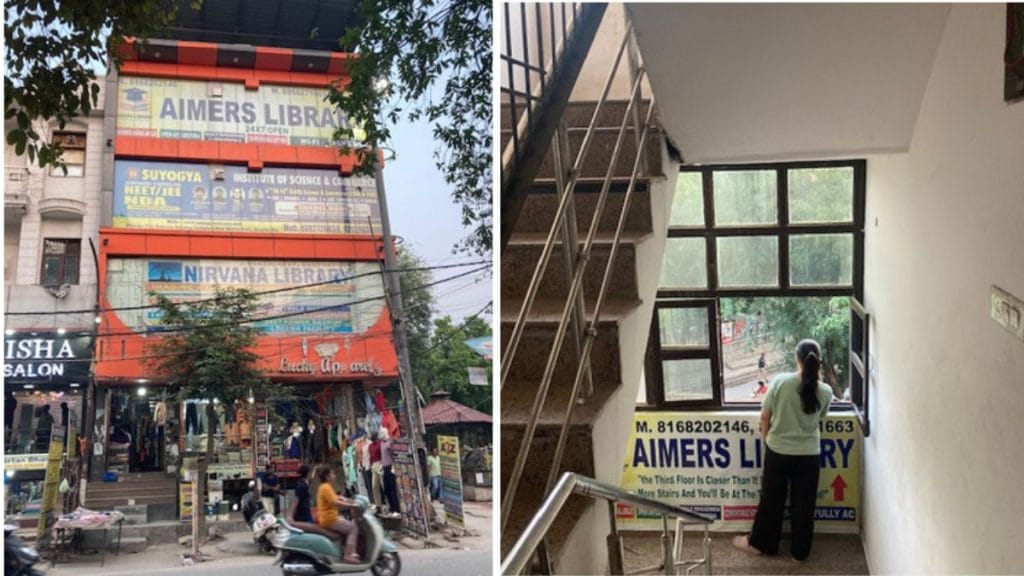
From Najafgarh to Rohtak, Sirsa to Lucknow, the word “library” is now being redefined.
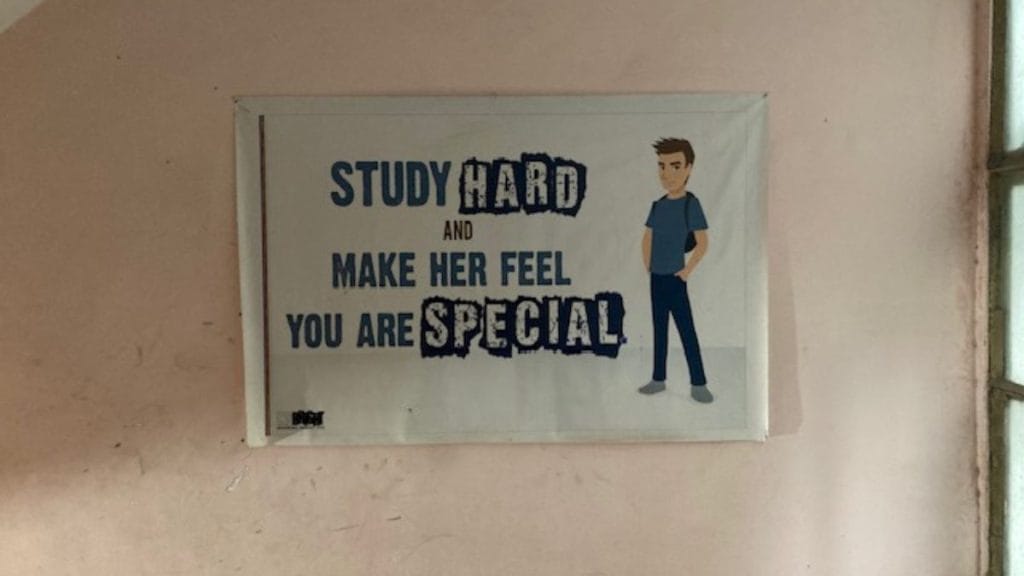
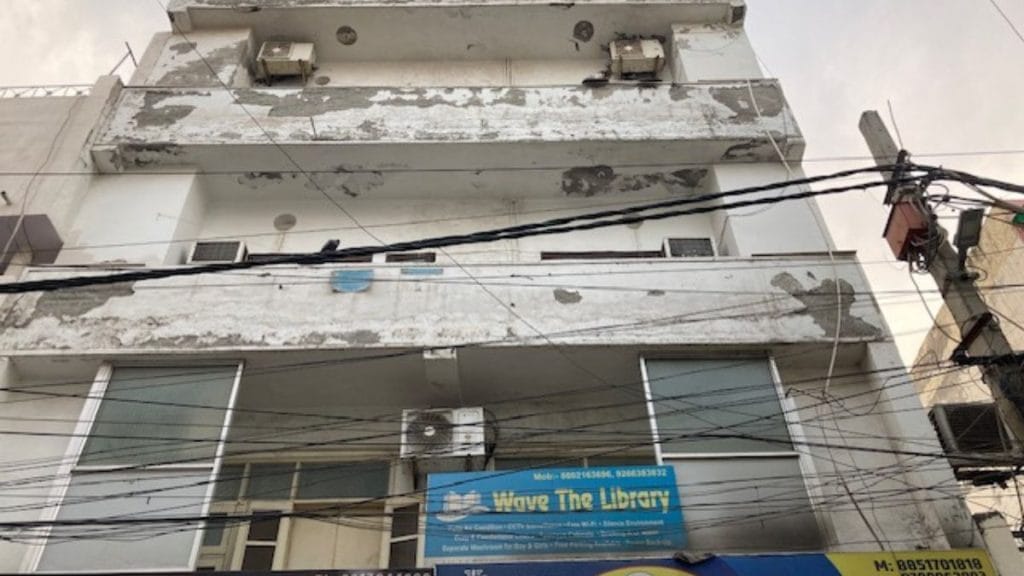
In these reading rooms, handbills lie scattered outside metro stations and marketplaces, while banners tied to balconies and tangled electrical wires advertise “AC Library”, “Silent Environment”, “Reserved Seats”, “Free Wi-Fi”, and “24-Hour Open”. Some promise “discipline” and “focus”; others borrow the language of ambition itself — naming themselves after civil servants, motivational ideals or icons like Swami Vivekananda.
Yet for 27-year-old Mayank who manages a reading room in Delhi’s Patel Garden as he prepares for his railway exam, a library has only one purpose — regardless of what one might call it.
“It would be strange to call it a ‘reading room’. Most people wouldn’t be able to understand,” he said. “Library likhna acchha lagta hai (it’s nice to call it a library).”
A room of freedom and frustrations
For many students, the appeal of a ‘library’ begins with one thing: space.
Sahil, 22, joined a reading room in Sirsa after finding banners plastered across walls and electricity poles near his home. He paid Rs 2,700 for three months and chose a corner seat away from the entrance. There were a lot of restrictions at home and he just wanted a quiet place to study.
“Even if I studied two hours at home and then checked my phone for two minutes, my family would think I spent the whole day using my phone,” he said. “I’m not allowed to close the door of my room either.”
He calls it “the story of every desi family”.
“They think locking the door means their kid is watching something inappropriate,” Sahil said. “It is what it is.”
Sahil is now content with his current reading room and what it has to offer. The last one he went to didn’t have a washroom but this one has. He also thinks libraries are value for money.
“People can stay in AC the whole day for Rs 1,000 a month,” Sahil said.
In small towns especially, many students say these spaces offer something rarely available at home: privacy without scrutiny.
Also Read: Inside small-town India’s Reel economy. Lights, camera, unemployment
Harshit, who uses a reading room in Rohtak while preparing for UPSC, describes them as spaces of social freedom as much as academic discipline.
“In Tier-3 cities, many decisions are passed through how the neighbourhood thinks, how is the reputation in society, and how many people know you because they are essentially urban hamlets,” the 25-year-old said. “So, the decision that one needs to make goes through a large number of societal and moral ringers.”
And this freedom also intersects with the country’s changing education landscape. Several students say many aspirants now enrol in distance-learning courses while spending years preparing for government jobs from these libraries instead of attending college regularly.
“For many people here these small reading rooms are the only place where they are allowed to be unsupervised by an adult, talk freely, laugh, study, make bonds— really like you have stepped in foreign land,” Harshit said.
Negotiating personal space
For many young women frequenting the libraries, the reasons are more complex.
Nisha, 20, who recently appeared for NEET, says joining a library helped her negotiate domestic work expectations at home.
“As a girl, there is a lot of work at home. If my mother is working alone, I cannot see that,” she said. “But at the library, it kind of feels like a job. You come in at 9 am, and stay till 9 pm. It gave me consistency.”
Nisha was the first in her family to join a library. Her family was initially hesitant and her mother would panic over her staying out for long hours in Delhi.
“Then she saw the results. After all, that is what matters,” she said. “If you make your family understand, they eventually do.”
But the spaces available are not always comfortable for women.
“Some men stare and stalk,” Nisha said matter-of-factly. “But I was a little strong, so I would fight back. But this is very common everywhere.”
Pihu eventually stopped going to one library partly because of the atmosphere.
“There were mostly couples talking loudly,” she said. “I never felt comfortable interrupting them.”
Still, the library had also become her place to breathe. Some afternoons, exhausted after finishing household chores before arriving, she would simply sleep at her desk, resting her head between folded arms inside the narrow cubicle.
Recognising the demand from women students, some owners have begun creating women-only sections.
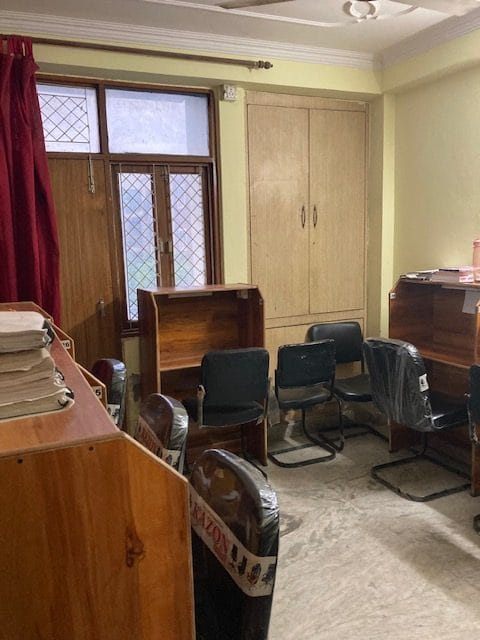
In a rented two-bedroom flat in Dwarka, teacher Chandra Shekhar, 53, runs one common study room and another exclusively for women after repeated requests from female students.
“Men can go study at a friend’s house,” he said. “For women, families ask questions. But if they say they are going to an institute, it is considered safe.”
A business built on aspiration
Behind the cubicles is a rapidly expanding business model tied closely to India’s coaching and competitive exam culture.
Sudhanshu Kumar completed his BTech from IISER Kolkata and left his 4-year job at Tata Consultancy Services to prepare for UPSC full-time in Delhi. Along with two partners, he opened his first reading room in Karol Bagh in 2023.
“We wanted to move towards UPSC but realised there are many living expenses. So we came together for this,” Sudhanshu, 25, said.
At one point, reading rooms were a booming business. They were mostly coming up around coaching centres like Mukherjee Nagar, Karol Bagh, and the cheaper alternative Patel Nagar. Coaching institutes also have their own libraries, but they are only for those enrolled in their classes. So students who couldn’t afford coaching chose the libraries.
Sudhanshu and his partners had around 20 branches operating from rented basements just a few years back.
That changed after the 2024 Rajendra Nagar flooding incident, after which many basement libraries and coaching centres in central Delhi were sealed over safety concerns. Several operators downsized or shifted locations.
Sudhanshu now runs just two libraries in Dwarka Mor and Matiala.
In Karol Bagh, the rents for the libraries are higher. But Dwarka is more affordable.
“It’s Rs 3,000 to 4,000 for 12 hours in Karol Bagh. In outer Delhi, it falls within the range of Rs 1,000 to 1,500, depending on the infrastructure and services,” he said.
Sudhanshu spends his nights at the study desk, while his days are fractured at the reception between attending to those enrolled in his library.
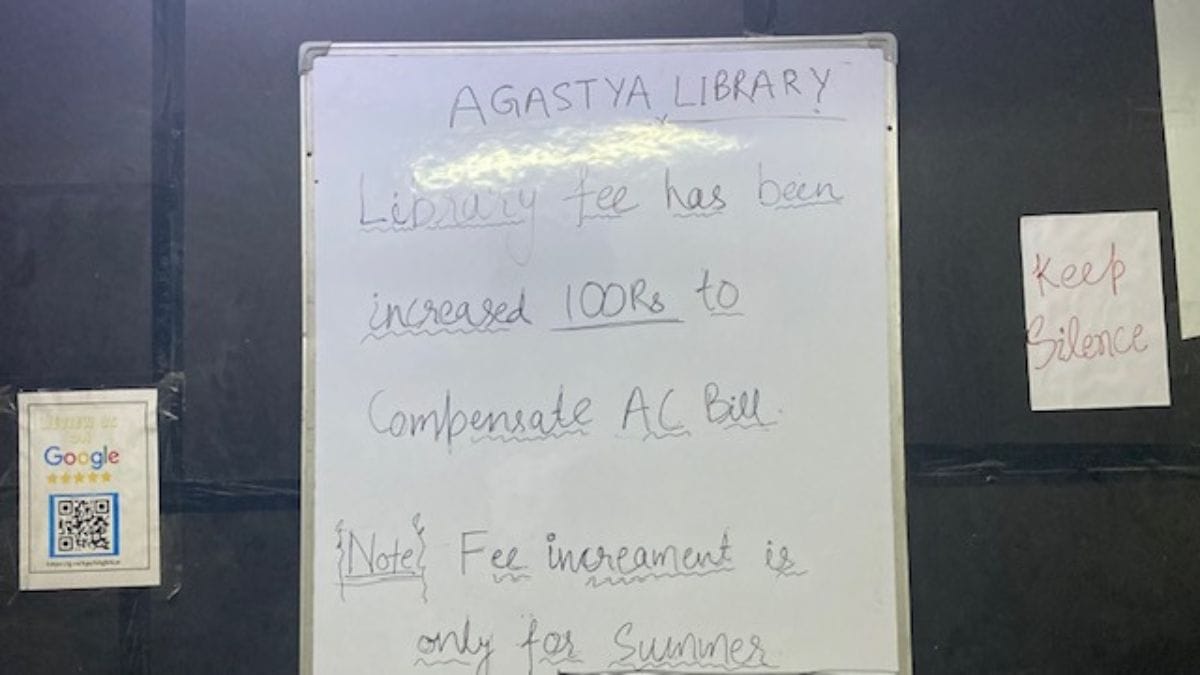
The finances are tight. A medium-sized facility can cost Rs 50,000 a month in rent, with electricity bills touching Rs 30,000 during summer due to air-conditioning usage. Then there’s wifi and miscellaneous expenses monthly. But Sudhanshu is not looking to make money immediately.
“I am preparing myself, so I am not looking at profit that way right now,” he said.
Mayank entered the business in 2022, when libraries in southwest Delhi were still few in number. He and his partners ‘studied’ the area stretching from Janakpuri to Najafgarh to understand the demographic.
In 2022, the initial investment was Rs 7 lakhs. Summers bring the biggest rush due to air-conditioning and students usually reserve seats for four to five months. At one of his libraries, 85 out of 92 seats are currently occupied.
But finances remain tight.
“There isn’t much money in it — just enough to run a household,” he said.
What a ‘library’ means now
Even among those who rely on these reading rooms every day, there is an uneasiness about what they are slowly becoming.
“It has become a fad,” Harshit said. “The serious students go there because they want silence. But now if you find one person genuinely studying, you will find five others around him sketching in notebooks or just passing time.”
For him, the reading room is increasingly becoming both a study space and a social space — part library, part hangout.
“I am happy people have found a place to be,” Harshit said. “But I still hope that in the future real libraries will open here. At least one.”
Preksha is a TPSJ alumnus currently interning with ThePrint.
(Edited by Stela Dey)
Great article!… A refreshing one among all the din in the news feed. Keep up the good work!