






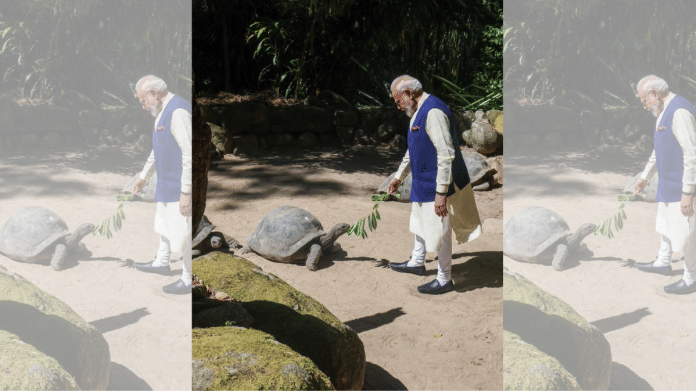


The friendship between India and the Seychelles received a boost this week as Prime Minister Narendra Modi concluded a three-day state visit. In a warm gesture symbolising the two countries’ long friendship, the PM fed Jonathan, the iconic 196-year-old Aldabra giant tortoise, believed to be the world’s oldest living land animal. He also addressed an extraordinary sitting of the National Assembly of Seychelles, becoming the first Indian prime minister to do so. The key outcomes of Modi’s state visit were a $175-million development package, the signing of nine wide-ranging agreements, and a significant boost to maritime security cooperation.
The mitrata or friendship between the two countries is rooted in history, while remaining relevant to the challenges of the future.
The historic trip also coincided with Seychelles’ 50th National Day celebrations, marking a crucial step under India’s MAHASAGAR vision for the Indian Ocean region.
Why Seychelles matters
The Seychelles is an archipelagic nation of 116 islands situated off the east coast of Africa in the Indian Ocean. It is the smallest country in East Africa, with a population of approximately 100,000+ as of 2022. It remained largely uninhabited until the 18th century, when it was claimed by the French, who brought in African, Arab and Indian labour to work the plantations. When the British took control in the early 19th century, indentured labour was brought in from India. The Seychelles became independent from the British in 1976, and has since moved from a largely agrarian economy to a market and service-based economy which is quite heavily dependent on tourism. From 1976 to 2015, the GDP grew by almost 700 per cent.
The Seychelles is separated from Mumbai by about 3,800 km, and a non-stop Indigo flight operates from Mumbai to Mahé, the largest and most populous island in the archipelago.
Maritime expert Abhijit Singh said that the East African country is strategically located on the major Sea Lines of Communication (SLOCs).
“During times of peace, the sea lines of communication (SLOC) serve as commercial trading routes, but they are also seen as strategic highways that give countries access to resources in faraway places. This is especially relevant to oil and gas shipments, a vast majority of which are transported via the sea. Consequently, SLOC protection has become a crucial condition for the sustenance and growth of regional economies,” Singh said.
The Seychelles serve as a gateway between East Africa, the Gulf and the Indian sub-continent. In times of war, it is a strategic geopolitical location for the transportation of oil that is shipped to India to meet our energy consumption.
Seychelles is also relevant for its “Blue Economy”—a framework launched in 2018 to promote sustainable marine development, and to align economic growth with environmental stewardship and social development. Large water bodies have the potential to sequester and isolate carbon dioxide and convert it into oxygen at rates four times that of trees and forests. Preserving marine resources in alignment with the United Nations Sustainable Development Goals, specifically SDG 14 and promoting good ocean governance is a goal of the island nations.
The Seychelles is also strategically located and in a position to counter open sea piracy and to ensure the safety and security of the Indian Ocean.
The country also monitors illegal fishing, maritime terrorism and drug trafficking, along with disaster response for rising sea levels caused by global warming. It is geographically well placed to counter these scourges of the sea.
Also Read: How India’s maitrata doctrine benefits from the US-Iran truce
Seychelles in India’s Indian Ocean doctrine
The Indian Ocean has become the playground of many countries with their vested interests, which include but are not limited to maritime dominance, sea route monopolisation and sea-trade dominance. Why then should India not seek importance in an ocean named after her?
India’s engagement with the Seychelles reflects the evolution of our maritime doctrine from a traditionally continental security outlook to one that recognises the Indian Ocean as central to strategic interests. This shift has been articulated through the vision of SAGAR (Security and Growth to All in the Region), which emphasises collective security, sustainable development and regional cooperation. More recently, the concept of MAHASAGAR (Mutual And Holistic Advancement for Security And Growth Across Regions) has expanded this vision by positioning India as a proactive stakeholder in the wider Indo-Pacific region, committed to fostering an open, inclusive and resilient maritime code that results in a universal maritime order.
Within this framework, the Seychelles has emerged as a key partner in advancing India’s role as a net security provider. New Delhi has consistently invested in strengthening the maritime capabilities of various island nations through coastal surveillance systems, hydrographic surveys, defence training, maritime infrastructure and humanitarian assistance and disaster relief.
Rather than pursuing influence through military projection alone, India has sought to build long-term institutional capacity and regional resilience. This approach signals that India is willing to step away from the traditional foreign policy mindset. It further shows India’s intention to move from being a regional power concerned primarily with its own security; to becoming a trusted provider of regional public good that enhances stability across the length and breadth of the Indian Ocean.
Also Read: India has a science soft power gap. Even after giving the world zero, Covaxin, Chandrayaan
Building climate resilience in the Indian Ocean
For Small Island Developing States (SIDS) such as the Seychelles, climate change is no longer a danger looming on the distant horizon, but an existential threat. With rising sea levels, coastal erosion is a constant, and the occurrence of extreme weather events is increasing alarmingly. The degradation of marine biodiversity directly affects livelihoods, food security and economic stability, more so for these island nations dependent upon the blue economy. Therefore, climate reliance has become inseparable from national and regional security.
India’s engagement with the Seychelles is based on this evolving scenario and places sustainable development goals alongside strategic cooperation. Through initiatives such as the International Solar Alliance, support for renewable energy transitions, disaster resilient infrastructure and climate adaptation projects, New Delhi is helping build resilience against both environmental and economic shocks. India’s emphasis on climate finance, capacity building and technology sharing further reinforces its commitment to development-led security.
Modi’s visit is a signal that the country’s Indian Ocean Policy extends beyond defence and maritime cooperation to encompass climate action as a strategic imperative. By integrating environmental sustainability with regional stability, India is positioning itself as a partner that recognises the unique vulnerabilities of island nations while contributing to a more secure, resilient and sustainable Indian Ocean.
The Indian Ocean is vast, and endless and the mysteries buried deep within remain buried for centuries. Case in point ,the vanished aircraft MH370, buried so deep somewhere within it that all efforts of modern technology to locate it remain failed. And so, a rules-based maritime order is all the more relevant in the Indian Ocean, where security and cooperation depend upon the adherence to International Law and Cooperative governance.
Maritime challenges are becoming all the more transnational; principles enshrined in the United Nations Convention on the Law of the Seas (UNCLOS), including freedom of navigation, peaceful resolution of disputes and the sustainable use of marine resources, have acquired renewed significance. India’s partnership with Seychelles reflects a shared commitment to safeguarding these norms while strengthening regional institutions that promote maritime cooperation, environmental stewardship and collective security.
Meenakshi Lekhi is a BJP leader, lawyer and social activist. Her X handle is @M_Lekhi. Views are personal.
(Edited by Insha Jalil Waziri)
When people were gasping for breath and dying for lack of beds in hospitals, the PM was busy feeding peacocks. Now, exam papers are being leaked left, right and centre, money from donations is being syphoned off and the PM is busy feeding tortoises! Just before the elections, he’ll feed the people revdis. That should do it.